Moscow has begun to reap economic benefits from rapprochement with Washington before reaching any agreement to end the war in Ukraine. Between easing US sanctions on Russian diesel and reopening negotiations on land and security guarantees, opportunities are expanding for Russian President Vladimir Putin to extract long-demanded concessions. Meanwhile, Donald Trump seeks a diplomatic breakthrough that would give him political leverage ahead of the congressional elections.
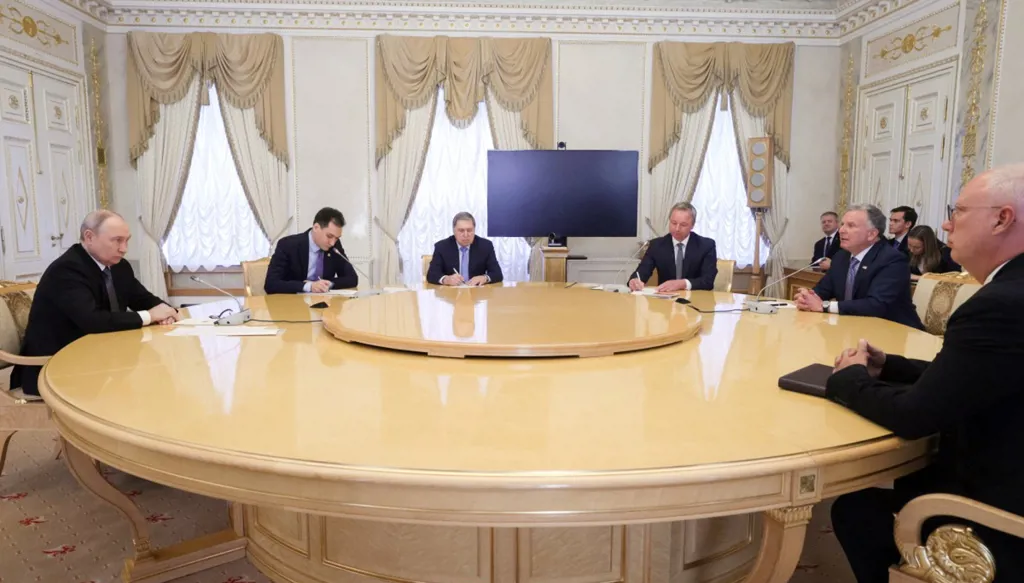
The talks between US envoy Steve Witkoff and Vladimir Putin on Wednesday in Saint Petersburg have rekindled the possibility of resuming trilateral negotiations after November 10, amid deep divisions over settlement terms.
The recent movements reveal two parallel tracks: complex political negotiations on Ukraine's future and an economic approach between Moscow and Washington that may continue independently of the negotiations' outcomes. What gains can the Kremlin achieve, and to what extent is the US administration's drive influenced by midterm election calculations?
Annahar explores these possibilities through contrasting perspectives from Moscow and Kyiv.
From Moscow, Dr. Saad Khalaf, a researcher specializing in Russian affairs and international relations, outlines in an interview with Annahar five strategic gains Putin aims to achieve from any potential agreement with the United States.
The first is to legally solidify regional gains by obtaining American and international recognition of Russia's sovereignty over Crimea, and cementing control over the four regions Moscow has declared annexed. This includes the withdrawal of the Ukrainian army from the remaining parts of Donbas and securing Russian control over about 70% of the Zaporizhzhia and Kherson regions, according to Khalaf's vision.
The second gain involves securing Ukraine's neutrality and permanently closing the door on its NATO membership, alongside agreements for mutual security guarantees that prevent the expansion of the alliance east toward Moldova and Georgia, and allow a re-evaluation of the deployment of Western military bases in Eastern Europe.
The third is related to the protection of vital Russian installations by halting Ukrainian attacks on oil refineries. Khalaf considers these strikes to be one of the most significant sources of pressure on the Russian economy over four and a half years of war, and sees their direct impact on the energy sector as surpassing that of some Western sanctions.
However, the gain that has effectively begun to materialize, according to his analysis, is the separation of economic cooperation with Washington from the political settlement. The "diesel deal" between Trump and Putin opened the door to specific American easing of sanctions on Russian diesel exports until April 2027, despite ongoing disagreements over land and Ukraine’s future.
Khalaf ranks internal legitimacy enhancement fifth, considering that an agreement that enshrines Russia’s main demands would allow Putin to present the war results as meeting the objectives of the "military operation," thus boosting his popularity, which he estimates at around 70%, and supporting political system stability.
Nevertheless, Khalaf dismisses the possibility of a comprehensive and swift settlement, given Kyiv’s refusal to withdraw from disputed lands and the European nations' insistence on maintaining sanctions. He speculates that Moscow’s most significant benefit might be the continued normalization of bilateral relations with Washington, even if the Ukrainian conflict remains unresolved.
Conversely, Mohamed el-Arouki, editor-in-chief of Ukraine Today website, presents from Kyiv a fundamentally different analysis in his interview with Annahar, arguing that the current US diplomatic moves lack the foundations of a serious peace initiative.
El-Arouki connects Witkoff’s rounds, from Oslo to Saint Petersburg, and the talk of resuming trilateral negotiations after November 10, with Trump’s electoral calculations. He describes these actions as a "public relations campaign" targeting the American voter before the congressional elections, citing the "diesel deal" as aligning with this direction.
According to El-Arouki, Washington is focusing its pressure on pushing Kyiv to cease targeting Russian oil refineries, while simultaneously reducing American military support for Ukraine, with no similar pressure applied to Moscow.
He supports his view with the continued Russian military operations, especially the intense strikes targeting Kyiv following the Witkoff-Putin meeting, describing the escalation as a "revenge campaign," and asserting that Russian military behavior contradicts the talk of impending peace.
El-Arouki notes that Ukrainian President Volodymyr Zelenskyy has shown readiness to discuss freezing the current fighting lines, but he emphasizes that the decisive decision on ending the war remains in Moscow’s hands, as the party that initiated it.
Between the Russian perspective viewing negotiations as an opportunity to cement military and security gains, and the Ukrainian one questioning Washington's motives, a formula emerges that might determine the war’s future: Moscow can attain economic and political benefits from its relationship with Trump without conceding its essential conditions, while Kyiv needs a settlement that protects its sovereignty and ensures its security.
Here lies the major hurdle for any anticipated agreement: Russian and American mutual interests may progress faster than the negotiations intended to end the war itself.