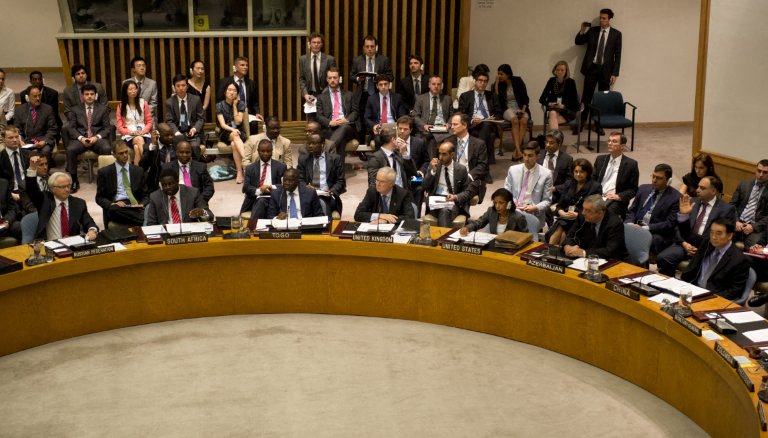
ALBAWABA- Russia and China vetoed a US-drafted resolution at the UN Security Council on Thursday that sought to extend the mandate of a panel of experts monitoring international sanctions on Iran, ending the latest effort to preserve independent oversight of sanctions-related violations.
The draft received 11 votes in favor, while Pakistan and Somalia abstained. The vetoes by Russia and China, both permanent members of the 15-nation Council, blocked its adoption.
The panel, associated with the Security Council's 1737 sanctions committee, had been intended to provide independent reporting on compliance and suspected violations. Its mandate was due to expire later this month, although the panel had already been effectively inactive for about a year because the Council had failed to agree on new members.
The United States and other Western governments argued that ending the mechanism would remove an important source of independent information on sanctions violations and create a monitoring gap that could make sanctions evasion more difficult to detect.
Russia rejected the US-backed proposal. Its UN ambassador, Vasily Nebenzya, described the draft as legally flawed and argued that the sanctions framework associated with the 2015 Iran nuclear agreement had expired. China similarly opposed what it described as political pressure and double standards, calling for the nuclear dispute to be addressed through diplomacy rather than confrontation.
Moscow and Beijing have maintained that UN restrictions connected to the Iran nuclear agreement ended with the expiration of Security Council Resolution 2231 in October 2025. Western governments, however, have maintained that the sanctions were restored through the agreement's "snapback" mechanism after European parties accused Iran of breaching its nuclear commitments. Iran has rejected that process and the legal basis for renewed UN sanctions.
Russia, China veto US anti-Iran resolution at UNSChttps://t.co/0TpYJ3kZcn pic.twitter.com/pQYw2tNYU2
The dispute stems from the 2015 Joint Comprehensive Plan of Action, under which Iran agreed to limits on its nuclear activities in exchange for sanctions relief. The United States withdrew from the agreement in 2018 and subsequently reimposed its own sanctions, while Iran gradually expanded nuclear activities and reduced some cooperation with international inspectors.
The Security Council's divisions have since deepened, with Western governments seeking continued mechanisms to monitor Iran's nuclear-related activities and sanctions compliance, while Russia and China have opposed what they regard as the continuation of an expired sanctions regime.
The latest confrontation comes amid heightened tensions over Iran's nuclear program and the wider US-Iran conflict. The dispute has also become intertwined with broader regional security issues, including attacks involving Iran-aligned groups, threats to energy infrastructure and shipping, and renewed Houthi attacks on Saudi Arabia and Red Sea routes.
Dr. Mansour Al-Maswari is Postdoctoral Fellow at Columbia University-Global Center, Amman. A Yemeni academician with a Ph.D. in English "Comparative Literature" and two MA degrees, one in political science and the other in English, Dr. Al-Maswari possesses more than 17 years of extensive experience in university-level teaching, research, research reviewing, bilingual translation, and copy-writing...
Subscribe to our newsletter for exclusive updates and enhanced content