Rubio Says US Wants Positive China Ties but Won't Abandon Allies
US Secretary of State Marco Rubio said on Thursday that the United States wants a positive relationship with China but that would not be at the expense of its allies.
"We have a role and can't abandon our allies. We've made that abundantly clear. We're going to have a good relationship with China," he told reporters in Manila according to Reuters.
"We have to have a relationship with China. We want it to be as positive as it possibly can be."
France Working on UN Resolution to Restore Freedom of Navigation in Strait of Hormuz
France is working on a draft United Nations Security Council resolution backing freedom of navigation in the Strait of Hormuz, a UN diplomat said on Friday.
The resolution would reaffirm the need to respect freedom of navigation in the strait, a flashpoint in the war in Iran, citing its importance for global shipments critical for food and energy security, the diplomat said, speaking on condition of anonymity because discussions on the measure have been private.
The proposed UN resolution would recall the need to respect the Law of the Sea and support peaceful initiatives aimed at ensuring safe passage in the strait, the UN diplomat added.
Iran’s disruption of the strait, through which a fifth of the world’s traded oil and gas transited before the war, has emerged as its main point of leverage.
The effects have been felt far beyond the Middle East and pose political problems for US President Donald Trump and his Republican Party ahead of November’s midterm congressional elections.
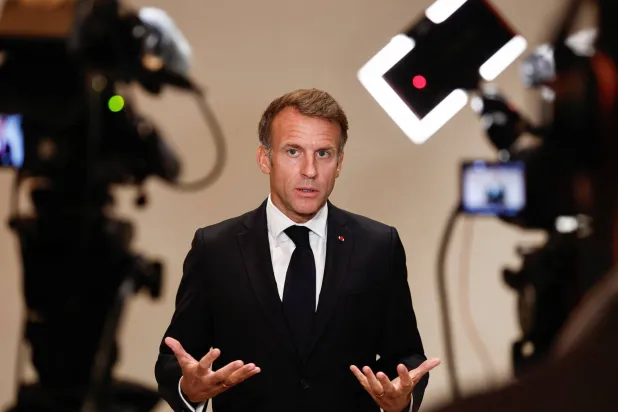
Paris has unsuccessfully attempted in the past to put a resolution together on the subject, but the latest move follows talks between France's President Emmanuel Macron on Monday evening and Trump on the sidelines of the UN General Assembly.
“Trump and Macron discussed the topic on the sidelines of this week’s annual UN gathering of global leaders,” the diplomat said. It also was discussed with Arab nations and Iran.
After his meeting the US president at Trump Tower in New York, Macron said: “Several options were discussed. We will be working on diplomatic solutions over the coming hours, which could make it possible, even without a comprehensive agreement, to find ways of allowing more container ships and oil tankers to transit.”
CNN reporters have been barred from traveling with US President Donald Trump as planned on Saturday, in a new move by the White House to limit the news network's access.
The president last week sought to ban three US outlets -- CNN, MS NOW and Politico -- from the White House, accusing them of providing only negative coverage on him.
After journalists with the three outlets were blocked from entering the White House complex, a judge ordered their access to be temporarily restored, saying Trump's move was likely unconstitutional.
For Trump's trip on Saturday to Tennessee, CNN had been scheduled to be the TV network in the press "pool" traveling with him.
However, a schedule released by the White House on Friday evening did not list CNN or any of the TV networks in the TV pool rotation.
The pool is a rotating group of journalists that travel with the president and provide coverage to other outlets, due to limited space.
The White House schedule only listed a "Secondary TV" correspondent and crew: Lindell TV -- a staunchly pro-Trump outlet run by his close ally, businessman Mike Lindell.
Earlier this week, when CNN's White House access was still revoked, the top five US broadcasters made a rare joint move to halt pool coverage of the White House in solidarity.
"The public has a vital interest in receiving accurate, independent information about its government. No administration should restrict a news organization because it objects to its reporting," ABC, CBS, CNN, Fox and NBC said.
CNN declined to comment when reached Friday by AFP. The White House did not respond to a request for comment.
Iran Proposes Hormuz Plan, Trump Reportedly Refuses
Iran offered a plan to reopen the strategic Strait of Hormuz, Tehran said Friday, but within hours reports indicated that US President Donald Trump rejected the proposal.
The waterway key to the world's oil supply is central to the conflict between the United States and Iran, which is at a stalemate after nearly seven months.
But new mediation efforts at the UN's gathering of world leaders in New York this week offered some optimism of progress toward a deal.
Iran's Foreign Minister Abbas Araghchi met for talks on Tuesday with Trump's envoy Steve Witkoff, and previously set out conditions for ending the war and reopening the vital shipping channel.
"Iran has conveyed to the United States, through Qatar, a concrete seven-day plan. If the necessary conditions are met, the strait can be reopened, and normal maritime passage restored within seven days," Araghchi said at the UN, according to AFP.
"The choice now rests with the United States. Iran does not accept coercion, threats, or intimidation, and Iran will not surrender its sovereign rights under pressure.
However, with hours of his comments The Wall Street Journal reported Trump had rejected the proposal, citing US officials familiar with the matter.
The report noted that the US president was skeptical Tehran would meet his demands and added he sees a renewed bombing campaign as likely.
Trump also posted an image to his Truth Social platform of a map showing the Strait of Hormuz circled and labelled "Trump Strait."
Earlier media reports suggested the new plan calls for a cessation of all hostilities in the Middle East for seven days, including in Lebanon.
It also reportedly calls for the release of frozen Iranian assets estimated to be worth at least $12 billion, as well as the lifting of sanctions on Iranian oil and an end to the US naval blockade of Iran.
On the seventh day of the truce, Iran would reopen Hormuz.