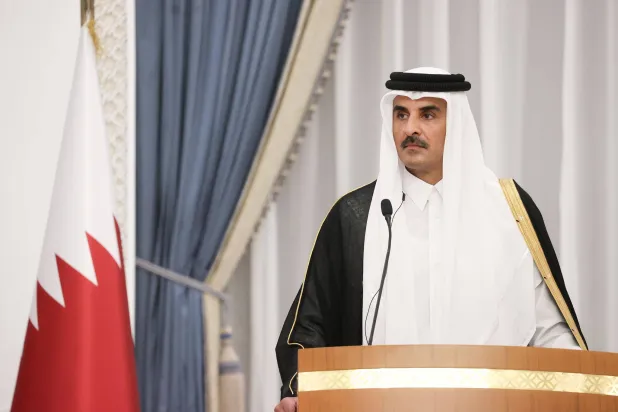
Qatar’s Emir Sheikh Tamim bin Hamad Al Thani on Tuesday called for closer security coordination among Gulf countries. He also called for stepped-up efforts to secure maritime routes in the Gulf and the Strait of Hormuz and energy infrastructure. Speaking to the Shura Council, the Emir said that his country had been “attacked on its territory by Iran, in a blatant violation of its sovereignty, the provisions of international law, and the principles of good-neighborly relations,” stressing that the armed forces and security agencies had carried out their duty to defend the country. He emphasized that Qatar would not abandon its approach based on dialogue and negotiation, but would not hesitate to protect its sovereignty, saying: “Our commitment to dialogue and peaceful solutions does not mean compromising the defense of our country, just as our right to defend our sovereignty does not conflict with our determination to prevent the war from expanding.” He said recent events had demonstrated the interconnected nature of regional and global security and the impossibility of isolating the repercussions of conflicts from the global economy and international stability. He stressed the need for continued cooperation and coordination among the Gulf Cooperation Council states, noting that protecting the sovereignty and stability of GCC countries is a shared responsibility. He added that Qatar would continue working with its regional and international partners to preserve security in the region. He explained that Qatar had confronted the crisis through a four-track strategy: defending the country without being drawn into war; ensuring the continuity of services, supply chains, and economic activity; contributing to efforts to achieve a ceasefire and reopen waterways; and pushing for the resumption of negotiations and the achievement of peaceful settlements. On the economy, the Emir revealed that a significant portion of the country’s exports had been disrupted as a result of the closure of the Strait of Hormuz and the direct damage sustained by some energy facilities in Ras Laffan Industrial City. He noted that Qatar supplies around one-fifth of global liquefied natural gas (LNG), meaning that any disruption to its exports has a direct impact on energy markets and consumers worldwide. He explained that the repercussions of the crisis were concentrated primarily in the energy sector, while non-hydrocarbon sectors continued to grow, accounting for around 80 percent of real gross domestic product, according to figures presented in his speech. He also revealed that total public revenues fell by 42 percent during the first half of the year, while expenditures declined by 14 percent, stressing that the government had decided not to reduce essential services or alter its development priorities despite the financial pressures. He said the state had confronted the crisis by relying on earlier policies that included strengthening financial reserves, reducing public debt, and developing non-oil revenues. At the same time, he called for continued fiscal discipline and greater efficiency in public spending. The Emir announced projects and investment opportunities valued at approximately 221 billion Qatari riyals (about $60.7 billion) over the next five years. These include infrastructure projects and public-private partnerships, as well as investments in real estate and hospitality. He noted that the Qatari economy recorded real growth of 2.9 percent in 2025, while average inflation remained stable at 0.5 percent. The country also posted a current account surplus and maintained its high sovereign credit ratings. The Qatari Emir also accused Israel of committing crimes in the Gaza Strip that constitute “genocide.” He called for holding Israeli officials accountable.