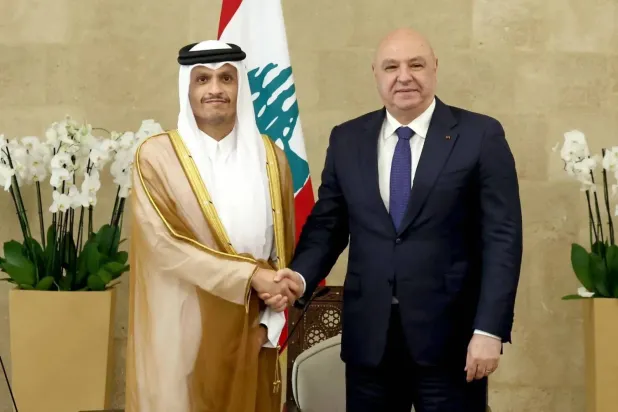
Lebanon and Qatar are close to reaching an agreement to overhaul Lebanon’s electricity sector, with Doha set to finance, develop and operate the project without requiring any upfront investment from the Lebanese treasury, Prime Minister Nawaf Salam announced Friday. The announcement came during a visit to Beirut by Qatari Prime Minister and Foreign Minister Sheikh Mohammed bin Abdulrahman Al Thani, who unveiled plans for a major energy investment and broader cooperation, including energy interconnection projects linking Lebanon with Syria and Iraq. Energy dominated the talks, alongside Israeli attacks in South Lebanon and Qatar’s continued support for the Lebanese Army. Aoun calls for pressure on Israel Al Thani began his visit at Baabda Palace, where President Joseph Aoun praised Qatar’s Emir Sheikh Tamim bin Hamad Al Thani and the Qatari leadership for their efforts to ease regional tensions and restore stability. Aoun urged Doha to work with Arab and friendly countries to press Israel to halt its attacks in South Lebanon and implement the framework agreement reached through US-sponsored negotiations with Lebanon. He described the mounting toll of Israeli operations, including casualties and widespread destruction in southern villages, and called for intensified diplomatic efforts to secure an Israeli withdrawal. Aoun also reiterated Lebanon’s condemnation of attacks on Gulf countries, most recently Saudi Arabia, and reaffirmed solidarity with Gulf states. Welcoming stronger bilateral ties, he highlighted Qatar’s willingness to help address Lebanon’s longstanding electricity crisis. For his part, Al Thani reaffirmed Doha’s support for the Lebanese government’s efforts and called for Israel to withdraw from occupied Lebanese territory and hand over those areas to the Lebanese Army. Qatar to finance and operate electricity project At a joint news conference at the Grand Serail, Salam announced that the two governments were nearing an agreement to rehabilitate, develop and modernize Lebanon’s electricity generation infrastructure. The proposed project would cover various sources of power generation and the infrastructure needed to support them, with the aim of providing a more reliable electricity supply at a lower cost. Salam explained that the initiative would follow a build-operate-transfer (BOT) model, under which Qatar would finance, implement and operate the project before ownership is transferred. Crucially, Lebanon would not have to provide any upfront capital investment, helping overcome the financial obstacles that have long hindered improvements to electricity supply. Salam outlined the government’s priorities as increasing production, reducing costs and improving management, stressing that reliable electricity at affordable prices would encourage investment and help revive the economy. The discussions also covered securing gas supplies and preparing an intergovernmental agreement to pave the way for a comprehensive solution to the electricity crisis. Broader energy partnership Al Thani confirmed that both countries had agreed on a comprehensive framework for energy cooperation, including a major investment project intended to benefit Lebanon’s economy and participating Qatari companies and institutions. He reaffirmed Qatar’s commitment to standing alongside the Lebanese people during a difficult period for the region and expressed hope for closer cooperation across other sectors. Turning to regional security, the Qatari prime minister urged all parties to implement UN Security Council Resolution 1701, called for Israel’s withdrawal from all occupied positions and stressed the importance of respecting existing agreements. He also revealed that Doha was coordinating with Washington on reconstruction efforts in South Lebanon to enable displaced residents to return to their homes. Qatar would continue supporting the Lebanese Army as a national institution responsible for safeguarding the country’s security and stability, he added. Berri stresses support for army Al Thani also met Parliament Speaker Nabih Berri to discuss political and security developments in Lebanon and the region, continued Israeli attacks and bilateral relations. Berri expressed appreciation for Qatar’s longstanding support, particularly for South Lebanon, and its commitment to Lebanese sovereignty, the withdrawal of Israeli forces and the return of displaced residents. He welcomed Doha’s willingness to contribute to economic recovery and reconstruction. Both leaders agreed on the importance of strengthening national unity and supporting state institutions, particularly the Lebanese Army and security forces, as guarantors of stability and sovereignty.