Why Francis Fukuyama’s forgotten warning matters now? (1)
By Abdelmonem Fawzi
Our world enters a new phase of accelerating events, making a highly turbulent scene unfold. The separate crises we face indicate show a world getting ready for the biggest event in human history, one that may change life as we know it.
In my opinion, we are facing interconnected events within their historical and strategic context, even if the identity of the entity behind them or the existence of a single plan managing all their details has not been proven.
Perhaps the most dangerous aspect of the situation is not the Microsoft outage, US flight suspensions, or the breach impacting European cooling systems. It is in fact the convergence of these developments with unprecedented government actions urging citizens to stockpile water and food, prepare emergency kits, and be ready for power outages, communication disruptions, and the loss of essential services.
Some governments in the most developed countries ask their citizens to prepare to live for several days without the usual services. When European institutions talk about preparing for geopolitical crises, cyberattacks, and supply chain disruptions, we are not talking about routine household advice, but about a shift in the philosophy of managing societies and preparing for the future.
Controversially, the widespread disruption to Microsoft services, including Outlook, Teams, and other digital services, affected institutions and users in multiple countries.
Then came the developments surrounding Jensen Huang, CEO of Nvidia, and his resignation amidst a scandal with personal and intelligence dimensions, following reports of potential ties to an individual suspected by US authorities of having links to Chinese intelligence.
This issue transcends the personal sphere, reaching into one of the world’s most sensitive industries: the chip industry and artificial intelligence.
Furthermore, we found ourselves besieged by television series and films that depict the end of our current way of life, a regression to a primitive, primordial existence amidst total devastation.
The cinema works Leave the World Behind, Fallout, The Last of Us and Station Eleven are clear cases in point.
The American series Paradise is an apocalyptic political thriller created by Dan Fogelman, that has received generally positive reviews from critics, with praise for its premise, writing, and performances. It was also nominated for 11 Primetime Emmy Awards, including two nominations for Outstanding Drama Series and acting nominations.
Fogelman said he drew inspiration for the core concept of the series from a real-life moment a year earlier when he was in a business meeting with a wealthy executive.
During the meeting, a construction crane collapsed outside, shaking the building. The executive’s panic made Fogelman reflect on how quickly wealth and power lose their meaning in crises, sparking the idea of exploring power dynamics when a high-profile figure and their protector face sudden danger together.
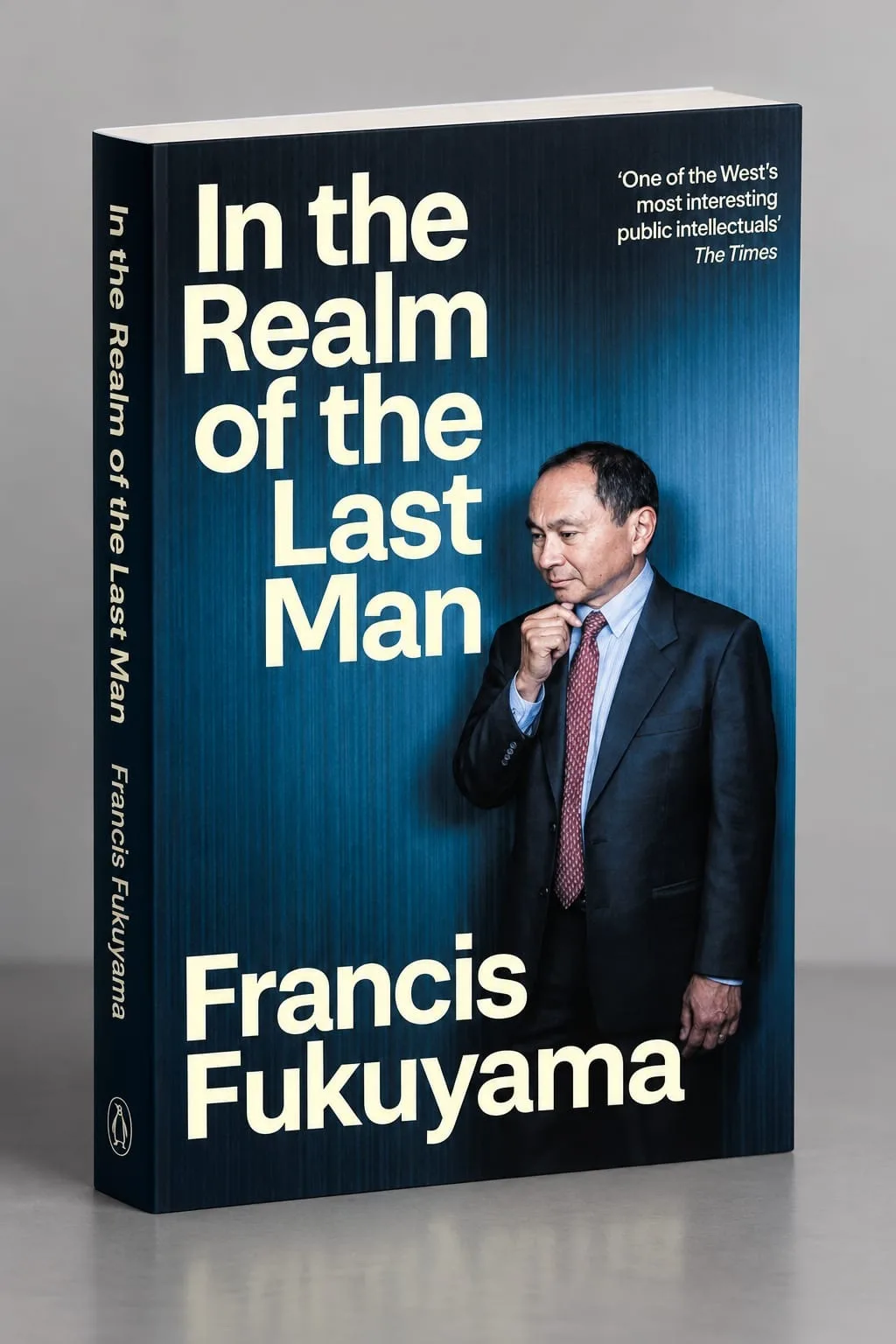
In the middle of all this turmoil and noise, the man who coined the phrase “the end of history” emerges. He penned the new book In the Realm of the Last Man: A Memoir which was published on 8 September 2026. The book is structured into 35 chapters across 304 pages.
Francis Fukuyama, 74, is an American political scientist and thinker of Japanese descent. His new book was accompanied by a media buzz because he captivated the world several decades ago with his “end of history” thesis.
At the time of the Soviet Union’s collapse and the fall of the Berlin Wall, he argued that history, or at least the history of ideas and political systems, had reached its culmination.
Fukuyama claimed that there was no room for further developments after liberalism’s triumph, proving itself the ideal system for managing people’s lives.
This thesis was initially presented in a widely acclaimed article published in the small, right-wing American magazine The National Interest and later in a book that became famous for its first half of the title: The End of History and the Last Man.
This book achieved the international bestseller. For decades afterwards, Fukuyama’s fame spread far and wide, attracting immense attention, both positive and negative, satire and praise.
Now, he is publishing his memoir, adhering to the lesser-known part of the title: In the Realm of the Last Man. More than a conventional memoir, the book is a personal political history, the story of a life that illuminates the troubled fate of democracy and liberalism over the last 50 years. It returns to and develops the concepts that have been central to his work, namely recognition, trust, identity, human nature, institutions, and the Last Man.
Fukuyama is remembered for predicting The End of History just when liberal democracy triumphs over its rivals. What is forgotten is his warning: democracy could still collapse from the inside, as a restless populace (The Last Man) turns to nihilistic self-destruction.
The book covers Fukuyama’s family background, early intellectual formation, and break from the neoconservative movement.
The book does not offer a purely theoretical review of the “end of history” thesis. Rather, it weaves together the author’s intellectual biography, his reflections on American politics, and the evolution of his ideas about the state, institutions, and society, culminating in discussions of contemporary issues, such as populism, declining trust in institutions, bureaucracy, and artificial intelligence.
The book’s central theme attempts to explain the current crisis of liberal democracy through the concept of the “last man”, the individual who has achieved a high degree of security, well-being, and legal equality, but who may, in turn, lose the sense of need for conflict, ambition, and risk-taking.
This, in turn, opens the door to a resurgence of political conflicts based on identity, recognition, and the search for status.
In the book’s introduction, Fukuyama emphasiسes that interpreting the “end of history” as a declaration of the cessation of events and conflicts was an inaccurate reading of his original thesis.
He believes that history might reach a point where the liberal democratic model becomes the most complete framework in principle, while still remaining susceptible to crises and setbacks.
Here, he returns to Alexandre Kojève’s concept of the struggle for recognition, explaining that humans do not only pursue material interests but also seek recognition of their dignity and status.
The question the book poses, therefore, is not whether history has literally ended, but rather whether liberal democracy can survive in the face of forces working from within and without to undermine it.
Fukuyama places this question within a broader context that includes the rise of nationalist populism, the decline of democracy since the 2008 global financial crisis, the growing power of authoritarian regimes, and the social and technological transformations that have reshaped the relationship between individuals and the state, institutions, and society.
Abdelmonem Fawzi
Writer and expert on international relations
The post Proclaiming end of history prophesies end of world appeared first on Egyptian Gazette.