ALBAWABA- Iranian President Masoud Pezeshkian addressed the 81st United Nations General Assembly on Wednesday, accusing Israel and the United States of double standards over nuclear weapons, sanctions and the use of force, while declaring Iran ready for dialog but determined to defend itself.
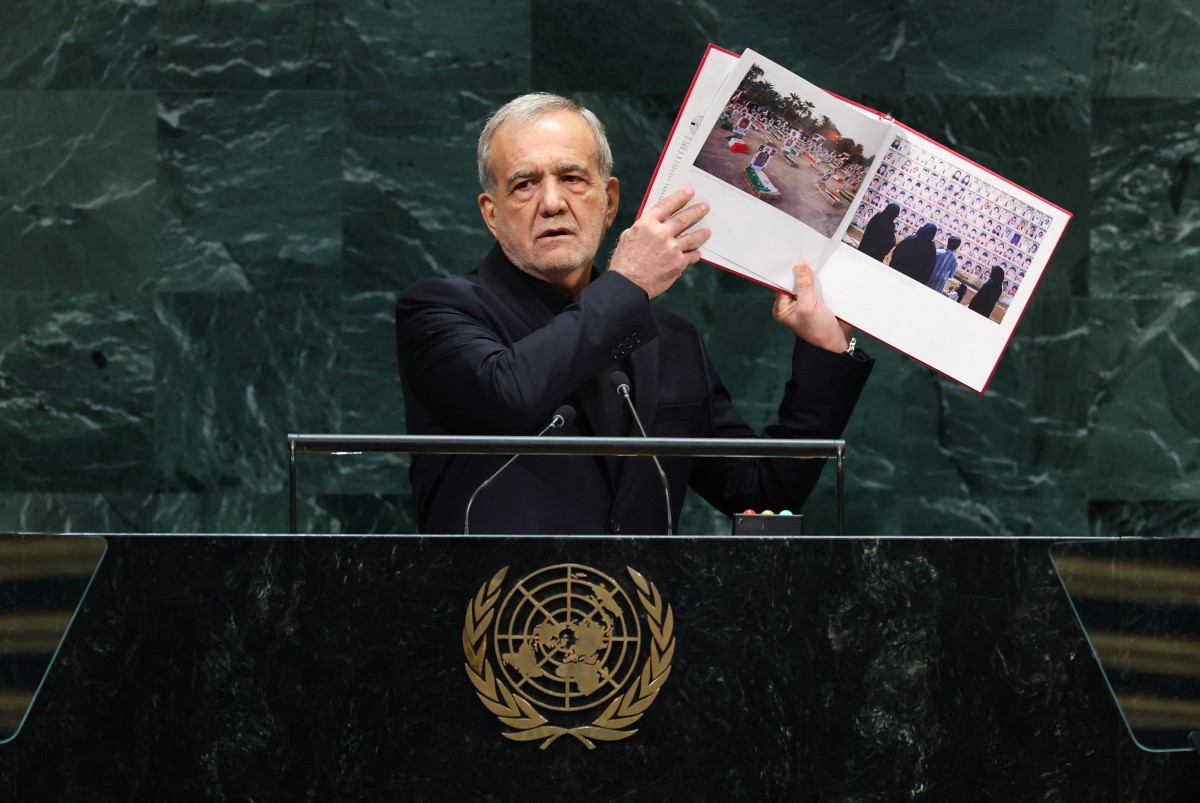
Holding photographs of the late Supreme Leader Ali Khamenei and schoolchildren killed in attacks, Pezeshkian rejected U.S. characterizations of Iran as a terrorist state. “We have been the victims of terrorism,” he said. “I come from an Iran in which our esteemed supreme leader was assassinated… I come from an Iran where they bombed a school.”
Pezeshkian said Iran had not started a war in 200 years and that the current conflict had been imposed on his country. “We’re not afraid of fighting a war,” he said, vowing that Iran would defend itself “until our last breath.”
On the nuclear issue, Pezeshkian challenged what he described as international double standards, pointing to Israel’s undeclared nuclear arsenal and its status outside the Nuclear Non-Proliferation Treaty. “Atomic and nuclear bombs are in the hands of the Israeli regime, but the inspectors are requested to come to Iran,” he said. “Israel has the bombs, has weapons of mass destruction, is not a member of the Non-Proliferation Treaty, during her shameful life has not allowed a single inspection, but they are rewarded… to be able to bomb any capital in the region at will.”
Pezeshkian reiterated Iran’s position that its nuclear program is intended for peaceful purposes and said Tehran would not surrender what it considers its right to civilian nuclear technology. “No nuclear weapons, and no limitations to new peaceful nuclear technology,” he said, adding that Iran seeks nuclear energy for progress rather than to threaten other societies.
Turning to Gaza, Pezeshkian accused Israel of killing more than 70,000 Palestinians and contrasted Israel’s actions with the sanctions imposed on Iran.“Israel kills & kills. But Iran is subject to sanctions,” he said. “They kill, we are sanctioned.”
He described Palestine as “an open wound on the conscience of the international community” and Gaza as a symbol of the failure of international mechanisms to prevent civilian suffering. “We cannot speak of peace while ignoring Palestine,” he said.
Iranian President Pezeshkian calls for peace in Palestine and defends its use of military force: "Lasting peace in west Asia is impossible without justice for Palestine... They will resist. What other choice do they have? Succumb to bullying?" pic.twitter.com/JiVoTbG9Gg
The speech came a day after President Donald Trump disclosed that U.S. officials, including special envoy Steve Witkoff and Jared Kushner, had held a three-hour contact with an Iranian delegation on the sidelines of the UN General Assembly.
Trump described the talks as very good and productive and said he believed they could eventually reach a settlement. Witkoff also said the meeting had gone well. Iranian officials confirmed that Foreign Minister Abbas Araghchi participated in the contact and that Qatar helped mediate the discussions.
The diplomatic contact marked a significant opening after months of confrontation, although the two sides remain divided over the terms of any settlement. Iran has said that it could reopen the Strait of Hormuz within seven days if Washington eases military pressure and lifts its blockade of Iranian ports, while also calling for the release of frozen Iranian assets and an end to the war.
Pezeshkian’s speech therefore combined an offer of diplomacy with a rejection of negotiations conducted under what Tehran considers coercion. His message was that Iran is prepared to talk but will not accept what he described as the “language of force” or restrictions that it regards as violating its rights.
Iranian Foreign Minister Abbas Araghchi reinforced that argument in separate meetings with European counterparts on the sidelines of the General Assembly. He accused European governments of applying “double standards” by claiming to defend the rule of law and human rights while remaining indifferent to, or supporting, what Tehran describes as U.S.-Israeli military aggression against Iran.
Araghchi also linked the security situation in the Strait of Hormuz to U.S. and Israeli actions, saying restoring stability in the strategic waterway required an end to Washington’s aggression. He called on European countries to end their support for Israel and prevent what he described as Israeli impunity.
Dr. Mansour Al-Maswari is Postdoctoral Fellow at Columbia University-Global Center, Amman. A Yemeni academician with a Ph.D. in English "Comparative Literature" and two MA degrees, one in political science and the other in English, Dr. Al-Maswari possesses more than 17 years of extensive experience in university-level teaching, research, research reviewing, bilingual translation, and copy-writing...
Subscribe to our newsletter for exclusive updates and enhanced content