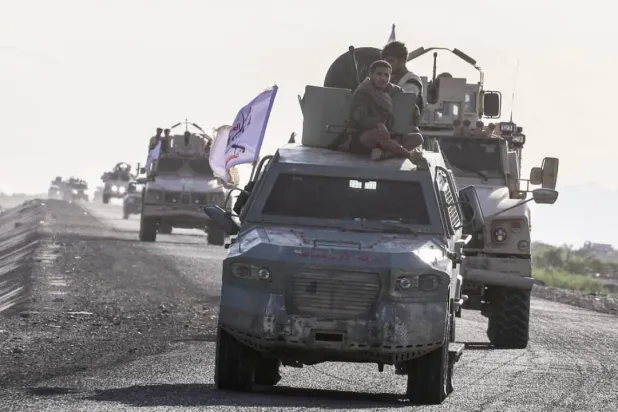
The Yemeni military's Operation Dawn of Yemen entered its tenth day on Wednesday, with some of the fiercest fighting continuing on the front lines in Taiz Governorate in the southwest, as well as in Marib and Al-Jawf. Air and ground strikes have intensified as government forces say they are seeking to weaken the combat capabilities of the Iran-backed Houthis and cut off their supply lines. Meanwhile, casualties and displacement continue to rise, placing mounting pressure on hospitals, markets and essential services. The Yemeni Armed Forces announced that they had carried out 2,200 precision strikes over 24 hours, involving fighter jets, drones, field artillery, rocket launchers and sniper units. They said preliminary battlefield assessments indicated that approximately 1,200 Houthi fighters had been neutralized, while more than 440 military vehicles and other equipment had been destroyed or damaged across various fronts. Armed Forces spokesperson Col. Majed Al-Nuzaili said the operations focused on command and control centers, fortifications, firing positions, observation and reconnaissance posts, as well as troop assembly areas, weapons and ammunition depots, transportation and supply assets, and what he described as high-value military targets. He added that government forces had continued to expand their offensive operations on the eastern and southern fronts, making territorial gains under intensive fire support. In Taiz, strikes targeted Houthi fighter concentrations and reinforcements in an effort to disrupt the group's ability to support its positions and regroup its forces. Field sources say the group is suffering daily casualties, including fighters killed, wounded and captured, among them field commanders. Estimates suggest that approximately 15,000 Houthi fighters have been killed or wounded over the past ten days, although the group has not released a comprehensive casualty toll. Fighting on Multiple Fronts In Taiz, fighting in recent hours has been concentrated on fronts south, east and west of the city, with renewed clashes in Al-Aqrud. Military sources reported that battles erupted in Al-Sarari, Dhi al-Birah and Dhahih following Houthi attempts to attack government positions. The sources said government forces had forced Houthi fighters to retreat from Al-Sarari in the Sabir al-Mawadim district, while airstrikes targeted a gathering and a facility belonging to the group in the Al-Hawban area east of the city. On the western front, clashes continued around Jabal Han, Al-Sayahi and Jabal Hadhran, within the Al-Dhabab front overlooking the main road leading into the city. Fighting also spread to the Al-Shaqab and Al-Aqrud fronts southeast of Taiz, coinciding with intensified battles in the Al-Mahawilah and Al-Aghabirah areas along the Al-Waziiyah axis in the southwest of the governorate, as well as continued clashes on the Al-Mudaribah front in neighboring Lahj Governorate. According to a government statement, military engineering units are working to clear mines and improvised explosive devices from recaptured positions on the western front and secure roads and passageways in an effort to protect civilians and facilitate their return to areas they fled. Decision to Continue the Operation On the political front, Yemeni Presidential Leadership Council Chairman Rashad al-Alimi affirmed that Operation Dawn of Yemen would continue toward its declared objective of ending the Houthi takeover, restoring state institutions and placing weapons and decisions of war and peace exclusively under the authority of constitutional institutions. In an address marking the 63rd anniversary of the October 14 Revolution, Al-Alimi said the armed forces had performed well since the operation began and that temporary changes on the ground would not deter the state from fulfilling its responsibilities, with support from brotherly and friendly countries. He added that the Houthi threat was not confined to a particular governorate or region but extended to the security and future of Yemenis in both the north and south. He stressed that developments in Taiz and Marib were closely linked to the security of Aden, Hadramout and the country's other governorates. Al-Alimi justified the launch of the operation by citing the exhaustion of opportunities for de-escalation and continued Houthi attacks on cities, villages, neighboring countries and international waterways. He stressed that the decision to restore state institutions had taken effect and was irreversible. Humanitarian Warnings The expansion of military operations has coincided with international warnings about their impact on civilians, particularly as the number of wounded and displaced people rises and healthcare facilities become increasingly unable to respond to growing needs. The International Committee of the Red Cross (ICRC) said Wednesday that hospitals across Yemen were facing mounting difficulties in coping with a sharp increase in the number of people wounded in the fighting. It noted that some frontline healthcare facilities in Marib, Taiz and along the Red Sea coast had admitted more than 700 wounded patients in a single week. Firas Abu Samra, the ICRC's health coordinator, said medical teams were under enormous pressure, while only a small proportion of functioning healthcare facilities were capable of providing comprehensive trauma care. The organization warned of shortages of surgical supplies, anesthetics, oxygen and medicines, as well as the limited capacity of Yemen's already strained healthcare system to cope with another wave of mass casualties should the fighting expand. On displacement, the International Organization for Migration (IOM) reported that it had recorded 217,303 displaced people, representing 36,216 households, as of October 12. Approximately 55 percent of those displaced were concentrated in Taiz Governorate, while Lahj recorded more than 45,000 affected people and Aden more than 26,000. The consequences extend beyond displacement and injuries. The United Nations warned of dwindling essential supplies in Taiz, with wheat and flour stocks potentially running out in less than three weeks, according to reports from its humanitarian partners. UN spokesperson Stéphane Dujarric said food prices had risen by approximately 50 percent, while gasoline prices had tripled and cooking gas had become largely unavailable. Fuel shortages have also threatened water supplies, amid overcrowded displacement sites, limited access to clean water and inadequate healthcare services. These conditions are heightening the risk of worsening food insecurity and deteriorating health conditions in a city of more than 1.5 million people, which has endured years of Houthi restrictions on movement and supplies because of the siege imposed on its access routes.