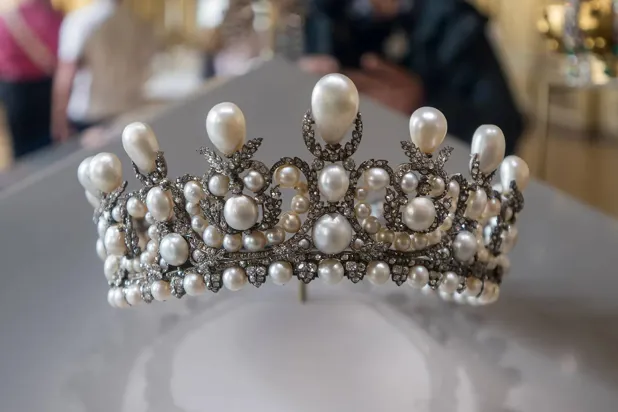
One year after a stunning break-in at the Louvre Museum, the four main suspects are in jail awaiting trial, but police appear to have run out of leads to locate the stolen crown jewels. Thieves disguised as workmen sliced their way into the museum with industrial disc-cutters on October 19 last year before making off with eight irreplaceable items worth an estimated $100 million. They include a brooch and crown from Napoleon III's wife Eugenie. President Emmanuel Macron referred to the robbery as an attack on France's history. Experts from law enforcement and private art theft agencies who spoke to AFP believe the best chance of recovering the treasures is if the thieves acted alone and stashed their loot somewhere in the Paris region. "There was a short period of time where they may have hidden them in a wall or buried them," Christopher Marinello from Art Recovery International, a private agency, told AFP. All four men were arrested within 10 days of the heist. Sets of sumptuous jewelry are on display at the Louvre Museum on April 27, 2025, in Paris, France. (AP) - Interrogation - The last known sighting of the glittering 19th-century gems was on CCTV footage recorded in an underground lock-up in the gritty Aubervilliers suburb of northern Paris, where all the suspects live. Extensive searches directed by the 100-strong investigation team have been carried out at their homes and families' homes, in cellars, garages and attics -- all to no avail. If the jewels have been hidden or handed to a "fence" for safekeeping, there is still a chance that one of the suspects confesses in exchange for a more lenient sentence, said renowned Dutch private art detective Arthur Brand. "The French police are very professional, they know how to interrogate, they know how to put pressure on (someone)," he told AFP. "You only need one to talk, and in many cases, one talks." A sapphire jewelry set worn by Queen Marie-Amélie and Queen Hortense. (AFP/Getty Images) - Dismantling - The more worrying scenario is that the gang was acting on orders from a ringleader or middleman with links to organized crime -- to whom they handed the jewels once they had finished their smash-and-grab. "The power of organized crime is not only to bring the experience to commit a crime, but also to have people to take the objects and sell them," said Corrado Catesi, head of the stolen art unit at international police body Interpol. In custody, two of the suspects have claimed a ringleader was part of their team, which is being treated with skepticism by investigators, a source close to the case told AFP recently. The worst-case scenario is that the jewels were transported either out of France or to a local contact in the underground precious stones business. "It's mainly diamonds, so they have to dismantle them, recut them and sell them. If they would go to one place, it would be Antwerp," said Brand, referring to the Belgian diamond hub. Marinello lists Tel Aviv and India as other possible destinations. Tobias Kormind, managing director of 77 Diamonds, Europe's largest online diamond jeweler, told AFP that "once recut, re-entering the legitimate supply chain to be bought by wholesalers or retailers is fairly straightforward". "Unless a stone possessed ultra-distinctive internal inclusions, even top diamond laboratories like the GIA would struggle to flag a freshly polished diamond as stolen property," he said. An emerald earrings and necklace set worn by Marie-Louise, the second wife of Napoleon Bonaparte. (Getty Images) - 'Still a chance' - But if the jewels fell into the hands of an organized crime group, there appears to be still some grounds for hope. Brand referred to several cases where stolen jewels were recovered, notably after a raid on the TEFAF art fair in the Netherlands in 2022 or the break-in at the Gruenes Gewoelbe museum in Dresden, Germany, in 2019. "Although we all think that most of the gold, silver and diamonds that get stolen, we never see them back, in some cases, we do," he explained. "There is still a chance that we will see the Louvre jewels again and it might be that somebody talks before the court case." The jewels remain listed as missing in Interpol's database of stolen artworks. Analysis of investigations around the world reveals that objects "can take from three months to 40 years to be recovered", Catesi told AFP.