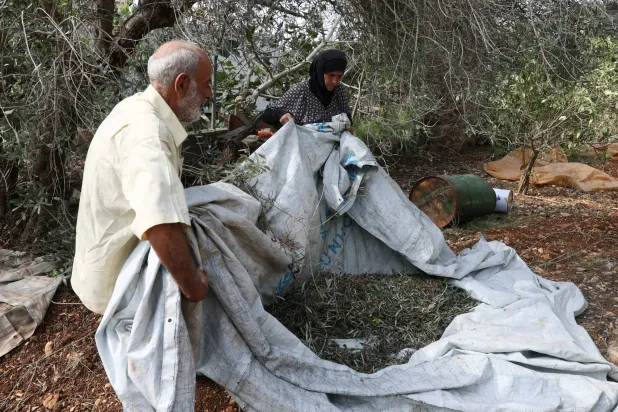
The killing of a retired Lebanese Army chief warrant officer by Israeli tank fire in Yater has underscored the perilous reality for southern farmers. Targeted while inspecting his home and olive grove, his death has turned this year's harvest season into a stark symbol of the dangers facing those attempting to reach their land. The incident comes as residents of border villages continue to be deprived of their harvests for nearly three years. It also coincides with a lawsuit filed in France accusing the Israeli military of uprooting around 600 ancient olive trees in Zawtar al-Sharqiyah. Local officials warn of economic and social repercussions that extend far beyond the loss of crops. Volunteers from Lebanon's northernmost province of Akkar and the city of Sidon take part in an olive-picking initiative in the southern Lebanese village of Jibshit near Nabatieh on October 11, 2026, in a show of solidarity with Southern Lebanon and its farmers. (Photo by MAHMOUD ZAYYAT / AFP) Targeted While Inspecting His Land The Lebanese Army announced on Sunday the death of retired Chief Warrant Officer Ali Abdel Hassan Sweidan after being directly targeted by Israeli tank fire while inspecting his property in Yater in the Bint Jbeil district. The army said a military unit supervised the recovery of his body after contact with him was lost. The municipality of Yater stated that he had been checking on his home and olive grove on the outskirts of the town when he came under fire from the direction of Sarbine, warning residents against approaching unsafe areas. The incident once again highlights the obstacles facing farmers during a season when families traditionally head to their groves to gather their harvests, as access to parts of agricultural land has become fraught with ongoing security risks. 600 Trees at the Center of a Lawsuit In Paris, a 37-year-old French businessman of Lebanese origin filed a complaint against unknown persons on September 22, accusing the Israeli military of uprooting roughly 600 olive trees from his family's land in Zawtar al-Sharqiyah. According to his lawyers, cited by Agence France Presse (AFP), some of the trees are approximately 500 years old, while the family has cultivated the land for about 250 years. The complaint includes allegations of theft, destruction, and damage to property as potential war crimes. The complainant suspects that the trees were transported to Israel, though this has not been established judicially. He stated that his family home was destroyed in an Israeli strike in April, before the trees were uprooted following Israeli control of the area. Volunteers from Lebanon's northernmost province of Akkar and the city of Sidon sort olives during an olive-picking initiative in the southern Lebanese village of Jibshit near Nabatieh on October 11, 2026, in a show of solidarity with Southern Lebanon and its farmers. (Photo by MAHMOUD ZAYYAT / AFP) Half the Fields Out of Reach Hanna Al-Amil, head of the municipality of Rmeish, told Asharq Al-Awsat that since the beginning of the war nearly three years ago, residents have been deprived of access to a large part of their olive fields “because most of them lie along the border, where security conditions do not permit locals to reach them and harvest their crops.” “Even today, we do not know whether we will be able to harvest olives this year, especially since the season has not yet started and security risks continue to prevent access to the land." He explained that roughly three-quarters of Rmeish's territory lies along the border and that more than 50 percent of its olive groves have remained unharvested for the past three years. This deprives families of a basic source of income, he added. Al-Amil stressed that agricultural losses are not limited to olives but also affect tobacco cultivation, the town's primary agricultural activity. "This year's tobacco production reached only about 60 percent of pre-war levels, meaning families have lost a significant portion of the income on which they relied." A Memory Shared by Families and Generations Mohammad Ismail, head of the municipality of Zawtar al-Sharqiyah, told Asharq Al-Awsat that the town's olive groves are “more than just trees or a source of income. They are heritage, history, and the memories of generations. They embrace the hills and fields, shade the alleys of Zawtar, and provide cool breezes that ease the summer heat." He noted that olive trees also provide heating wood for many residents. According to Ismail, the olive harvest is an annual occasion that brings entire families together. "Not merely to gather the crop, but to renew their connection to the land and to the ancestors who planted and cared for these trees, keeping a shared memory alive across generations." "Today, the occupier seeks to strip us of our spirit and sever our connection to history, our ancestors, and life itself. It seeks to erase the traces of life from our hearts and minds and wipe away its fragrance from our memory,” he said. "What is happening is not merely the uprooting of trees. It is the uprooting of hearts from chests and an attempt to erase the people's memory and their bond with the land,” he added. Olive Trees as Part of Southern Identity Ibrahim Sweidan, deputy head of the municipality of Yater, told Asharq Al-Awsat that "olive groves have become part of the identity of southern Lebanon. For southerners, the olive tree is not merely a tree but part of who they are and their attachment to the land." A Lebanese farmer shows harvested olives in the southern Lebanese village of Zawtar al-Gharbiyah, near the neighboring village of Zawtar al-Sharqiyah, where Israeli forces are stationed, in southern Lebanon, 10 October 2026. EPA/WAEL HAMZEH He said the strongest evidence of that attachment is the return of residents to their villages and homes despite difficult security conditions and their determination to remain on their land. According to Sweidan, attacks on agricultural land, public facilities, and homes all form part of the same pattern: "A strategy aimed at undermining the foundations that allow people to remain in their villages and weakening everything that connects southerners to their land and identity."