North Korea continues to strengthen its nuclear and missile capabilities, while U.S. President Donald Trump's administration faces growing difficulties in resuming communication with North Korean leader Kim Jong Un. The chances of persuading him to abandon his country's nuclear arsenal are dwindling, creating an increasingly serious challenge for Washington and its allies, according to a report published by The Wall Street Journal.
This comes after years of U.S. efforts, including negotiations, economic incentives, sanctions and international isolation, failed to convince Pyongyang to abandon its nuclear program. According to the report, the United States now faces the possibility that North Korea's nuclear status has become irreversible.
The report revealed that Trump attempted last year to contact Kim through phone lines and established communication channels, but received no response. The U.S. president subsequently resorted to sending a letter to the North Korean leader, but White House officials struggled to deliver it.
Officials devised a plan to wait outside North Korea's mission to the United Nations in Manhattan until one of its diplomats passed by. They eventually managed to hand over the letter, but it was later returned unopened to an American representative during a United Nations meeting.
These attempts coincided with Trump's renewed efforts to arrange a meeting with Kim during his recent visit to Asia. Both sides considered holding direct talks at the last minute, but the North Korean leader set conditions that Washington could not accept, according to people familiar with the discussions.
In a sign of Pyongyang's expanding military capabilities, North Korea's nuclear warhead stockpile has grown from an estimated 20 to 30 in 2019 to approximately 60 today, according to figures cited by the newspaper. The country also possesses solid-fuel intercontinental ballistic missiles capable of reaching the United States.
This development marks a shift in the nature of North Korea's arsenal, which previously relied heavily on liquid-fuel missiles that had to be fueled on launch pads, making them more vulnerable to detection and preemptive strikes. Solid-fuel missiles, by contrast, can be pre-fueled and launched from mobile vehicles.
The country's military advances have extended beyond nuclear missiles to include hypersonic technologies, reconnaissance satellites, underwater drones and next-generation ballistic missiles.
The report links North Korea's growing military capabilities to its closer ties with Russia, as well as cryptocurrency theft operations that provide the regime with additional financial resources.
Since 2022, relations between Moscow and Pyongyang have deepened, with North Korea supporting Russia following its invasion of Ukraine. Washington later revealed that Pyongyang had supplied Moscow with missiles and artillery shells.
In September 2023, Kim visited Russia's Far East, where he met President Vladimir Putin, who pledged his country's assistance in developing satellites. In 2024, the two countries signed a mutual defense agreement that revived commitments dating back to the Cold War and paved the way for the deployment of North Korean troops to Russia.
At the same time, the report noted a shift in China's position. Beijing has, at least publicly, stopped calling for North Korea to abandon its nuclear weapons, instead emphasizing the need for a "fair and neutral" approach to achieving peace on the Korean Peninsula.
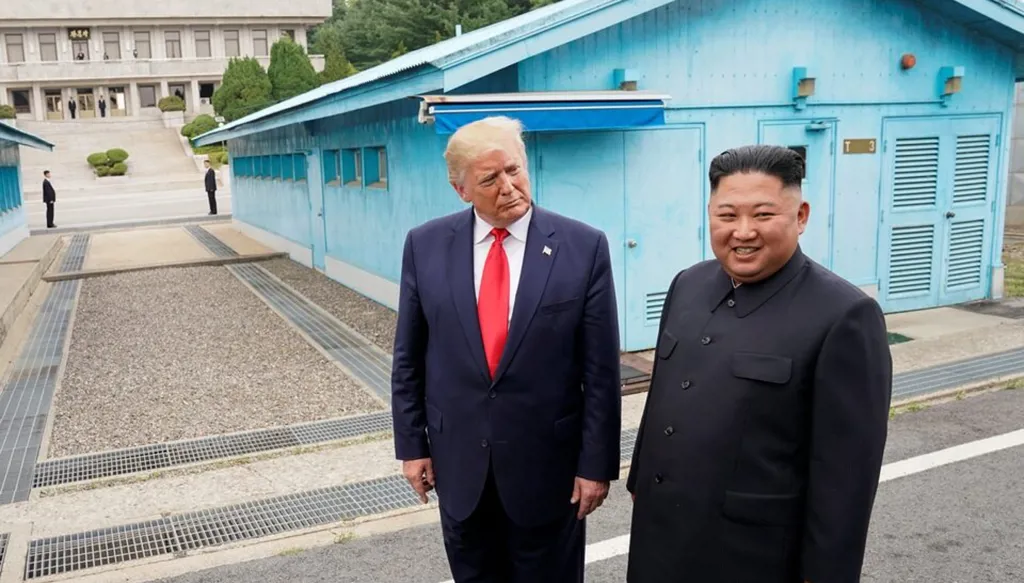
Trump and Kim held three meetings during the U.S. president's first term, beginning with the Singapore summit in June 2018, where they pledged to work towards the complete denuclearization of the Korean Peninsula without establishing a clear mechanism for achieving it.
At their second summit in 2019, Kim offered to shut down some facilities at the Yongbyon nuclear complex in exchange for the lifting of UN sanctions. Washington, however, demanded a freeze on North Korea's nuclear and missile programs, along with a roadmap towards complete denuclearization. The talks ultimately collapsed, and Trump left abruptly without reaching an agreement.
Today, Trump faces a different challenge as Kim seeks to push Washington to recognize North Korea as a nuclear state, arguing that peaceful coexistence is possible if the United States accepts his country's nuclear program.
Washington, meanwhile, continues to declare its commitment to denuclearization, despite lacking a detailed political plan to address the issue and leaving the position of special U.S. envoy for North Korea policy vacant, according to The Wall Street Journal.