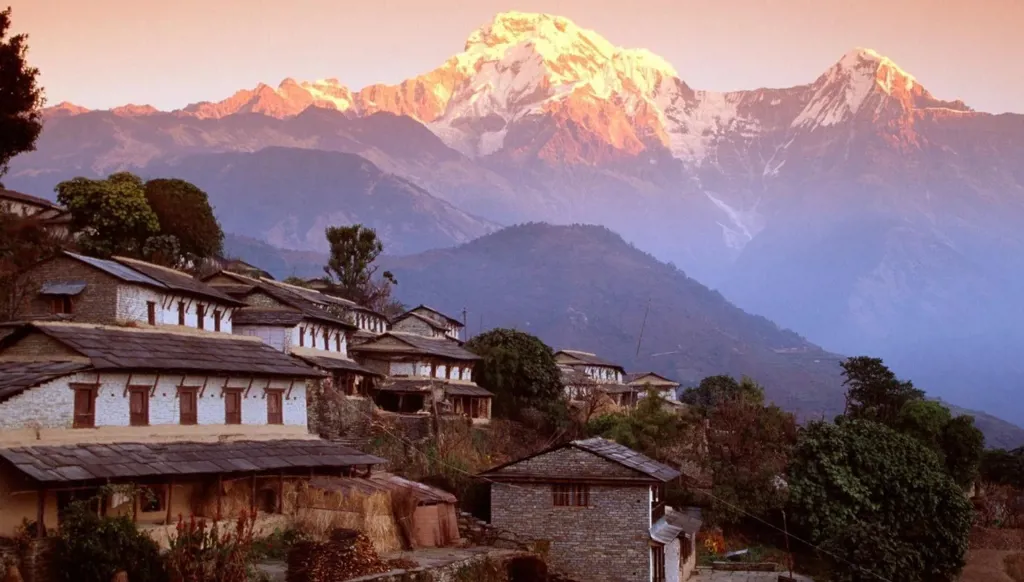
The upcoming UN climate summit in Turkey will once again misuse a catastrophe to get attention. This year, the summit will highlight the tragedy in Nepal, where an ice-and-rock avalanche tore through northern Nepal in late August. The disaster has left more than 1,400 dead and 5,000 missing and a recovery bill of nearly $5 billion, about an eighth of the country’s economy. And yes, it carries a lesson for the world, just not the one campaigners are selling: ever bigger climate budgets.
Just days after the disaster, the UN’s climate chief, Simon Stiell, declared that climate change is making such tragedies “much more likely, frequent and severe.” Climate activist Bill McKibben wrote that Nepalis “are not causing the crisis that is killing them: we are.”
Climate change may well have played a part. The World Weather Attribution group, which rarely understates the case, finds that human-caused warming raised Himalayan summer temperatures by about 1.5°C. Yet even it calls climate change “a destabilising factor acting on a pre-existing geological predisposition, rather than the fundamental cause.” The largest study of snow avalanches across High Mountain Asia, published this year, mapped 60 million of them since 1990. It found no long-term trend across 85% of the catchments.
Either way, carbon cuts are not the answer. If every country at the summit pledged deeper cuts and, for once, kept its word, the glaciers of Langtang would not refreeze. Trillions of dollars spent cutting carbon buy a barely measurable drop in temperature by the end of the century.
What the Trishuli valley needed is no mystery. A flood becomes a mass-casualty disaster when the people in its path are not warned in time. Some areas were too close to warn, but others had 40 minutes or more.
Downstream in Bidur, principal Rajendra Dawadi evacuated and saved some 900 students minutes before the flood swept his school away. His warning came by word of mouth, not by siren.
Nepal’s own damage assessment calls for more monitoring, repairs to wrecked stations, and sirens and text alerts along the rivers. The initial cost is a trivial $2.3 million.
Nepal hasn’t lacked climate money. It lacked climate money spent on keeping people alive. Nearly 30% of all development money for Nepal went to climate: more than $3 billion committed in 2020-24, scattered across a bewildering array of well-meaning projects. Nearly half a billion dollars went to power lines and smart meters to swap fossil fuels for hydropower, in a country that already gets almost all its electricity from water. German aid committed €6 million, three times the cost of a warning system, to solar panels to cut CO₂ emissions.
Even programs that should have helped lost their way. A $150 million World Bank disaster-resilience program from 2024 promised better warnings, then spread itself across droughts, wildfires, heat waves, building-code compliance and other rivers.
The Green Climate Fund came closest. In 2020 it approved $27.4 million to make the Gandaki river basin, which includes the Trishuli, more resilient to floods and landslides. None of it went to sirens or flood alerts. Instead, a large part went to irrigation, which helps with drought, not floods, plus farmer schools, ecotourism and a gender action plan. A $50 million project for sensors, sirens and backup communications sat in the fund’s pipeline for seven years before approval in 2025. It began work in March and is due to finish in 2033. Having tried everything else, the donors finally got around to what Nepal needed.
Warnings are among the cheapest lifesavers. The World Meteorological Organization estimates that spending $800 million on early warning in poor countries would avoid $3 billion to $16 billion in losses a year. Bangladesh lost more than 300,000 people to a cyclone in 1970; since 2007, forecasts, shelters and drills have kept its annual cyclone deaths under 200. Worldwide, deaths from climate-related disasters have fallen by more than 97% in a century. Almost none of that came from cutting emissions. It came from being richer and better prepared.
Growth is the adaptation policy that covers every hazard at once. Extreme poverty fell from 55% of the population in 1995 to under 1% in 2022. But although average growth since 1996 has been a respectable 4.2% per year, most South Asian economies have grown faster. The fixes are unglamorous and well known: more power generation, better roads to let exporters compete, fewer regulatory hurdles, and a better deal for the migrants whose remittances make up a quarter of the economy.
A richer Nepal builds sturdier bridges, sites its dams and roads more carefully, keeps its sensors running and pays for its own sirens.
There is something perverse about campaigners using yet another disaster to demand more of the policies that failed its victims. If the upcoming climate summit wants to honor the dead of the Trishuli valley, it should pay for the warning systems they never got, then get out of the way of Nepal’s growth.
President of the Copenhagen Consensus, Visiting Fellow at Stanford University's Hoover Institution, and author of "False Alarm" and "Best Things First".