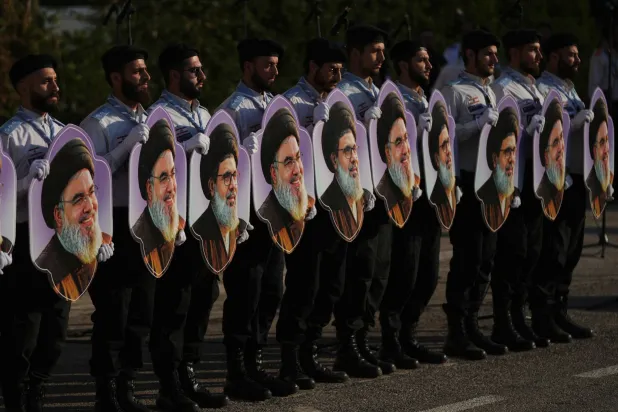
“Imagine if he had not died,” my interlocutor says over the phone from Beirut. He has close knowledge of Hezbollah and is in daily contact with its broader social environment. He poses a hypothetical question: What if Hassan Nasrallah had survived and had been the one required to lead the confrontation? He does not mean a military confrontation with Israel. “That is what the party is doing, and that is its playing field,” but rather “a confrontation with himself, his supporters and his community over this catastrophe he brought upon them.” Would he have signed a ceasefire agreement? Would he have agreed to negotiations or opposed them as his successor does today? Would he have been able to return to the “If I had known” line he used after the 2006 July War? A torrent of questions that will never find answers, and “an enormous void the size of the hole that swallowed him and his comrades in the southern suburbs,” says another source from southern Lebanon who witnessed all the Israeli wars on Lebanon, lost family members, friends and homes, and stands on the opposite political side from Hezbollah. He continues: “Two years have passed, and the community and its surroundings are still in a state of shock and complete denial... a state of collective delirium. It is as if people did not lose a military commander or a religious leader, but rather the person who gave them a narrative about their circumstances.” There is broad agreement over Nasrallah’s ability to “theatricalize” the war and its losses, transforming the costs borne by the afflicted, the grieving and the bereaved into an epic moment of euphoria and victory. That, it seems, is what his supporters and followers miss most today. It is as though their involvement in the war of support and the price they paid for it remains a detail compared with the absence of the person who could dictate its favorable narrative. That rhetorical void is not due only to the fact that Hezbollah Secretary-General Naim Qassem lacks his predecessor’s ability, but also because Nasrallah himself had begun losing his public space, image and public presence well before his assassination. In this sense, “the moment of his assassination came as a rescue from many losses and enormous obligations.” The source says: “Nasrallah actually died before the moment of his assassination... He died with the pager operation and the series of assassinations that followed. He died when he lost his ability to mobilize and justify, when he was no longer able to offer people a narrative, and when no one cared about his speeches or waited for them as they once did.” Here, the source points to a role he considers more important than the organizational position Nasrallah held within the party. He “was neither a military tactician nor a religious man in the conventional sense, so much as a ‘man of mobilization’ who gave the party a power normally enjoyed by states, not parties or armed organizations.” Such an overwhelming presence, of course, does not emerge overnight. A supporter of Hezbollah, who was injured in the Israeli pager operation against the group, uses his phone whose back cover bears the image of slain leader Hassan Nasrallah during a ceremony held to mark the second anniversary of Nasrallah's killing in a strike by Israel, in Beirut's southern suburbs on September 27, 2026. (Photo by Anwar AMRO / AFP) “As Though He Never Existed” A sociologist and writer who follows transformations within Hezbollah and its social environment recalls Nasrallah between 2000 and 2006 and describes him as closer to a “party activist” before he gradually built a presence that, in his view, was consolidated with the assassination of Rafik Hariri, when his words acquired regional weight. Since the 2000 liberation, Nasrallah had cultivated this aura and “worked tirelessly on it,” relying on the party’s full media apparatus to establish an image “closer to a legend and demigods,” thereby justifying the continuation of carrying arms. Until quite recently, his television appearances were like “Umm Kulthum evenings. The streets would empty, people would sit transfixed in front of their screens, and they would be enthralled by what they heard.” Paradoxically, those listening were not Hezbollah members, nor were they all part of its immediate social environment. At different stages, Nasrallah had become a public event: “His supporters listened to him, his opponents listened to him, neighboring countries listened to him, and everyone waiting to know what would happen the next day listened to him.” Today, two years later, “it is as though he never existed.” A woman from southern Lebanon belonging to a family with considerable social and religious standing traveled to Tyre and Nabatieh one day before the second anniversary commemorating the assassinations. She says: “I did not see his pictures on the streets or buildings as was customary. Had I not caught sight of a small picture of him, tucked away to the side in a small shop, I would not have noticed his complete absence from the public scene at all.” She adds: “Even in private gatherings, no one talks about him anymore. What seemed even stranger to me was that this coincided with the anniversary... It may seem at first that there is indifference toward him, but I believe he has become that absent figure who is ‘not spoken of.’ He is now the quintessential Shiite ‘taboo.’” According to the woman, who is close to the party’s social environment and trusted within its small community without being part of it, it seems that “there are no longer many who love the ‘Sayyed’ outside the hard core of party supporters and those on the party payroll.” Even his former broad base of supporters did not go to the condolence gatherings, which are “a central ritual for Shiites.” Ali Abbas, 14, who lost his right eye with severe damage to his right lower eyelid and lost some fingers in pager attacks across Lebanon on September 17, 2024, recovering at his home, in Barish, in the Tyre district, southern Lebanon, September 1, 2026. REUTERS/Zohra Bensemra “Only the Guard Remains” My interlocutor from the south brings me back to Nasrallah’s legacy, saying that “there is no one left to inherit him... even Hezbollah as we knew it died with him.” To explain this view, he elaborates: “In politics, Nasrallah caused unprecedented political embarrassment for his closest allies by declaring the war of support after personally assuring Parliament Speaker Nabih Berri that he would do the opposite. Then, after the six rockets were launched, Berri made calls and tried to persuade the party not to issue a statement claiming responsibility for the rockets. He obtained another explicit commitment, which did not survive even a few hours before it too was broken.” Until October 7, 2023, Nasrallah played a regional role with a relatively comfortable margin for maneuver. He was “the trusted intermediary between Iran and Lebanon, government, sects, people and institutions. He played roles in relations with the surrounding region and the outside world, sparing Tehran many direct confrontations with neighboring countries. He would pass on decisions and absorb the shocks in its place.” But that, the source says, gradually began to change after October 7, and then fundamentally after Nasrallah was killed, to the point that “today, only the Revolutionary Guard remains. Nothing else. The Guard directly controls every part of the party, its leadership, fighters and strategy. Naim Qassem is unable to play the role of intermediary or messenger.” As for the party’s structure, the source continues: “Hassan Nasrallah is the last black-turbaned figure in the secretary-general’s office. Naim Qassem wears a white turban, and that reflects a different religious hierarchy. His [reported] deputy is Mohammed Raad, a member of Parliament and not even a religious cleric.” If we exclude the person who had been a candidate for the secretary-generalship before Qassem but was excluded, or removed himself, as some say, Ibrahim Al-Sayyed Amin, who was the closest to the position after Hashem Safieddine, one might turn to Nasrallah’s son, Mohammed Mahdi. He is a young cleric with a turban and an active party cadre. “But he has not been prepared for that role and has not yet matured,” according to several sources who agree on the point. People check the rubble of buildings which were levelled on September 27 by Israeli strikes that targeted and killed Hezbollah leader Hassan Nasrallah in the Haret Hreik neighbourhood of Beirut's southern suburbs, on September 29, 2024. (Photo by AFP) Nasrallah’s Sons... The Burden of the Legacy One source explains: “After his death and the deaths of those around him, we can see the importance of family ties within the circle of trust that surrounded him, and which turned out to underpin the party’s leadership.” According to the source, “what Nasrallah destroyed by choosing to remain in his position surrounded by these close leaders, and by waiting for the death that was inevitably approaching him, was the fabric of family, clan and party together. It is difficult, if not impossible, to repair.” What is striking is that throughout all this, he did not include his sons or work to prepare any of them to succeed him. According to the sociologist and writer, “historical leaders of this magnitude do not think about succession, perhaps because of some form of narcissism in them, leaving their children struggling with their identities and with managing the weight of the legacy on their shoulders.” The sons, specifically Jawad and Mohammed Mahdi, who have increased their public presence recently, are “a phenomenon worth pausing over, particularly as each tries to humanize the father and imitate his image... but in reality, with little success.” A close examination of the social media accounts the two young men have recently turned to shows a determined effort to borrow from their father’s behavior, from imitating the movement of his hand and his manner of speaking to something resembling a division of roles. One, for example, appears to emulate a religious authority in his turban, while the other invokes Guevara and the liberation of peoples at times, then the martyrs and the righteous, along with his certainty that his father will return with them, at others. “The Spell of the Eyes”... Just a Bubble Today, instead of building on that “legend,” “Nasrallah’s narrative has become a farce... and is now at the mercy of the wind,” one source says. He continues: “Two years after his death, all we have to do is look at the ease with which his immediate circle is handling his legacy to realize that there is no custodian of this legacy... All those narratives about his leadership charisma, his commanding presence and the spell of his eyes, the common comparison used to describe Nasrallah, drawn from descriptions of Gamal Abdel Nasser, have suddenly vanished. As if they were merely a bubble.” “All it takes is for a marginal politician to claim on television that he used to sit with him for around seven hours. What kind of exaggeration is that? Or, for example, his son Mahdi talking about how he would prepare breakfast for him, or the video showing him driving around in a car in the southern suburbs, for which we do not know the context, date or source. Was it the party media? Al-Manar TV? Who decided that these stories should be made public today?” The Loss of Voice and Image More questions all point to the same issue: the opening up of the narrative that Nasrallah had monopolized. His narrative about himself and his party, whose rhythm he controlled through a committed media machine that did not depart from what he dictated. Was that why the slogan of the anniversary was “We Remain Committed to the Pledge”? And was that why Qassem launched an institution to preserve and publish Nasrallah’s legacy? Perhaps the aim was to “humanize” the man and make him an accessible figure, conveying a message to the grieving popular base that he was like them and among them despite his absence. But in practice, the result was exactly the opposite. The “void the size of the hole” and the leadership crisis are viewed by the sociologist through the lens of the mass of people that was once strongly present and has become “more obscure and closed than ever,” and “completely unknown to anyone outside its close members.” He says: “It is as though the Shiites as a whole have withdrawn, leaving a void in the mechanisms of daily life, in their relationship with other parties, other sects and the broader Lebanese sphere.” Apart from the small number who appear on social media and fiercely defend the war of support, the social mass that Nasrallah once represented appears, in his view, less visible and less present. He says: “It is as though, with the loss of Nasrallah, they lost the voice and the image.” But what appears from the outside to be a decline reveals, within the narrow circles of trust, another ordeal. A girl, a member of Hezbollah's al-Mahdi Scouts cries as she holds up a poster during a gathering marking the second anniversary of the assassinations of Hezbollah leaders Hassan Nasrallah and his cousin and successor, Hashem Safieddine, who were killed in Israeli airstrikes, in Dahiyeh, a southern suburb of Beirut, Lebanon, Sunday, Oct. 4, 2026. (AP Photo/Hassan Ammar) Is “Shelter” Inevitably Coming? The woman from southern Lebanon says that “the void in the party’s leadership today seems like a luxury compared with the void in the forces that drive daily life for southerners.” She continues: “It is as though Amal has inherited the streets and the scene in Tyre in particular instead of the party. What the party members once represented as a deterrent to the activists is no longer there today, so these people have become a de facto authority controlling everything... and there is much bitterness in that.” Today, many people in southern Lebanon want to believe their new secretary-general’s statement that “shelter” is inevitably coming, and that Iran will not abandon them or stop supporting them with money, weapons and influence. But they remain silent about the fact that the money will not come, and that the mere use of the word “shelter” instead of the “decent housing and decent furnishings” Nasrallah promised them after the 2006 July War says a great deal about their circumstances. Between denial and the deep mourning suffered by the party’s community, the greatest shock remains “the loss of the power and the ‘surplus of power’ they enjoyed for more than two decades and wielded as a daily weapon against the rest of the Lebanese... Therefore, their social contract today appears to be based on treating that narcissistic wound by directing all their anger at the agents.” It is as though the excessive talk of traitors and agents compensates them for the deafening silence about everything else. In their view, these are the Lebanese, all Lebanese outside their own community, and everyone who did not support them in their support effort. So they erupt in anger whenever they are mentioned, seeking relief from their misery through more insults and threats.