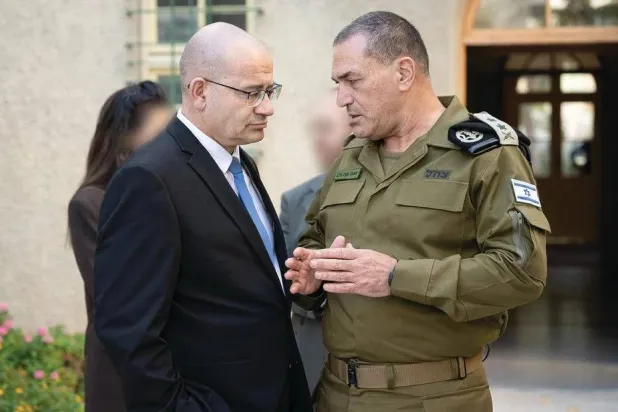
Israeli Mossad chief Roman Gofman and military Chief of Staff Eyal Zamir are at odds over whether to launch another strike against Iran. While Gofman supports a unilateral Israeli attack without US participation if no alternative remains, Zamir favors waiting for a decision from US President Donald Trump. Israeli news website Ynet, in a report published jointly with Yedioth Ahronoth on Friday, said Gofman had adopted a more hawkish position during recent security discussions, amid concerns that Iran may be secretly continuing to develop chemical weapons. According to senior officials familiar with his position, Gofman believes further delays in confronting the alleged Iranian chemical weapons threat could leave Israel facing an operational challenge that would be far more difficult to eliminate. In Gofman's assessment, the mere emergence of such a threat makes it too risky to allow Iran to acquire these capabilities. Security sources said Mossad and Israeli military intelligence, known as Aman, share the same intelligence assessments. Zamir also supports striking Iran but believes the threat is not yet imminent. Zamir considers it preferable to await Trump's decision and act alongside the Americans, whose participation could provide a significant force multiplier and improve the chances of achieving a lasting strategic outcome. A security source said the military's position is that Israel would attack without US involvement if an immediate existential threat emerged. "But that is not the situation at present," the source added. Reuters reported on November 18, citing two informed sources, that the Israeli military assesses Iran does not pose an imminent threat to Israel, meaning immediate military action is unnecessary. Ynet explained that operational responsibility for any strike would ultimately fall to the Israeli military. The air force would carry out the main offensive operations, air defenses would respond to Iranian retaliation, and military intelligence would provide the information needed to sustain the campaign. Disagreement Before the Elections The differences between Gofman and Zamir date back to before Israel's elections. According to Ynet, Trump raised military readiness for a possible strike against Iran roughly a month before the elections, prompting Israel to reach its highest level of alert. Zamir opposed going to war before the elections, while Gofman took a different position, arguing that Israel should seize the opportunity to act jointly while the United States remained prepared to participate. Trump ultimately abandoned plans for the attack, and the alert level was lowered. Gofman visited Washington three weeks ago, presenting new intelligence concerning developments in Iran's alleged chemical weapons program and seeking to advance plans for a joint strike. His position was based on the assessment that the opportunity to inflict significant damage on Iranian capabilities would not remain open indefinitely. Two sources told Reuters that Gofman had advocated joint US-Israeli strikes during meetings with American officials and had met CIA Director John Ratcliffe. They said Gofman briefed US officials on Israeli intelligence concerning Iran, with one source indicating that the information related to Tehran's nuclear program. Israeli media also reported that Gofman traveled to Miami to meet US envoy Steve Witkoff. Former Israeli minister Ron Dermer, a close associate of caretaker Prime Minister Benjamin Netanyahu, was in the United States around the same time to advocate a joint attack, according to the two sources. The sources described Gofman's and Dermer's contacts as part of Netanyahu's efforts to persuade Trump to launch another strike against Iran, saying Netanyahu believes the opportunity is narrowing. One source said Israel fears the United States could begin withdrawing its substantial military deployment from the region before the end of the year. Following the visit, Trump announced on November 9 that he was postponing strikes against Iran after meeting Qatar's prime minister. A source involved in diplomatic efforts said Gulf leaders had urged Trump not to attack Tehran. Washington has yet to make a decision. Ynet said the window of opportunity being discussed in Israel extends until the new US Congress is sworn in, approximately six weeks away. Unilateral or Joint Strike? Ynet noted that Israel is capable of attacking Iran independently, as it demonstrated during Operation Rising Lion. However, the United States possesses capabilities Israel lacks, most notably B-2 bombers and bunker-busting munitions. A joint strike would provide Israel with American political backing, while a unilateral operation would give it greater freedom to make decisions without being constrained by White House calculations or Trump's willingness to sustain the campaign. The report cautioned that Israeli and American interests do not necessarily align. Trump could seek to halt operations after achieving limited objectives or pursue a diplomatic agreement, while Israel might prefer to continue striking until it has inflicted more substantial damage on Iranian capabilities. Ynet concluded that Israel does not necessarily need the United States to attack Iran, but it does need American participation to improve the chances of achieving a strategic outcome rather than merely an operational success. The calculations also include the risk that Israel's overt and covert regional allies could face Iranian retaliation. According to the report, Washington understands these potential consequences and has therefore not yet given the green light for a joint military operation. Ynet emphasized that the disagreement within Israel does not concern the need to address the Iranian threat itself, but rather how and when to act. Chemical Weapons Allegations Israeli Defense Minister Israel Katz accused Iran on Tuesday of working to develop chemical weapons. In a statement published by the Likud party, Katz said Israel would not allow Tehran to acquire such capabilities. During a briefing with Israeli journalists, Katz also raised the possibility of a preemptive strike. "If we discover that the Iranians intend to attack Israel, can't we ask the military to launch a preemptive strike and thwart the threat?" he asked. Iranian Foreign Minister Abbas Araghchi responded Wednesday, accusing Israel of attempting to deceive the United States and draw it into another war by alleging that Iran was concealing chemical weapons in pharmaceutical factories, despite being a member of the Organization for the Prohibition of Chemical Weapons. Avigdor Lieberman, leader of the Yisrael Beytenu party and an ally of Gadi Eisenkot, who has been tasked with forming Israel's next government, described the statements concerning Iranian chemical weapons as serious. However, he said there was "no justification for an independent Israeli attack in the near future." Netanyahu's political rivals have accused him of seeking to escalate the conflict to improve his political standing following an inconclusive election, allegations he has denied.