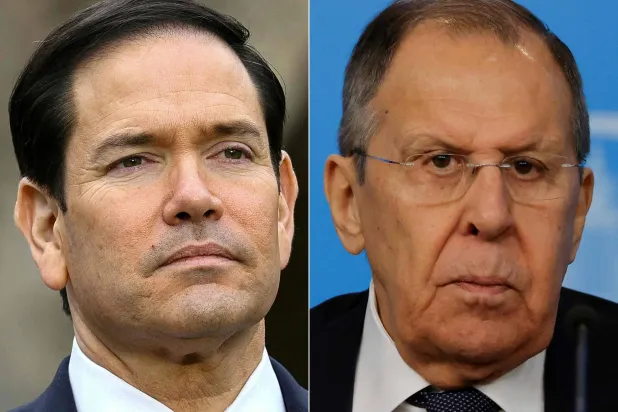
Moscow again said it “will not pause” its military operations in Ukraine for fear that Europe might exploit a temporary halt to supply Kyiv with more weapons, also stating that it is still reviewing the US invitation for President Vladimir Putin to attend the upcoming G20 Summit in Miami. “We are not going to have a pause in our special military operation,” Russian Foreign Minister Sergei Lavrov told the UN Security Council on Wednesday, accusing Europe of wanting to use a halt to the fighting to “pump the Kyiv regime with weapons.” On Wednesday, US secretary of state Marco Rubio raised concerns the Ukraine war could spread, amid warnings in the UK and Europe over the threat posed by an increasingly hostile Russia. Speaking at the UN in New York, America’s top diplomat said, “One of the concerns we have, among many, about the war between Russia and Ukraine is that it could metastasize and spread into other places, that it could grow into somewhere else, be it through a hybrid attack, be it through a sabotage attack, be it through a misunderstanding – some pilot went the wrong way and all of a sudden you’ve got active combat.” He said the US has raised that in multiple meetings with multiple countries because it is of real concern. Rubio’s remarks came shortly after his meeting with Lavrov on the sidelines of the UN General Assembly in New York. Despite his concerns, Rubio said Russia and Ukraine have both expressed interest in a limited ceasefire covering energy and grain sectors. Washington invited Putin to a December G20 meeting in Miami, Florida where he could hold a summit with Trump, according to Rubio. He said Washington remains open to engaging with Russia on the war in Ukraine, despite stalled efforts to bring an end to the conflict. The G20 summit will take place at the president’s golf resort, Trump National Doral Miami, from Dec. 14-15. On Thursday, the Kremlin said Russia would consider the invitation. Kremlin spokesman Dmitry Peskov told reporters in Moscow that the Russian government was grateful for the invitation extended to Putin to attend the G20 summit in Miami, adding that officials would determine their position through diplomatic channels. “We will determine our position (on whether to take part in the event or not) and work it out through diplomatic channels,” Peskov said when asked about the invitation, declining to specify whether Putin would attend the gathering in person or participate virtually. Trump has been trying since returning to the White House in January last year to broker an end to the war in Ukraine, but without achieving a breakthrough. Peskov reiterated Russia's position that it is seeking a peace settlement, not a temporary ceasefire. For his part, President Volodymyr Zelensky told leaders at a “Crimean Platform” summit on the sidelines of the UN that Kyiv was ready for a maritime truce in the Black Sea based on proposals such as those put forward by Egypt, India and Türkiye. Ukraine and its allies are racing to secure limited agreements on energy infrastructure and Black Sea shipping before winter, fearing renewed Russian strikes on power and heating facilities, while Moscow continues to show little interest in wider negotiations to end the war. Trump met with Zelenskiy on Tuesday to discuss a ceasefire on energy-related targets. “Ukrainians understand that this winter could be very harsh for us. But in response, we will have no choice but to make it painful for Russia too,” Zelensky told the UN General Assembly during the annual gathering of world leaders in New York. “When someone gives Russia more money through trade, they are giving this war more time. That is precisely why we insist on restricting trade with the aggressor, and that is precisely why we ourselves are cutting into Russia’s revenues,” he said. Lavrov will deliver Russia's address at the United Nations General Assembly on Saturday, while Putin is skipping the New York gathering as he has for over a decade. Meanwhile, Zelensky said Ukraine has transferred two captured North Korean soldiers to South Korea, prompting Seoul to express regret that the move had been disclosed publicly despite an agreement to keep it private. Announcing the transfer in an address to the General Assembly, Zelensky said the two men had recently been sent to South Korea after being captured while fighting for Russia in the war against Ukraine. “These guys are not easy to capture alive. One of them, when he realized he was going to be taken prisoner, tried to kill himself. And he was shocked that fate did not let him die,” Zelensky said in his speech. Ukraine captured the two North Koreans in Russia's Kursk region in January 2025. They were the first North Korean soldiers to be captured alive since the country joined the Russia-Ukraine war in 2024. Zelensky said at the time that he would hand them over to North Korean leader Kim Jong Un if he could facilitate their exchange for Ukrainians held captive in Russia. Human rights groups, however, urged him to send them to South Korea, citing the risks of punishment the soldiers faced. South Korean media reported that the two captured soldiers had expressed their desire to defect to South Korea. The transfer comes as South Korea has voiced support for efforts to revive dialogue with North Korea and Trump has renewed his willingness to engage with Pyongyang. South Korean President Lee Jae Myung said it was “deeply regretful” that Ukraine had made the transfer public, adding that the two sides had agreed not to disclose it. “The repatriation of North Korean prisoners is a highly sensitive issue with significant implications for diplomacy, national security, and the situation on the Korean Peninsula,” Lee said in an X post. North Korea has sent an estimated 14,000-15,000 troops to support Russia's war since 2024, according to Ukrainian and South Korean estimates, with most deployed in the Kursk region to help repel a Ukrainian incursion. Pyongyang has also supplied Russia with millions of artillery and mortar rounds, as well as ballistic missiles, long-range artillery systems and multiple-launch rocket systems, according to Ukrainian and independent assessments. Meanwhile, around 10 powerful explosions rocked the Ukrainian capital in the early hours of Thursday, according to AFP journalists on the scene, as authorities issued a missile alert. The explosions, which set off car alarms, came a day after a series of Russian strikes that killed at least seven people in Ukraine and sparked fires in Kyiv. Shortly before the blasts rang out, the Ukrainian Air Force had issued a warning that Russian ballistic missiles were heading toward Kyiv and its surroundings and the Chernigiv region north of the capital. The Ukrainian capital, home to around 3 million people, has been the target of particularly intense drone attacks over the past few days, amid a marked escalation in long-range strikes on both sides of the front line. Also, seven people were killed in a Russian strike on a farm in the Kharkiv region of eastern Ukraine on Thursday, Prime Minister Sergiy Koretsky said, after a wave of attacks across the country. “In the morning, a drone struck an agricultural enterprise, killing seven people and injuring 10,” he wrote on Telegram.