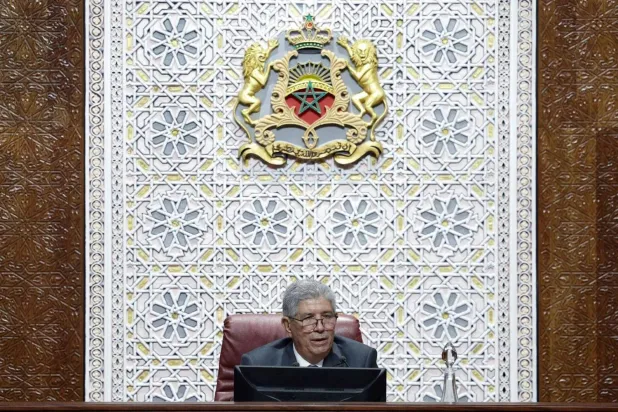
Ahmed Touizi’s rise to become Morocco’s parliament speaker in October 2026 marks the opening of a new political phase after a reshaping of the country’s governing majority and opposition. The elevation of the senior Authenticity and Modernity Party figure to lead the House of Representatives directly reflects the legislative election results and the balance of power among parties in parliament. It also puts his long record in education, local government and regional administration under closer institutional scrutiny. As Touizi begins his five-year term, he faces major organizational and constitutional challenges. He must steer legislative debate with balance and manage competition between the governing majority and opposition groups at equal distance, safeguarding the rights of all sides while preserving the authority of the institution. The parliamentary showdown and the numbers behind the vote Touizi capped his political career by being elected parliament speaker at a plenary session on Tuesday, Oct. 13, 2026. He secured what is regarded as the third-highest constitutional office in the state with an absolute majority of 220 votes, backed strongly by the parties in the new governing coalition. His main rival, Idriss El Azami El Idrissi of the opposition Justice and Development Party, won 59 votes. The ballot also carried a quieter political message. Of the 369 votes cast, 90 were blank or invalid, reflecting the scale of underlying tensions inside the legislature. The House completed the formation of its constitutional bodies the following day. Lawmakers unanimously approved a single list with 293 votes, establishing the chamber’s bureau under the principle of proportional representation and appointing eight deputy speakers. Mustapha Baitas of the National Rally of Independents was named first deputy speaker and Khalid Chennak of the Istiqlal Party was second deputy speaker. They were joined by Abdellah Bouanou of the Justice and Development Party and Mohamed Ouzzine of the Popular Movement. The restructuring also extended to the heads of the chamber’s nine permanent committees, the core engines of the legislative process. Mohamed El Gharass of the Constitutional Union was appointed head of the Foreign Affairs Committee, Moncef Toub of the Istiqlal Party the Interior Committee, Mohamed Ghiyath of the National Rally of Independents the Justice and Legislation Committee, and Hicham El Mhajri of the Authenticity and Modernity Party the Finance Committee. Mustapha Ibrahimi of the Justice and Development Party was named head of the Social Sectors Committee, Mohamed Al Aaraj of the Popular Movement the Productive Sectors Committee, Abdelhak Amghar of the Socialist Union of Popular Forces the Infrastructure Committee, Hassan Derham of the Party of Progress and Socialism the Education and Culture Committee, and Hanan El Masi of the Authenticity and Modernity Party the Public Finance Oversight Committee. From the geographic margins to the top of the legislature Touizi’s political career is closely tied to his stronghold in Al Haouz province, particularly the town of Ait Ourir near Marrakesh. The mountainous, developing area was more than his birthplace and childhood home. It became his decisive electoral base and the platform from which he built his political influence. That deep local connection gave him grassroots legitimacy, but it also brought persistent criticism. Local actors and opponents have argued that his record in local administration failed to deliver the hoped-for development gains in his hometown and surrounding areas. From natural sciences teacher to politics The new parliament speaker is 71 and was born in the 1950s, living through the major transformations of modern Morocco. Touizi studied science before entering public service as a natural sciences teacher in Morocco’s public education system. Throughout his career, he has repeatedly invoked his roots as an educator in his speeches. For years, that background shaped both his political rhetoric and his direct communication with ordinary citizens before he turned full-time to electoral and institutional politics. Political pragmatism and a long journey across parties Touizi’s partisan record shows clear political flexibility and an ability to adapt to shifts in Morocco’s party landscape and changing balances of power. He began his political career in 1974 within organizations linked to the National Union of Popular Forces in Marrakesh, then associated with a radical leftist current. As Morocco’s political landscape shifted, Touizi moved among several parties, including the Constitutional Union and the Popular Movement, before joining the liberal Authenticity and Modernity Party. He rose through its ranks to become a member of its political bureau and one of the leading figures shaping its parliamentary balance. From local government to the legislative engine room Touizi has held a succession of local and legislative posts over several decades. He served as president of the Ait Ourir municipal council for several consecutive terms, becoming a familiar figure in local administration. He expanded that territorial influence when he was elected president of the Marrakesh-Tensift-Al Haouz regional council from 2011 to 2016, before Morocco adopted its current regional structure. His career also extended to parliament. He spent years in the House of Councilors, where he served as a chamber quaestor, before moving to the House of Representatives as a lawmaker for the Al Haouz constituency. He later headed the Authenticity and Modernity Party’s parliamentary group during the previous legislative term, gaining detailed knowledge of the inner workings of lawmaking and the balance between parliamentary blocs. Taking the speaker’s chair and inheriting a long legacy Touizi succeeds Rachid Talbi Alami of the National Rally of Independents as parliament speaker. His election also places him in a long line of prominent figures who have led Morocco’s legislative institution since the early post-independence period. They include Mehdi Ben Barka in the National Consultative Council, Abdelkrim Al Khatib, Dey Ould Sidi Baba and Ahmed Osman, who led the parliamentary institution for the longest uninterrupted period, as well as Abdelwahed Radi, Mustapha Mansouri, Karim Ghellab and Habib El Malki.