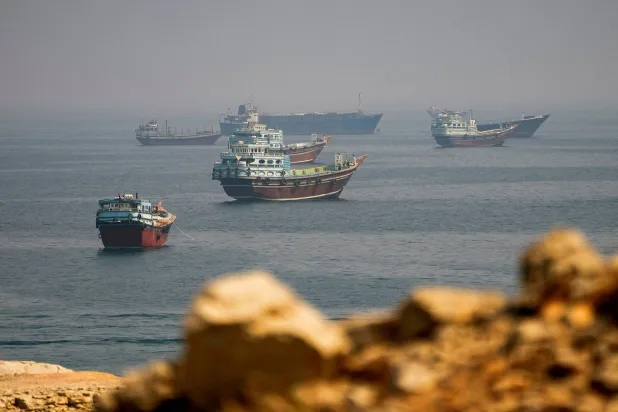
The temporary agreement announced by the United States and Iran to end months of conflict and reopen the Strait of Hormuz does not mark an immediate end to a commercial disruption that has unfolded largely away from the spotlight that focused mostly on oil and gas. While energy markets await the resumption of crude and LNG shipments, shipowners carrying fertilizer cargoes remain trapped in uncertainty, awaiting operational guidance on transit procedures and safety. The situation highlights the gap between a political agreement and the actual restoration of global supply chains, as the world’s most important maritime chokepoint enters what experts describe as its most difficult logistical phase. Hormuz is not only an energy artery. It is also a critical route for fertilizers, urea, potash and petrochemicals — commodities that underpin global food security. One million tons waiting Data illustrate the scale of the disruption. According to tanker-tracking firm Kpler, more than 40 fertilizer vessels carrying roughly one million tons of cargo have been stranded behind the strait since the US-Israel war on Iran started at the end of February. As a result, weekly fertilizer exports through Hormuz plunged by 90 percent, falling from about 600,000 tons a week in late February to just 60,000 tons in early June, reflecting the near paralysis of dry-bulk commodity traffic. Logistics expert Nashmi Al-Harbi told Asharq Al-Awsat that Gulf fertilizer producers account for about 15 percent of global supply, warning that any disruption to this corridor has ripple effects on food security and agricultural prices from Asia to Latin America. Tankers and cargo vessels are seen in the Gulf of Oman, along shipping routes linking the Strait of Hormuz and the Arabian Sea, Tuesday, June 16, 2026. (AP) India offers perhaps the clearest example. Bandana Preyashi, an official at India’s Ministry of Chemicals and Fertilizers, said 16 fertilizer vessels bound for India had been stranded near the strait. The delayed shipments include eight vessels carrying 330,000 tons of urea and four carrying 257,000 tons of diammonium phosphate, in addition to ammonia and sulfur cargoes. Despite the disruption, India has already imported five million tons of fertilizer this year and has issued a global tender for an additional 1.7 million tons to meet summer crop demand, underscoring the urgency of domestic requirements. Energy first Analysts expect oil and liquefied natural gas shipments to receive priority once traffic resumes. Alexis Ellender, Kpler’s senior dry-bulk freight analyst, said oil and LNG tankers are likely to receive immediate priority, arguing that fertilizers do not carry the same strategic importance during the initial reopening phase. Al-Harbi agreed, noting that transit decisions will depend on factors including demurrage costs, cargo conditions and destination-port capacity. He argued that the real bottleneck is no longer Hormuz itself but receiving ports in India and East Africa. Logistics specialist Hassan Al Heliel expects authorities to implement a “wave transit” system, allowing groups of eight to 12 vessels to pass at a time. Delayed shipments are expected to account for 30 to 40 percent of the initial traffic, while higher-risk cargoes such as ammonia will remain under close scrutiny. A crane unloads a shipment of fertilizers from a cargo ship at Mundra Port in Gujarat, India. (Reuters) Insurance costs and market shifts The crisis has sharply increased shipping costs. Marine insurance premiums have risen by between 300 and 600 percent on some routes, adding roughly $40 per ton to transportation costs. According to Al-Harbi, the increase has temporarily eroded the competitive advantage of Gulf producers against rivals in Russia and Morocco, particularly in Asian and Latin American markets. Al Heliel estimated that total delivered costs have risen by 12 to 25 percent per ton, prompting exporters to focus on nearby and more stable markets such as India and Southeast Asia while reducing exposure to Latin America. Although Gulf producers retain a structural cost advantage of 25 to 35 percent over competitors, he said competition has shifted from product pricing to delivery efficiency. New challenges Both experts argued that the political breakthrough marks the beginning, not the end, of market disruption. Al-Harbi described the next phase as “the most operationally challenging,” noting that vessels rerouted during the crisis will not immediately return to normal patterns and that emergency supply contracts signed during the disruption must be rebalanced. He estimated it could take six to nine months for shipping networks to fully normalize. Al Heliel warned that rescheduling delayed vessels could create significant congestion at Asian ports, many of which are already operating at 80 to 90 percent of capacity, potentially extending waiting times by an additional five to 10 days. “The breakthrough does not signal the end of disruption,” he said. “It marks a deeper reshaping of global supply chains around a new balance of risk and efficiency.”