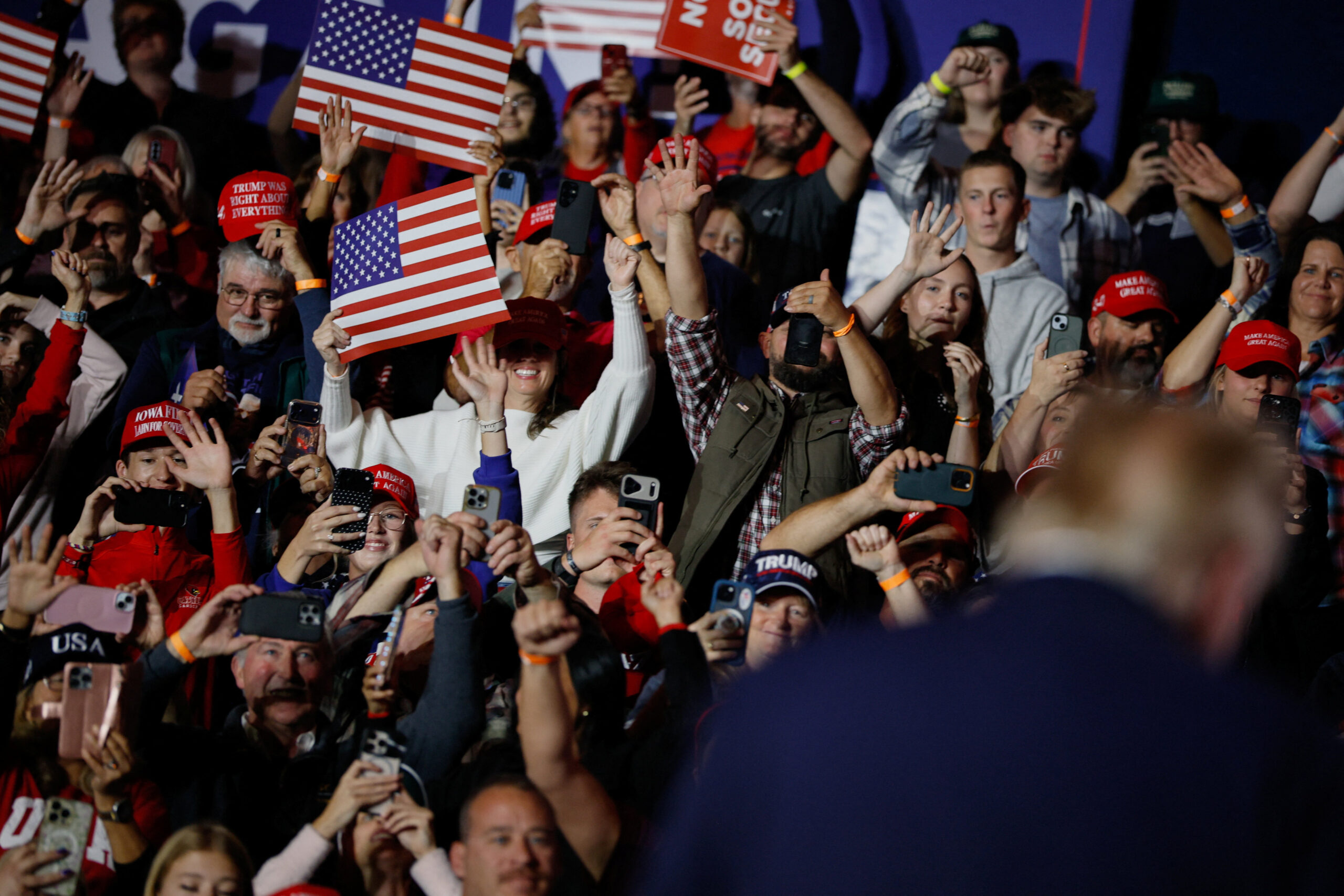
WASHINGTON: Voters struggling with high prices and angry over an unpopular war with Iran will decide whether to drastically shift power in Washington in midterm elections Tuesday that will serve as a referendum on President Donald Trump’s second term.
Democrats were cautiously optimistic about their prospects as they watched Republicans spend the campaign’s final stretch pumping tens of millions of dollars into states and districts that Trump won handily just two years ago. They are betting that discontent over Trump’s failure to deliver on his promise to tackle rising costs and perceptions that he has been more focused on gilding the nation’s capital than their pain at the pump will depress Republican turnout and drive their own voters to the polls.
Republicans held out hope that their overwhelming money advantage would help stem the tide, but they were bracing to lose control of the US House and fighting to hang onto the US Senate — an outcome that seemed unlikely earlier this year, given a map widely seen as favoring their party.
Still, the margins are tight in both chambers, and just one or two seats could tip the balance. Democrats need a net gain of four seats in the 100-member Senate to win the majority, an uphill climb because many of the most competitive races are in historically red states. In the 435-member House, they only need three.
More than 57 million people had already cast ballots as of Monday, with turnout surpassing the early vote four years ago in many closely watched states.
Trump, whose party has struggled when he is not running to turn out the low-propensity voters who have fueled his victories, has told voters to act as though he is, even as many Republican candidates have tried to keep their distance.
“I really want you to pretend I’m on the ballot,” he told the crowd in Salina, Kansas, on Sunday evening at the final of several dozen rallies in the closing weeks of the campaign.
Trump’s aggressive schedule included stops in the reddest states, including Mississippi, South Carolina and Texas, underscoring his party’s challenges.
The president has also continued to make false claims about voting fraud, such as insisting noncitizens are casting ballots en masse. His administration has already filed lawsuits in Alaska and California, and Democrats fear interference and voter intimidation as his Justice Department threatens to prosecute local election officials.
It’s an election that could reshape the political landscape
The results will shape the final two years of Trump’s second term after the Republican-controlled Congress acted as a rubber stamp to much of his agenda. While Trump has proven adept at steamrolling efforts to rein him in, Democrats taking control of even one chamber of Congress would open the floodgates to investigations as well as possible impeachments. Defense Secretary Pete Hegseth and tech titan Elon Musk, a former top Trump adviser, are among the possible targets.
An especially strong showing for Democrats would also provide a boost to the crop of potential presidential candidates waiting in the wings, from California Gov. Gavin Newsom to Illinois Gov. JB Pritzker to former Transportation Secretary Pete Buttigieg. It could also complicate the paths of Vice President JD Vance and other Republicans who may be looking to turn their loyalty to the president into momentum.
Republicans had tried to buck historical precedent — a president’s party almost always loses seats during the midterms — with an aggressive redistricting effort aimed at creating a more favorable congressional map. But the plan may fall short as new districts drawn in Florida and other states to be safely red may not vote that way.
Other Trump choices could prove costly. In Texas, Trump worked to oust longtime incumbent Sen. John Cornyn in favor of scandal-plagued Attorney General Ken Paxton, setting the stage for an extraordinarily expensive race against Democratic nominee James Talarico, who Democrats hope may finally help them realize their dream of flipping the state.
And in North Carolina, Sen. Thom Tillis chose to retire after clashing with Trump. The president’s chosen replacement, former Republican National Committee Chair Michael Whatley, has struggled to gain traction against the Democrats’ candidate, former Gov. Roy Cooper.
“Everything depends on turnout. If we turn out our voters we win, and that’s what we’ve been planning for,” said Republican National Committee Chairman Joe Gruters, expressing optimism on the eve of the election.
The vast majority of Republican television ad spending in the general election, 88.1 percent, was spent in states and districts that Trump won in 2024, according to an Associated Press analysis of data from AdImpact, a media tracking firm. That included more than $850 million spent on ad reservations in states and districts Trump won by 10 percentage points or more.
Polling shows that only 35 percent of US adults approve of Trump’s performance as president, according to the most recent polling from The Associated Press-NORC Center for Public Affairs Research. And most blame him for high prices as they struggle to afford gas and groceries.
What was once his strongest issue is no longer. Only 25 percent of US adults now say they approve of Trump’s handling of the economy. Overall, about 7 in 10 say the country is heading in the wrong direction.
“The American people are angry. They want change. They want folks who are going to stand up for them,” said Rep. Suzan DelBene, chair of the Democratic Congressional Campaign Committee, who said momentum was on her party’s side, despite what seemed like Republicans’ infinite money supply.
The results, she said, should deliver a resounding message that people “have soured on his agenda.”