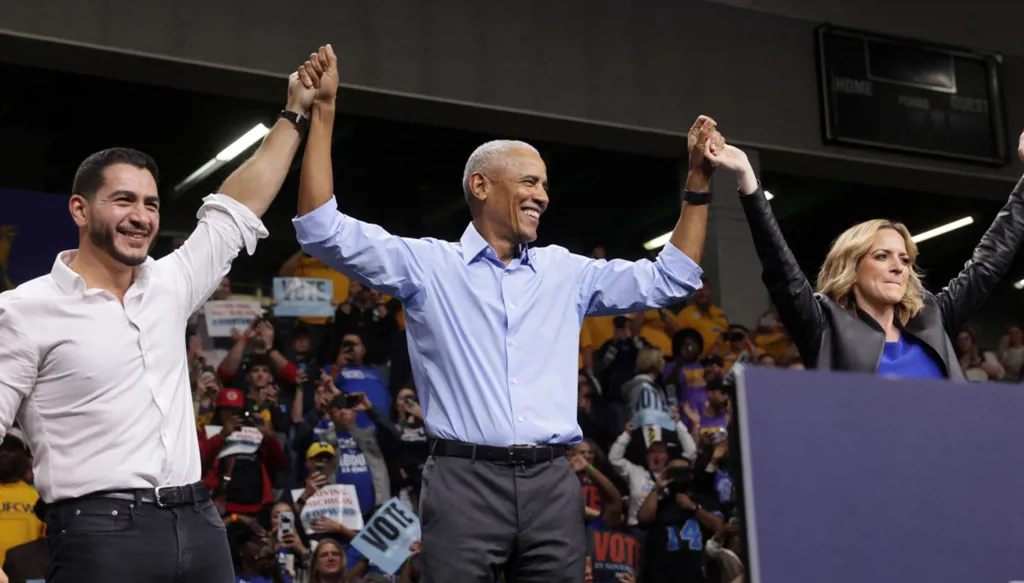
The decline in support for U.S. President Donald Trump among some Arab voters could shift the balance of the race in Michigan if it translates into votes for Democrats or coincides with disillusioned voters returning to the polls. Abdul El-Sayed's Senate candidacy also raises the possibility of attracting people who do not typically participate in midterm elections.
These possibilities carry weight in a state where Trump won in 2024 by a margin of 80,103 votes, according to official results. Ahead of the November 3 elections, a poll shows a close race between El-Sayed and Republican Mike Rogers. However, measuring the impact of Arab voters on the contest is more difficult than simply identifying their discontent.
Between declining support for Trump and Democrats' efforts to revive their voters' enthusiasm, the Arab vote in Michigan could carry weight in several ways. This report examines what election results and polls reveal about this shift, whether El-Sayed's candidacy could bring additional voters to the polls, and how these factors could influence a tightly contested Senate race.
Ray Hanania, a journalist and commentator who follows Arab American affairs, tells "Annahar" that Trump "lost a lot of support from the Arab American community, both Christian and Muslim" because of his position on Gaza and his support for Israel. He believes voters were drawn to Trump more as a protest against Democratic leaders than out of personal conviction, but now feel even more let down by him.
He highlights demands for lower property taxes, better education, and religious freedom, noting that many Arab leaders focus on Middle Eastern issues rather than addressing the full range of local priorities affecting their communities.
James Zogby, president of the Arab American Institute, cautions against reducing this shift to a simple transfer of Trump voters in a conversation with "Annahar." "Democrats will vote for Democrats, and Republicans will vote for candidates sharing their beliefs," he says. He expects Arab Democrats to be more enthusiastic about voting than they were in 2024, when anger over wars was accompanied by support for other candidates and abstentions.
Zogby believes El-Sayed has inspired the community and made its members proud, while Trump has angered them through his immigration policies, positions on Arabs and Muslims, support for Israel, and the war on Iran. The White House announced the launch of major military operations there on February 28, 2026. Zogby lists ending the war and discriminatory practices among the community's demands, alongside concerns over prices, taxes, healthcare, and education.
Nationally, a joint survey by "The Washington Post" and "Share" found that 58 percent of registered Arab voters support Democrats in congressional elections, compared with 34 percent who support Republicans.
Poll and political participation researcher Dr. Yousef Shahoud warns, in a conversation with "Annahar," against applying national findings to Michigan, arguing that the national survey tells us "very little, if anything at all" about the state's contest. Arab communities differ from one state to another, while the candidacy of an Arab American introduces a unique factor that national questions about party preferences do not capture.
Shahoud expects El-Sayed to encourage "a significant number" of people who are not accustomed to voting in midterm elections to participate. He attributes this potential mobilization to El-Sayed's clear positions on Israel and Gaza, as well as his public service image, while acknowledging the limited availability of reliable data on Arab Michiganders.
He explains that interpreting polls requires paying attention to who is included in their samples. Identifying as being of Middle Eastern descent does not necessarily mean identifying as Arab. Differences in respondents, particularly in small samples, may also account for some discrepancies between results without necessarily reflecting actual changes in attitudes.
He therefore cautions against treating every increase in Democratic support as evidence that Trump voters are switching sides. Some of that increase could instead come from voters returning to the polls. Understanding the impact of each factor requires knowing who actually participated and how they voted.
He also points out that identifying as independent does not necessarily mean distancing oneself from Democrats. Such voters may continue supporting Democratic candidates or avoiding Republicans. While previous voting patterns help predict turnout, El-Sayed's candidacy could attract people who do not typically participate in midterm elections, potentially strengthening Democrats through increased participation as well as changes in voting preferences.
In a Marist poll conducted from October 15 to 18 among 1,185 registered voters, El-Sayed leads among likely voters with 50 percent against 48 percent for Rogers, with a 4.3-point margin of error. Forty-three percent of respondents said their family finances had worsened over the past year. The poll's release does not provide a separate measurement of Arab voters.
Zogby expects El-Sayed to win but acknowledges that "nothing is certain." Anger towards Trump could prompt some voters to change their choice and others to return to the polls. The Arab vote's impact will depend on the scale of these shifts, while the available data remains insufficient to determine whether it will decide the race.