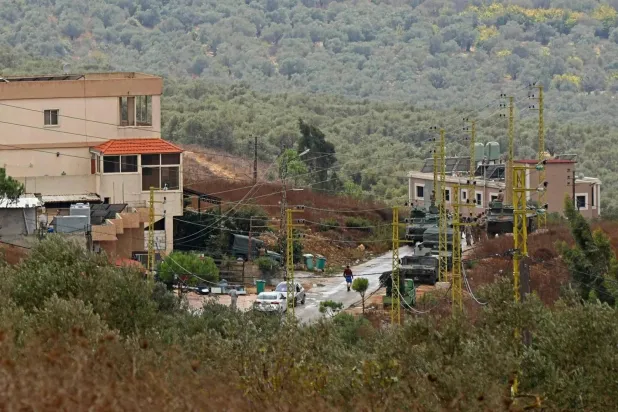
Tensions flared between the Lebanese army and Israeli forces on the outskirts of the southern Lebanese town of Deir Mimas on Friday after an Israeli unit advanced toward a newly established army position and demanded that it be evacuated. Contacts through the ceasefire monitoring “mechanism” helped contain the situation, and the Israeli force later withdrew to its position at Tall al-Nahhas. The Lebanese army maintained its deployment in the area and reinforced its presence along the main road in Burj al-Muluk. The confrontation began when an Israeli force advanced toward the outskirts of Deir Mimas, reaching an intersection near a position recently established by the Lebanese army to support local residents and secure their movement in the area, particularly during the olive harvest. According to information from the scene, the Israeli force ordered Lebanese soldiers to dismantle the position and leave the area before throwing stun grenades nearby in an attempt to drive them away. The incident prompted a military alert but no exchange of fire. The Lebanese army initially sent reinforcements to the newly established position, as contacts were initiated through the relevant military channels to prevent the confrontation from escalating. Dispute over position’s location The Israeli military said the Lebanese position was located inside what it calls the “Yellow Line,” an Israeli designation for the area that Lebanon does not recognize as an official border or demarcation line. The military coordination group for Lebanon, operating under the “mechanism,” intervened to address the dispute. Intensive contacts sought to prevent the confrontation from developing into a direct clash between the two armies. The Lebanese army temporarily evacuated the contested position during efforts to resolve the standoff, allowing the Israeli force to move into the area for a limited period. The Israeli troops withdrew about 90 minutes later from the position near the entrance to Deir Mimas and returned to their post at Tall al-Nahhas. Lebanon’s state-run National News Agency said Israeli troops searched several homes in Deir Mimas during their presence in the area. The Lebanese army, meanwhile, maintained its deployment, with units remaining stationed along the main road in Burj al-Muluk as they monitored Israeli movements and other developments along the route. The confrontation was among the most significant recent incidents of direct contact between the Lebanese army and Israeli forces. It centered on a dispute over the location of an army position and occurred as discussions continued through the “mechanism” over conditions in southern Lebanon and the Lebanese army’s deployment there. Israeli movements on several fronts The tensions in Deir Mimas coincided with Israeli movements elsewhere in southern Lebanon. Israeli military vehicles advanced from the direction of the town of al-Tiri toward the outskirts of Hadatha, near Haris in the Bint Jbeil district. Israeli artillery shelling also resumed on Friday morning against the towns of al-Mansouri and Majdal Zoun following heavy bombardment before and after midnight. Explosions were heard in the city of Tyre and several surrounding towns and villages. Several shells struck Wadi al-Azziyeh, while artillery fire also hit Wadi Nahle on the outskirts of Shaqra. Israeli forces fired illumination flares over the towns of Hadatha and Aita al-Jabal in the Bint Jbeil district overnight. Explosions were heard at dawn across large parts of southern Lebanon, reaching the city of Sidon and its surrounding areas. The escalation comes as political and military contacts continue over the implementation of arrangements for southern Lebanon. Confrontations on the ground have repeatedly occurred at several locations amid continuing Israeli movements and military operations along the border region and inside a number of southern towns.