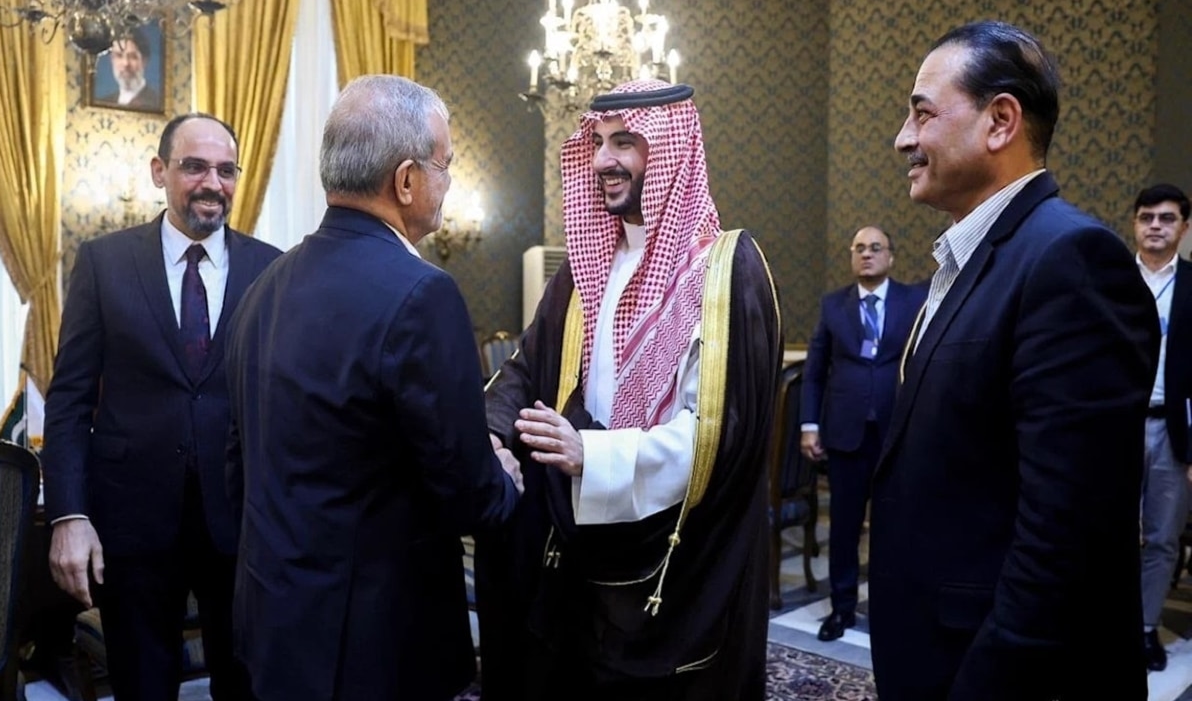
Saudi Defense Minister Khalid bin Salman, Pakistan’s army chief Asim Munir and Türkiye’s intelligence chief Ibrahim Kalin arrived in Tehran on Monday for talks with senior Iranian officials, including President Masoud Pezeshkian, Foreign Minister Abbas Araghchi and Supreme National Security Council Secretary Mohsen Rezaei. Iranian officials said Munir initiated the visit after informing Tehran of the three countries’ decision during a trip to Iran last week. The Mecca Pact, established as a framework for collective deterrence, has faced two simultaneous challenges just two months after its formation. It must demonstrate its ability to counter attacks from Yemen while preventing its members from being drawn into a potential US-Israeli war against Iran. These pressures have driven the alliance to seek Tehran’s help. Saudi Arabia’s Foreign Ministry said the visit aimed to de-escalate the current crisis, encourage dialogue and diplomatic solutions, and support mediation efforts by Qatar and Pakistan. However, the most immediate concern appears to be the escalating confrontation between Riyadh and Sanaa. In recent days, following its reported takeover of the Bab Al-Mandab Strait, Yemen’s Ansar Allah movement launched extensive attacks on major Saudi airports, particularly Riyadh airport, as well as military bases and energy facilities. Saudi Arabia responded with dozens of airstrikes on Yemen. Riyadh, a key member of the Mecca Pact, expected the alliance’s collective defense mechanism to kick in, with Pakistan and Türkiye coming to its aid. Both countries expressed reservations about direct intervention because of the potential consequences for their own interests. This has left the pact’s commitments looking like little more than words on paper, even to Saudi Arabia itself. The three-country delegation therefore had a clear objective, mainly to use Iran’s influence to persuade Ansar Allah to halt its attacks. During his previous visit, Munir directly asked Iranian officials to use their ties with the movement to achieve that goal. The request amounted to an implicit acknowledgment that the Mecca Pact could not resolve the Yemen crisis on its own and that even strong collective defense arrangements might prove ineffective without Iranian cooperation. Iran may influence Ansar Allah through its ties with the movement, but that does not mean the group takes orders from Tehran or would accept an agreement reached by the four governments without conditions. Meanwhile, Tehran saw the visit as an opportunity to demonstrate that it holds a key to de-escalation in Yemen and the wider region, rather than Riyadh, Islamabad or Ankara. Iran argues that regional security should rest on cooperation among regional states, without US intervention. Iran’s official news agency described Tehran’s participation in the talks as a “prerequisite” for establishing a new security framework in the Gulf. Ali Bagheri, deputy secretary of Iran’s Supreme National Security Council, said Iran and the three visiting countries could work together to establish an “indigenous regional security system,” drawing on what he described as Iran’s successful experience in safeguarding national security during the recent war. Pezeshkian, for his part, told the three visitors that Tehran supported “any understanding that would strengthen regional security” and expressed his country’s readiness to “take steps toward regional cooperation and resolving disputes.” However, prospects for easing tensions in Yemen remain uncertain. Iran may influence Ansar Allah through its ties with the movement, but that does not mean the group takes orders from Tehran or would accept an agreement reached by the four governments without conditions. Ansar Allah has its own domestic and regional interests and demands. Even if the delegation sought Iran’s help to contain the current fighting, a successful outcome would require direct or indirect talks with Ansar Allah itself and efforts to address the political roots of the Yemen crisis. Iran could facilitate such negotiations. The confrontation between Ansar Allah and Saudi Arabia also cannot be separated from the conflict between Iran and the US. Both crises are unfolding within the same regional context. Tehran’s willingness to help reduce tensions in Yemen is therefore uncertain unless the US-Israeli war against Iran also ends. Iranian officials have repeatedly insisted that the conflict must end on all fronts across the region. The second, more strategic reason for the visit is growing concern about another US-Israeli attack on Iran. Multiple reports suggest Washington and Tel Aviv are preparing for what would be a third war. Depending on its intensity and Iran’s response, which Iranian officials have described as potentially more destructive, such a conflict could have far-reaching consequences for countries across the region, including members of the Mecca Pact. From this perspective, the delegation’s visit was also an effort to create diplomatic space and reduce the risk of miscalculation. Pakistan is seeking to strengthen its role as a mediator through its ties with Iran and its contacts with Arab states and the US. Türkiye has also sought to maintain channels of dialogue with different regional actors. Saudi Arabia has a direct interest in preventing a war that could threaten its borders and energy infrastructure. Riyadh also recognizes that the cost of a military confrontation with Iran or its allies would far exceed the cost of reaching an agreement or understanding to ease tensions. The visit therefore reflects a shared interest among Mecca Pact members in preventing the crises in Yemen and the wider region from spiraling out of control. This is an edited translation of an article originally published in Arabic.