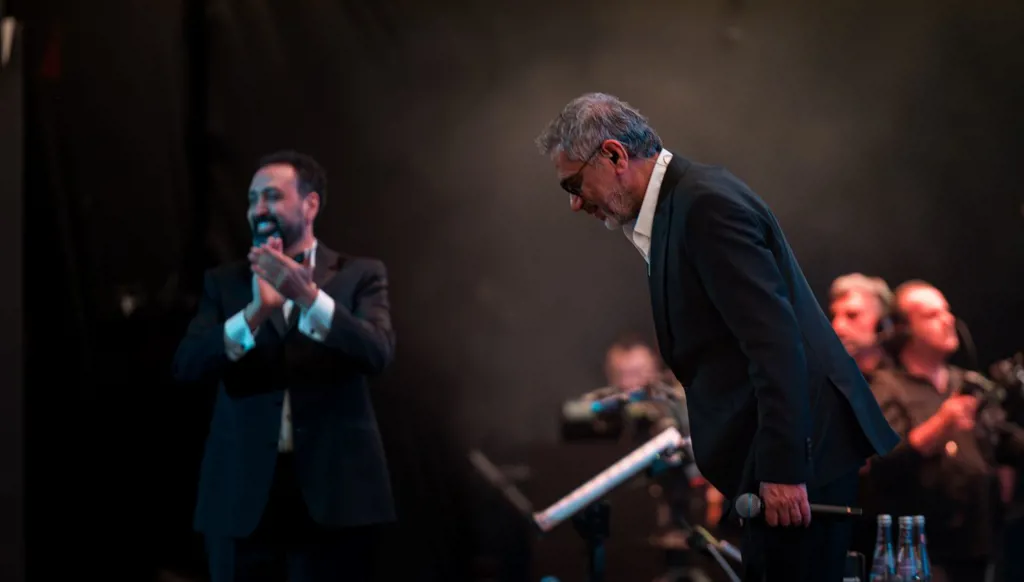
Fadel Chaker, “the Ghayeb” (the absent one), has returned, bringing with him a feeling unlike any other and a musical brilliance that made his comeback far more than a fleeting appearance. Behind the voice that captivated audiences was a musical story brought to life by 85 musicians from different nationalities and musical traditions. United in a single ensemble, they gave his songs a rich musical dimension and added an exceptional touch to his return.
This comeback required extensive musical preparations, culminating in two performances titled “Awdat Al Ghayeb” (The Return of the Absent One) at the Abu Bakr Salem Theatre in Riyadh on October 22 and 23, 2026, as part of Riyadh Season. The orchestra accompanied his songs with live arrangements.
At the heart of this experience was maestro Majd Jreideh, who conducted the orchestra at both concerts. In an exclusive interview with Annahar, Jreideh recalls his emotions throughout the experience and reveals what went on behind the scenes, from selecting the musicians and preparing the arrangements to rehearsals and the details leading up to the performances. He also reflects on the moments that remained etched in his memory while working alongside Fadel Chaker.
He describes conducting the orchestra at the two “Awdat Al Ghayeb” (The Return of the Absent One) concerts as “like a dream,” explaining that his emotions were too overwhelming to put into words.
“It was an incredible, indescribable feeling, like a dream. My emotions were overflowing beyond measure, and I felt as though I were flying with joy, especially when I met Fadel and we held the rehearsals. Then he sang, I played, and the orchestra performed,” he told Annahar.
Jreideh reveals that Fadel Chaker asked him from the outset to put together an orchestra of international calibre. This presented him with a challenge that pushed him to seek a combination of professionalism, experience and emotion.
“When I spoke with Mr. Fadel about the preparations, he told me, ‘I want a world-class orchestra, Majd. I want the finest orchestra in the world.’ His words had a profound impact on me, so I decided to deliver exactly that: a world-class musical ensemble.”
The orchestra brought together musicians from ten nationalities: Lebanese, Syrian, Jordanian, Iraqi, Egyptian, Turkish, Greek, Brazilian, Russian and American.
Jreideh began preparations approximately one month before the first concert in Riyadh. His work extended beyond selecting the musicians to include preparing the arrangements and coordinating communication among the orchestra members to ensure harmony between the different musical sections.
Recalling the rehearsals, he says the musicians’ professionalism and precision were remarkable. Despite their different nationalities and musical backgrounds, he felt as though they had been playing together for many years.
He adds that the musicians made a point of practising individually before the group rehearsals, helping speed up the process and achieve the desired cohesion. These groups included the wind section, strings, percussion and choir, allowing the team to focus on musical details and exchange feedback more precisely.
As for the musical notation, he explains that he prepared scores for approximately 60 to 70 songs for the string section, along with a similar number of scores for the solo instruments that carry the main melody. In total, he worked on around 120 to 140 musical scores.
One moment that remained etched in Jreideh’s memory was Fadel Chaker’s admission that he felt nervous before the two concerts. The maestro believes this statement reflects the artist’s humility, but it contrasts with the commanding presence and confidence he witnessed on stage.
“What struck me most was when Mr. Fadel Chaker said he was feeling nervous. I believe this reflects just how humble he is, but what I saw on stage was the complete opposite,” he told Annahar.
He adds that returning to the stage after approximately 14 years away, standing before such a large audience, and performing amid extensive preparations, fully equipped sound and lighting systems, and an orchestra of this size requires exceptional artistic ability.
Jreideh also revealed that further concerts with Fadel Chaker are in the works, with surprises being prepared for Al Khobar, Qatar, Jordan and Abu Dhabi. He said he could not disclose any details at this stage.
He explained that the overwhelming demand in Abu Dhabi and the sellout of tickets led to the organisation of an additional concert to accommodate the large number of people hoping to attend. He added that Fadel Chaker is “a very special phenomenon in the Arab world.”