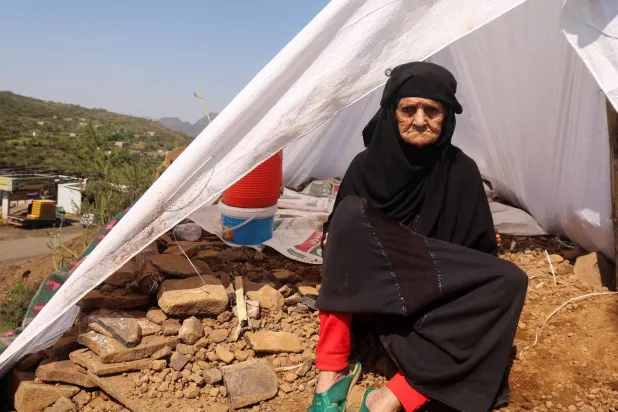
As fighting escalates once again in Yemen's long-running war, thousands of families have been forced from their homes, many of them for a second or third time. In the Al-Farsi camp in Aden, Arwa told AFP how she, her husband and their four children left Mokha on Yemen's western coast as it was seized by Iran-backed Houthi fighters. They shared a single motorcycle to travel 200 kilometers, first to Al-Arah in the Lahj governorate and then on to Aden, temporary seat of Yemen's government. "We couldn't find any means of transport... We stayed out in the cold and didn't have clothes to keep us warm," Arwa told AFP at the camp, where sat on the ground by a tent. The camp currently hosts 128 families living under canvas along dirt paths where barefoot children run. Their tents are sparsely equipped -- some bedding, cooking pots, and a few clothes and belongings that the families managed to bring with them when they ran. It is not the first time Arwa has been forced to flee her home. Nine years ago she left Maqbanah in Taiz governorate to head to Mokha, also because of the war. "I hope I can find a house to live in with my children. We're exhausted by the heat, the dust and the humiliation," she said. "I hope the situation improves and we can return to our home and our families." Armin Yedgarian, a representative of the UN High Commissioner for Refugees, said the camp was "in dire need of more support", adding that its 8,800 inhabitants included many elderly people and women with children. International organizations, including the World Food Program, distribute meals to the displaced. Arwa received a portion of rice to feed her children. But she regrets that her seven-year-old daughter, her only school-aged child, has not been attending class since the family was forced to head to Aden. - No schooling - At Aden's Al-Firdaws camp, which currently shelters about 110 families who arrived over the past two weeks, the acting representative of UNICEF's office in Yemen, Obiya Atchieng, told AFP that families' needs were not limited to food and basic supplies. "Most of the children were enrolled in schools," he says. "Our team carried out a field visit to assess the possibility of providing education services." Last week, UNICEF said 57,000 children had been displaced inside Yemen in just two weeks and 243 schools had been closed or suspended, affecting more than 137,000 students. Even before the latest escalation, 3.2 million school-age children were not enrolled. After years of relative calm, Yemen's civil war flared back to life in July against the backdrop of the broader conflict in the Middle East. In the past 10 days, a surprise Houthi offensive enabled the group to expand its areas of control as far as the strategic Bab al-Mandeb Strait linking the Indian Ocean to the Red Sea, and by extension, the Suez Canal. - 'Hearts beating' - As a result of a 2022 ceasefire, those under the age of four have not previously experienced conflict of this intensity. "The sounds of explosions were new to the children, and now any loud noise unsettles them, even if it's a motorcycle," said one 39-year-old father of two who remained in Mokha despite the Houthi takeover. "I try to reassure them and convince them there is no danger. But even when they're in my arms, I can feel their hearts beating rapidly against my chest." The man said he had been displaced from the city of Hodeidah eight years ago, and had no desire for it to happen again. Noha, a housewife and mother of two children aged eight and 10, said she broke down in tears when she heard they were fleeing from Al-Khokha in western Yemen -- which the Houthis captured less than two weeks ago -- to her husband's family home in Aden. "Because I cried, the children cried. We left in a bus with our neighbors and I haven't been able to make the children feel safe." "Today I learned that my neighbor, a mother of six children who was in her final month of pregnancy, was also displaced and died in Aden two days after we arrived because of postpartum hemorrhage," she said. "The newborn baby girl is in the incubator, and the other children and her husband are in a terrible, miserable state."