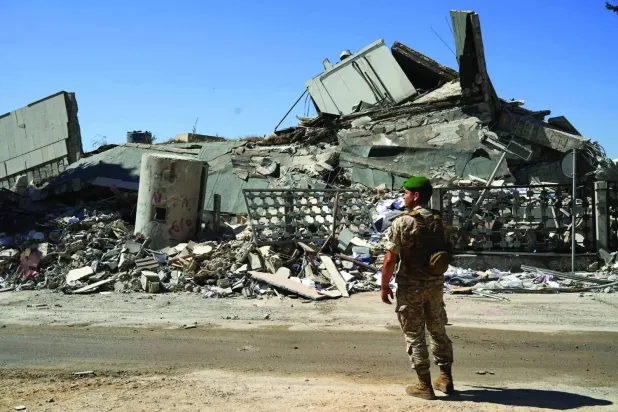
Lebanese parliament Speaker Nabih Berri rejected the establishment of any “buffer zones or security belts” in South Lebanon, stressing that the state bears responsibility for protecting and defending the area and rebuilding what has been destroyed by Israeli attacks. He also renewed his opposition to direct negotiations with Israel “under fire,” arguing that previous rounds of talks had produced no results. In a speech marking the 48th anniversary of the disappearance of Imam Moussa al-Sadr, Berri declared that “civil peace, national unity and the Lebanese Army are red lines that must not be crossed or undermined,” reaffirming his commitment to the army’s authority in the South, alongside UN peacekeeping forces. He rejected attempts to cast doubt on the army’s role and called for it to be provided with all necessary support. “The South is an integral part of Lebanon, and responsibility for protecting and defending it alongside its people, and for rebuilding what Israeli aggression has destroyed, rests with the state,” Berri declared. “We will not accept buffer zones or security belts in the South.” Turning to negotiations with Israel, he reiterated his warning against direct talks while hostilities continue. “We warned against direct negotiations with Israel under fire, while the rounds of negotiations have yielded no results,” he noted. He also renewed his opposition to the “framework agreement” between Lebanon and Israel, declaring: “We had exercised our democratic right to reject the agreement, and we maintain that position.” He said that the current stage, given “existential risks facing South Lebanon and the country as a whole, does not give anyone the right to act on any sovereign issue under any designation, whether a framework agreement or secret articles.” Berri also stressed his opposition to relinquishing Lebanon’s right to prosecute Israel over “crimes of genocide” committed against South Lebanon. He argued that the war with Israel “requires a national approach removed from any regional, partisan, sectarian or confessional considerations,” warning against attempts to push Lebanon toward internal divisions. “What Israel seeks is not Hezbollah, its weapons, the Amal Movement or the Shiite community. Israel wants strife,” he asserted, adding that “Lebanon represents the antithesis of Israel’s racism.” He urged the Lebanese to avoid internal conflict, saying: “Do not lose Lebanon to internal wars, divisions, or fatal political or security missteps.” On domestic affairs, Berri reaffirmed his commitment to the Taif Agreement, maintaining that “all partition and federalism projects are incompatible with this accord.” His remarks come amid growing domestic political debate over sovereign and security issues and the future of South Lebanon, as Israeli attacks continue and the negotiating track remains deadlocked. On regional developments, Berri expressed “support for all Arab and Pakistani efforts to end tensions and establish stability in the Gulf region.” He also paid tribute to “all brotherly and friendly countries that have stood and continue to stand by Lebanon.”