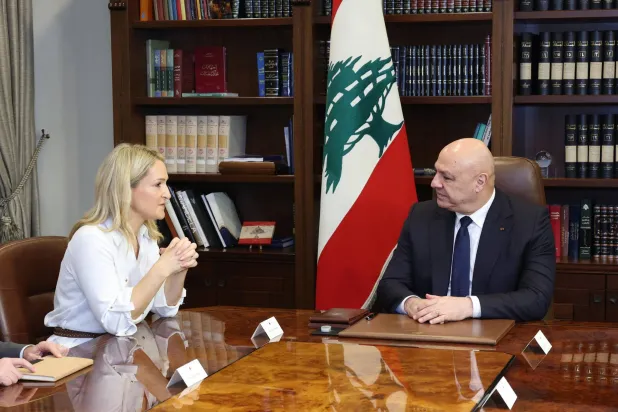
Lebanese President Joseph Aoun accused Israel of obstructing the implementation of a US-brokered agreement through continued attacks on southern Lebanon, saying Beirut’s contacts with Washington to halt the strikes have so far yielded no results. The president also reiterated Lebanon’s desire to extend the mandate of the United Nations Interim Force in Lebanon (UNIFIL) beyond this year, expressing openness to a European replacement force and warning that an international security vacuum in the south could threaten regional stability. A photograph taken during a media tour organised by the French Catholic charity L'Oeuvre d'Orient shows peacekeepers with the United Nations Interim Force In Lebanon (UNIFIL) patrolling near the southern Lebanese village Biout es Sayed on July 20, 2026. (Photo by Anwar AMRO / AFP) During a meeting with Irish Minister for Foreign Affairs and Trade and Minister for Defence Helen McEntee, Aoun accused Israel of failing to honor the agreement reached during negotiations in Washington. He said Israeli forces continued to bombard southern villages and towns, destroy property and bulldoze homes. The Lebanese leader stressed that Israel’s actions were preventing the Lebanese Army from extending state authority to the international border, ending the presence of armed groups and restoring stability. He called on friendly countries, including Ireland, to press Israel to end its attacks, withdraw from South Lebanon and release Lebanese prisoners. Such steps, he noted, would allow the Lebanese state to rebuild devastated communities and enable displaced residents to return home. Warning Against Security Vacuum in South Lebanon Turning to UNIFIL’s mandate, which expires at the end of the year, the president reaffirmed Lebanon’s wish for the peacekeeping force to continue its operations throughout 2027. He emphasized its role in monitoring developments in South Lebanon and supporting the Lebanese Army as it deploys to the international border following an Israeli withdrawal. UNIFIL also provides humanitarian, social and healthcare assistance to residents of southern villages, he underlined. If an extension proves impossible, Beirut would welcome the participation of a European force under arrangements agreed with the European Union or individual European countries, in cooperation with the United Nations. The Lebanese head of state warned that UNIFIL’s departure without a replacement could leave a security vacuum in the south, with potentially damaging consequences for regional stability. He added that logistical and technical assistance from an alternative force could facilitate the army’s mission and improve living conditions for southern communities. Aoun receiving Irish Foreign Affairs and Defense Minister and the accompanying delegation (Lebanese Presidency) Government Presses Ahead With Reforms On domestic affairs, Aoun affirmed that the government was pursuing economic and financial reforms in cooperation with parliament despite the difficult circumstances facing Lebanon. He welcomed potential Irish assistance in the humanitarian, social, military and educational sectors. The president also thanked Ireland for its contribution to international peacekeeping operations in South Lebanon since 1978 and paid tribute to Irish soldiers killed while serving there. McEntee welcomed the opportunity to visit Lebanon, assess conditions firsthand and meet Irish troops deployed in the south. She reaffirmed Ireland’s commitment to participating in peacekeeping operations, supporting the Lebanese Army and civil society, and working with public institutions to deliver needed assistance. The Irish minister stressed that her country would continue supporting Lebanon despite the difficult circumstances facing the region.