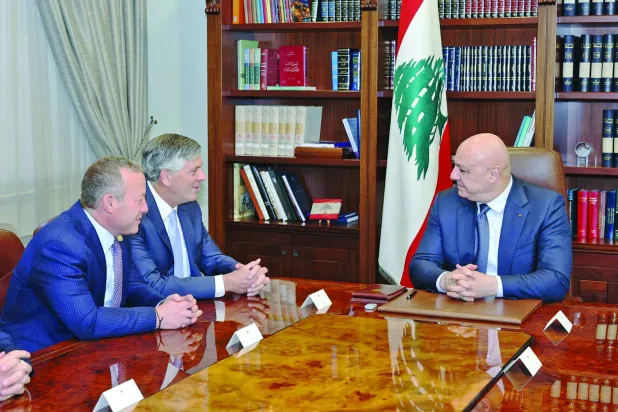
Lebanon’s top leaders urged Washington to pressure Israel to implement agreements and halt its operations in South Lebanon, while stressing the need for continued support for the Lebanese Army and pledging to press ahead with economic, financial and political reforms. The messages emerged from President Joseph Aoun’s and Parliament Speaker Nabih Berri’s meetings with US Reps. Darin LaHood and Josh Gottheimer, as well as Prime Minister Nawaf Salam’s talks in Washington. Aoun told the US lawmakers that Lebanon was placing considerable importance on Washington pressuring Israel to implement the “framework agreement” reached through Lebanese-US-Israeli negotiations in Washington. Lebanon remains fully committed to the agreement, while Israel continues to disregard its provisions, Aoun stressed, according to a Lebanese presidency statement. He stressed the need to halt demolition, bulldozing and destruction activities in the southern villages occupied by Israel, arguing that implementing the agreement required accelerating the return of Lebanese prisoners, resolving disputed points along the Blue Line and a gradual Israeli withdrawal from Lebanese territory alongside Lebanese Army deployment up to the internationally recognized southern border. Aoun warned that continued delays would prolong tensions in the south and hinder the state’s ability to extend its authority throughout its southern territory, remove armed manifestations and return displaced residents to their villages and towns. He also underscored the need to provide the Lebanese Army with the resources required to carry out its wide-ranging duties, from combating terrorism and smuggling and securing borders to protecting institutions and maintaining civil peace. On domestic affairs, Aoun reaffirmed the government’s commitment to financial, economic and judicial reforms, pointing to legislation including amendments to the banking secrecy law, bank restructuring and the media law. LaHood described the current situation as an opportunity to restore stability to Lebanon and the wider region and affirmed continued US assistance to Lebanon and its army through military aid provided by the administration with congressional approval. Berri, meanwhile, focused on the continuing Israeli operations in Lebanon, arguing that Israel’s failure to fulfill its obligations under agreements reached to end the war was the main obstacle to their implementation. He reiterated that the US administration and President Donald Trump had the ability to pressure Israel to halt its war on Lebanon, warning that its continuation would undermine efforts by the state and its institutions to carry out their roles, according to a statement from the parliament speaker’s office. Berri welcomed assistance to the Lebanese Army but stressed the need to avert a failure to renew the mandate of the UN Interim Force in Lebanon, or UNIFIL, noting that there was still time to prevent such a step. During a separate meeting with a British military delegation, he emphasized the importance of maintaining a UN umbrella and flag for any force assisting the Lebanese Army after Israel withdraws from occupied Lebanese territory. Deputy Prime Minister Tarek Mitri also presented Berri with a documented report on crimes committed by Israeli forces in South Lebanon. Berri maintained that Lebanon’s right to pursue Israel over those acts was a “sovereign right” that could not be relinquished. In Washington, Salam discussed economic and financial relations with US Treasury Secretary Scott Bessent, along with financial and banking reforms, negotiations with the International Monetary Fund and cooperation with the World Bank. Salam outlined government measures to address the repercussions of Lebanon’s financial crisis and rebuild the banking sector, while seeking US support for reforms and economic recovery. Discussions also covered efforts to curb the cash economy and strengthen transparency, compliance and measures against money laundering and terrorism financing. Meeting young Lebanese in Washington, Salam linked domestic reform with full state sovereignty, stressing that state-building rested on two inseparable tracks. “There can be no state with two armies, and no state with two decision-making authorities,” he declared, reaffirming the government’s determination to pursue reforms and extend state authority across all Lebanese territory. Salam stressed that government success should be measured not only by laws and projects but by its ability to build a country where young people see a future, making the return of Lebanese from abroad “a choice, not a sacrifice.” He called for a state that respects its citizens and provides a trustworthy judiciary, a productive economy and an effective administration, urging Lebanese abroad to remain engaged through their expertise, investments and connections. “Judge us by our work; judge us by the results,” Salam concluded.