Lebanon PM Stresses Need to 'Avert Vacuum' if UN Force Leaves
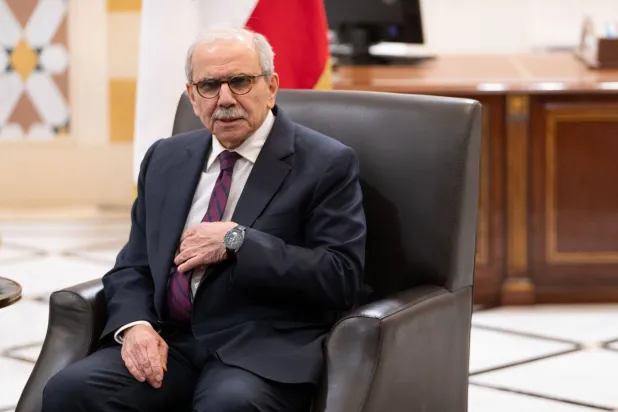
Lebanon's Prime Minister Nawaf Salam insisted at the UN Friday on the need to "avert the vacuum" that would be caused by withdrawing the UN peacekeeping mission deployed in the south of his country without a viable replacement.
"What we wish to stress here and today is the need to avert the vacuum that UNIFIL's withdrawal could create, were it to take place without agreement on a new international force to replace it," he said.
Washington Keeps Sights on Dismantling Militias Despite Iraq Withdrawal
Iraq reached a watershed on Wednesday as US forces withdrew from their bases nearly a quarter-century after an invasion that killed hundreds of thousands of Iraqi civilians and thousands of American troops, opened the door to Iranian interference in Iraq and beyond, and upended the regional balance of power.
The withdrawal fulfills a 2024 agreement signed by the administration of former President Joe Biden to end the US military presence in Iraq this year.
President Donald Trump’s administration has made little fanfare about the redeployment. It has yet to announce a comprehensive review of the invasion, which began in March 2003 and inflicted staggering human and financial losses.
As many as 210,000 Iraqi civilians were killed between the invasion and 2023, along with 4,599 US troops, according to Brown University’s Costs of War project. The cost reached about $2.8 trillion.
The departure of US troops and equipment marks a transition from a wartime coalition mission to an Iraqi-led security effort, according to Pentagon spokesman Sean Parnell.
“The primary responsibility for addressing Iraq's remaining security challenges, including ISIS remnants and Iran-aligned militias that undermine Iraqi sovereignty and regional stability, now rests with the Government of Iraq,” he added.
About 1,500 US and international coalition troops fighting ISIS had recently been stationed in Iraq as forces reorganized and withdrew ahead of Wednesday’s Sept. 30, 2026, deadline, a US official said.
The mission will continue in Jordan, where the Pentagon says it can strike militants threatening US personnel and interests.
US forces there will focus on ISIS fighters, the official said.
“If the situation deteriorates beyond Iraq’s and Syria’s ability to control it, and they ask for our help, we will intervene and help them.”
The military airlifted personnel and equipment out of Erbil, the last US military base in Iraq, in time to meet Wednesday’s deadline, a defense official said.
Some US Marines will stay to guard American diplomatic missions, alongside contractors maintaining Iraq’s fleet of F-16 fighter jets and US-made tanks, current and former US officials said.
“The military has already removed a Patriot air defense battery stationed around Erbil,” other officials said.
The United States will probably concentrate its remaining air defenses on protecting its embassy in Baghdad and consulate in Erbil, they added, despite continuing attacks by Iran and militias.
About 170,000 US troops were in Iraq at the height of its internal conflict in 2007. Former President Barack Obama pledged to end the war after his election in 2008. In 2011, he announced an end to combat operations and a phased withdrawal.
But ISIS and al Qaeda seized large swaths of Iraq and Syria in 2014, prompting the United States to lead a coalition of international and Arab partners in launching Operation Inherent Resolve. The campaign continued into Trump’s first term.
Iraq reclaimed its territory from terrorist groups and began to recover. Yet it remains burdened by the influence Iran gained through allied armed groups, whose involvement in the current US-Iran war poses serious risks.
US estimates put the number of Tehran-aligned fighters at more than 200,000. They use attack drones and ballistic missiles to strike US forces and neighboring countries.
The US withdrawal was supposed to coincide with the disarmament of militias, according to The Washington Post. But the groups ignored calls to disband, and Iraqi Prime Minister Ali al-Zaidi extended their disarmament deadline to June 2027.
Iran could benefit from the US withdrawal, Mark Cancian, a senior adviser at the Center for Strategic and International Studies in Washington, told the newspaper. But Tehran’s recent actions in the region have also forged unexpected alliances against it.
The invasion plunged Iraq into chaos by toppling President Saddam Hussein, Iran’s adversary on its western border, Cancian said.
Iranian attacks on countries hosting US troops during the latest war have pushed some of those countries closer to Israel, he added.
“We acted against them only in response to attempts to target our troops,” a US official said of Iran-backed militants.
Confronting the groups from now on would be “an Iraqi responsibility.”
As Iraq holds a “sovereignty celebration” this week to mark the withdrawal, the Trump administration is piling pressure on Baghdad to disarm Iran-backed militias. Many defy the state’s efforts to bring them under control.
Al-Zaidi’s government faces a daunting task: reining in militias that Iran insists on preserving.
Speaking to The New York Times, the Iraqi prime minister noted that every Iraqi today wants full sovereignty for their country.
He added that Iraqis also want authority to rest exclusively with the state, and pledged to end “the law of the jungle” in Iraq.
During al-Zaidi’s recent White House visit, Trump said: “We don’t think we need the military there anymore.”
“We have a great champion, a new champion. He’s young and handsome,” he added.
But Victoria Taylor, a former US State Department official who worked on Iraq, explained that believing al-Zaidi can disarm the militias within a few months is asking the impossible.