As diplomatic efforts struggle to secure international backing and UNIFIL’s departure draws closer, Lebanon faces mounting pressure over the future of the south and the terms of any potential security arrangements.
The Lebanese state is pursuing Arab and international avenues in an attempt to halt Israel’s advance southward and secure a UN umbrella to avert the dangers of a security vacuum once UNIFIL’s mission comes to an end.
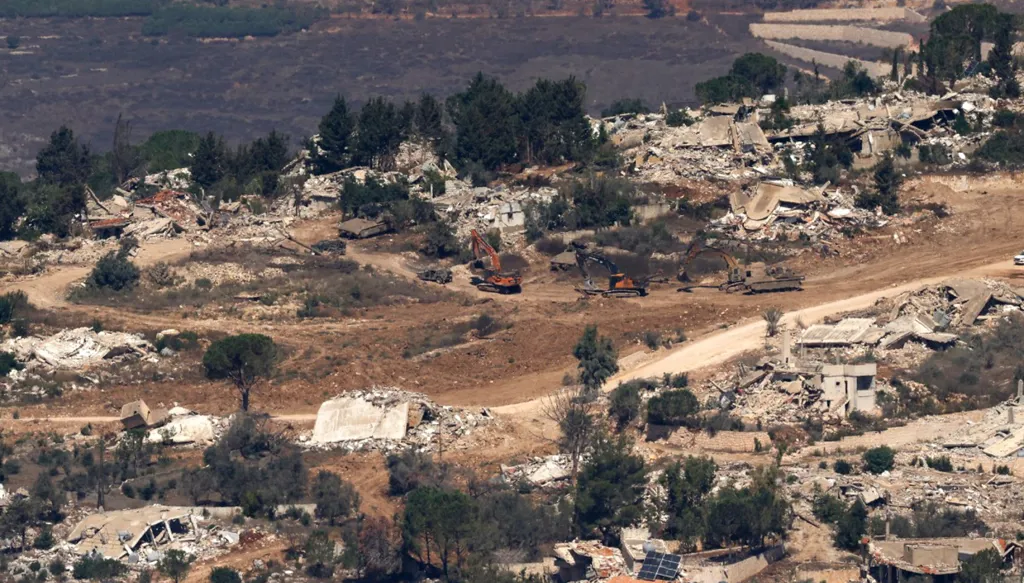
Despite the European initiative to establish an alternative international force, efforts have failed to persuade the United States to support an extension of UNIFIL’s mandate or the creation of an alternative force. Meanwhile, Israel is entrenching the security vacuum under occupation, indicating that its aim is to keep the buffer zone without international oversight and emptied of residents, while moving negotiations to the area it controls north of the Litani River, where it exerts control through fire and airstrikes.
While Lebanon reaffirms its commitments to the international community in an effort to strengthen its negotiating position in the face of tough Israeli demands, the government continues to reiterate the decisions it has taken on restoring state authority and placing arms under state control in order to secure support and assistance. Yet it has been unable to make any breakthrough. Negotiations remain stalled amid Israeli control and demands to dismantle Hezbollah’s military, financial, healthcare and educational infrastructure. Washington backs these demands without giving the Lebanese state any leverage with which to confront those opposed to negotiations, at least by securing an Israeli withdrawal from occupied areas in the south.
There are still no indications that countries have decided to provide assistance to Lebanon, as such assistance remains conditional on the disarmament of "Hezbollah," amid international talk of efforts to isolate the group in Lebanon. Meanwhile, Israel is consolidating its occupation along the Yellow Line and laying the groundwork for an expansion toward villages and towns in Nabatieh and Tyre, creating realities that will be difficult to confront in the next phase, both on the ground and at the negotiating table. This is particularly true as UNIFIL’s departure draws closer and Resolution 1701 is set aside. Lebanon is thus facing a deeply troubled reality in which, under the Israeli blockade and Hezbollah’s continued opposition and hardline stance, it will be unable to confront Israeli demands or any proposed formulas for security arrangements. Even the negotiating agenda, should talks resume, will be significantly reshaped by Israeli military force.
Lebanon will face what may be its most difficult circumstances in the coming months, beginning with the challenge of addressing the situation in the south, which Israel is exploiting for electoral purposes, as well as the possibility of further advances. This will also unfold amid an implicit US position that enables Israel’s aggressive actions, while at the same time putting pressure on the Lebanese state and the Lebanese Army to confront Hezbollah. This further strains the domestic situation amid displacement and the burdens it creates, as well as the risk of demographic change in several areas. Hezbollah could exploit this to turn its confrontation against the state and stir tensions internally, while adhering to Iran’s position and betting on changes along the Hormuz and Bab el-Mandeb fronts in an effort to rebuild what it calls the “balance of deterrence” and establish new rules of engagement after losing strategic positions and being unable to retain control over the territory.
Hezbollah does not appear to be reckoning with the reality created by its war of support in the south. Instead, it is shirking the responsibility it should bear for policies of unilateralism and dominance that led to the occupation and weakened Lebanon. Even as it addresses the issue of the displaced, it places the burden and consequences of a war it initiated on the state, while Israel has been waiting for opportunities to use various pretexts for its war. Today, Israel occupies the land and is wiping out all forms of life in the occupied areas and may be preparing to replicate the Ali al-Taher scenario in Nabatieh and deeper into the south.
The worst possible scenario would be for Hezbollah to cling to the slogans that led to Lebanon’s defeat and attempt to exploit the catastrophic consequences for political gain at home, while its officials turn a blind eye to Israeli incursions and the emptying of villages of their residents, further deepening the displacement crisis. They have yet to take an initiative that would meet the state halfway, allowing it to assume the lead and work toward forging a unified Lebanese position, one that Hezbollah remains far removed from. On the contrary, it continues to defy the situation despite the losses, insisting on its claim of victory on the grounds that Israel failed to achieve its objectives, even as Israel consolidates its occupation. And this is where the real danger lies.
Disclaimer: The opinions expressed by the writers are their own and do not necessarily represent the views of Annahar
Thank you for subscribing to our newsletter

