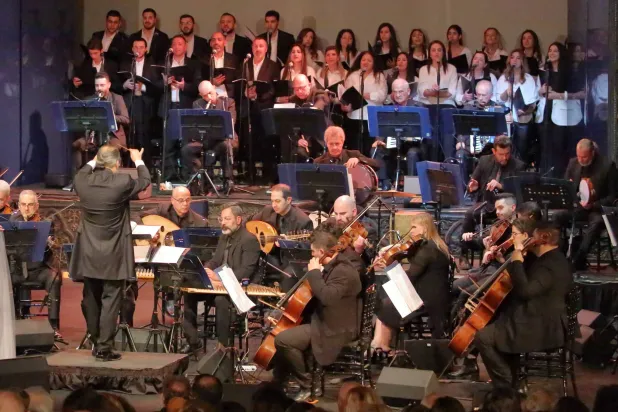
The Lebanese National Orchestra for Oriental Arabic Music will hold a concert on November 11 honoring legendary composer Mohammed Abdel Wahab, titled "In Love with Abdel Wahab, the Musician of Generations, and Eternity." Lebanese singer Nadine Awad will perform a selection of the late composer's masterpieces at Casino du Liban. The occasion will mark a milestone in her artistic career, as she becomes the first Lebanese female singer to perform Abdel Wahab's "Min Ghair Leih" in its entirety onstage. Maestro Andre Hajj, the orchestra's conductor and the artistic director of the evening's musical program, said his decision to feature a female voice stemmed from his confidence in Awad's talent and the vocal maturity that qualified her for the challenge. "Nadine is the daughter of the late musician Fouad Awad. We worked together at a concert about two years ago, when she performed Abdel Wahab's 'Ana Lak Ala Toul.' Her voice caught my attention, and I waited for the right opportunity for her to take the stage as a soloist and perform a selection of his songs," Hajj told Asharq Al-Awsat. Hajj described the complete performance of "Min Ghair Leih" by a Lebanese female singer as a remarkable undertaking, noting that it would be the first time a woman had performed the entire song onstage. "I see this as an excellent opportunity for Nadine to showcase her exceptional vocal talent. My role was to bring that talent to light, particularly because I have always enjoyed discovering voices of such distinction," he said. Hajj believes Lebanon has an abundance of singing talent that has yet to receive the recognition it deserves. He stressed the importance of continually seeking out new voices capable of carrying forward the legacy of authentic Arabic music left by its greatest performers. He explained that the concert is built around three fundamental artistic elements essential to any vocal performance: music, voice and lyrics. "We made sure all three were present. This was the principle the Rahbanis followed onstage to produce theatrical works of the highest caliber," he said. The evening will open with the music of "Ana wa Hobbi," followed by Awad's performances of "La Mish Ana Illi Abki" and "Ya Msafer Wahdak." Midway through the concert, Hajj and the orchestra will perform Abdel Wahab's celebrated composition "Al-Nahr Al-Khaled" (The Eternal River), composed in 1954 to lyrics by Egyptian poet Mahmoud Hassan Ismail. Written in classical Arabic and composed in the Kurd maqam, the work celebrates the eternal Nile River and its profound place in the emotional and cultural life of Egyptian citizens and farmers. Its poetry and music evoke the beauty of the riverbanks and surrounding palm trees, expressing the deep bond between Egyptians and their river. The program features a selection of Abdel Wahab's instrumental and vocal works, with the concert expected to last more than an hour. Hajj noted the strong public interest in such performances, saying all tickets were claimed on the first day of the announcement. The concert is being organized through a collaboration between the Lebanese National Conservatory and Casino du Liban. Among the songs Awad will perform is "Emta El-Zaman," written by Amin Ezzat El-Hegin and regarded as one of the enduring romantic taqtuqas, a form of light Arabic song, in the history of Arabic music. The evening will conclude with Awad's complete performance of "Min Ghair Leih," lasting approximately 30 uninterrupted minutes. It will mark the first such performance by a Lebanese female singer. "The song has never been presented in this way in Lebanon before. I consider it an artistic event that will help strengthen Lebanon's cultural and artistic standing," Hajj said. The concert is open to the public free of charge, allowing Lebanese people from different social backgrounds to participate in the musical evening. Hajj stressed the importance of broadening the audience for orchestral concerts rather than limiting attendance to particular age groups or social circles. "We need more concerts of this kind, and we must encourage schoolchildren to attend them. I believe artistic education begins at home and at school. There is an entire generation unfamiliar with the songs of the great artists of Lebanon and the Arab world," he said. "That is why I call on schools to incorporate classical music concerts into their educational curricula, strengthen students' musical appreciation and take them to performances where they can discover authentic music." Hajj noted that the national orchestra stages four such concerts every month, giving schools opportunities to include them in their artistic and cultural activities. "What is the point of having the same people, from the same generation, attend these concerts every time? We need to broaden their reach and involve young people so they can discover their Arab musical heritage," he said. "I am surprised to find that there is now a generation that has never heard of Fairuz, Farid Al-Atrash, Wadih El Safi or Sabah, or even Umm Kulthum and Abdel Wahab. I consider that a gap in general artistic and cultural knowledge." He emphasized that the national orchestra belongs to the Lebanese people and has a responsibility to make its cultural offerings accessible to everyone. "The national orchestra is not the exclusive preserve of anyone. It is a right of the Lebanese people, and it has a duty to ensure they can benefit culturally from all the concerts it presents."