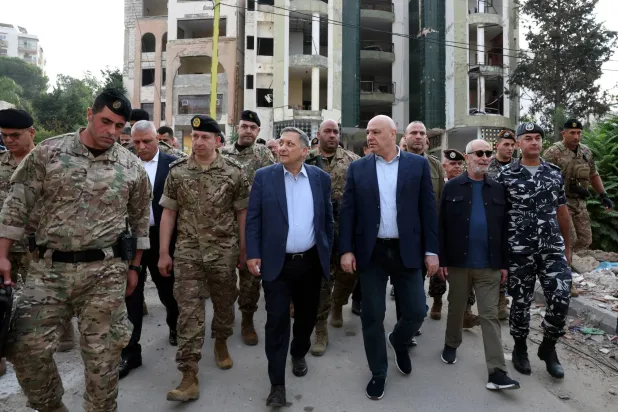
Lebanese authorities are cautiously approaching Israeli leaks that its forces are going to withdraw from some areas in southern Lebanon. However, the American mediator has not conveyed any confirmed information about this to Beirut. A senior official Lebanese source said the discrepancy between the political and military powers in Israel about remaining in Lebanon “does not mean things are running smoothly, given the ongoing stalemate on the negotiation track.” The source explained that Israel's failure to facilitate the negotiation process has downgraded the talks to the ambassador level, as is currently happening in Washington. Consequently, there is no party capable of lending credibility to any contrary indicators on the ground. Meanwhile, Israeli attacks around the Ali al-Taher region have continued, with decreased intensity, after the detonation of its tunnel network. This coincided with Israeli leaks by Channel 12, which is close to military and security circles, about Tel Aviv's readiness to withdraw toward a “gray line.” The leaks were followed by Israeli Defense Minister Israel Katz saying that the withdrawal from southern Lebanon should be preceded with the disarmament of Hezbollah. However, the developments on the ground seem to contradict his words. Field sources in the South told Asharq Al-Awsat that Israeli forces have left the Ali al-Taher ridge area and kept their troops at the Beaufort Castle. The sources said the town of Kfar Tebnit, strategically located between Ali al-Taher and the castle, has also become clear of any Israeli presence. The forces have also completed a military road connecting Beaufort Castle to Israeli positions south of the Litani River, bypassing other Lebanese villages north of the river where Israeli forces are currently present. The sources go even further, noting that the situation on the ground “does not indicate, as of yet, any Israeli intention for a larger escalation around Nabatieh, judging by the size of the forces Israel is mobilizing in the area and its field operations.” A picture shows destroyed houses in the southern Lebanese village of Kfar Tebnit on September 11, 2026, following an Israeli demolition on the Ali al-Taher ridge. (AFP) Ali al-Taher and negotiations After the Ali al-Taher detonation, Lebanese Army Commander Rodolphe Haykal contacted officials at the US Central Command to declare that the military was ready to deploy in the area, an official Lebanese source told Asharq Al-Awsat. The Americans then relayed the information to the Israeli Northern Command, which said that it would prefer that the issue be addressed at the next round of political negotiations between Beirut and Tel Aviv, revealed the source. The talks are set for early October after Lebanese President Joseph Aoun requested from the Americans that they be postponed from mid-September. The source said he asked for the delay because the Israelis were not receptive to Lebanese demands and due to their military escalation, the latest of which was the detonation at Ali al-Taher. Aoun demanded a specific agenda that allows for actual progress in the negotiations, because he considers that there is no point in “negotiating merely for a photo-op.” He revealed that Aoun had instructed Lebanese Ambassador to the US Nada Moawad, who will meet with her Israeli counterpart in Washington on Wednesday, to urge progress in consolidating the ceasefire and completing the release of Lebanese prisoners. This photograph taken from the southern Lebanese village of al Hanniyeh shows smoke as it rises from the site of an Israeli-controlled explosion in the nearby village of Al-Mansouri on September 6, 2026. (AFP) Tyre visit The source said that Aoun’s recent visit to Nabatieh will be followed by one to the coastal city of Tyre. It said that Aoun was “deeply pained” at the sight of the destruction in Nabatieh despite knowing what to expect. He then urged official circles to intensify their efforts and restore state institutions in the city and other southern regions. He requested the relevant ministries to intensify their work in the city to support the steadfastness of its residents, who “want nothing but safety, security, and a decent life in their homes.” Aoun requested the acceleration of the reconstruction process for the government building in the city following the destruction it sustained. He requested speeding up the disbursement of the $3 million allocated by the government for this purpose, out of concern that administrative red tape might delay it longer than necessary, said the source. Additionally, he requested the Ministry of Finance to allocate a piece of land it owns in the city to rebuild a center for the State Security apparatus, as an alternative to a center that was also destroyed by Israeli airstrikes. Aoun believes that the return of the state to the South “must be effective, and across all sectors, not just security.” Ties with Hezbollah remain severed Ties between Aoun and Hezbollah remain severed as demonstrated by the party boycotting the president’s visit and later slandering it. The party criticizes Aoun for not being “considerate enough” of the Shiite community, Hezbollah’s main support base, that has paid heavily in the war. Aoun's relationship with Hezbollah, since he was the army commander, has been based on “advice” and warnings that the party has not heeded. This began with the Al-Aqsa Flood Operation in Gaza in 2023, the party's decision to open a “support front” in solidarity with Hamas a day later and its decision in March to open another front, this time in support of Iran in the US-Israel war against it. On both occasions, Aoun urged Hezbollah against engaging in the war, but the party ignored him. On Ali al-Taher, Aoun managed to acquire through US Secretary of State Marco Rubio Israel’s approval that its forces will not advance on it, in exchange for the Lebanese army to deploy there instead. Hezbollah, through a mediator, initially agreed to the proposal, but later announced that neither the Lebanese nor Israeli forces would be allowed to enter the tunnels. As of yet, Aoun has not understood why Hezbollah would prefer to hand over the position to the Israelis rather than the Lebanese army, knowing that the Lebanese choice would protect Nabatieh and the surrounding areas.