From Tehran to Riyadh, the OMA partner discusses transforming industrial sites into cultural destinations, designing exhibitions, and creating architecture that reflects the identity of each place.
Between a major city like Tehran, museums and art exhibitions, and industrial sites transformed into cultural destinations, Kaveh Dabiri’s architectural experience extends beyond the traditional boundaries of the profession. His work goes beyond designing buildings to organizing space, narrating the story of a place, and creating environments where architecture meets art and culture.
Since joining OMA (Office for Metropolitan Architecture), one of the world’s leading architecture and design firms, in 2009, Dabiri has worked across the Middle East and Europe, from Dubai and Doha to Riyadh and Jeddah, on projects at the intersection of architecture, culture, and the arts. After more than 15 years at the firm, he became a partner and now leads the expansion of Riyadh’s JAX District. He previously led the scenography for the first and second editions of the Islamic Arts Biennale in Jeddah.
In an exclusive interview with Annahar, Dabiri discusses the cities that shaped his vision, his relationship with architecture and exhibition design, his experience in scenography, and how architectural projects can be developed while preserving the identity of their surroundings.
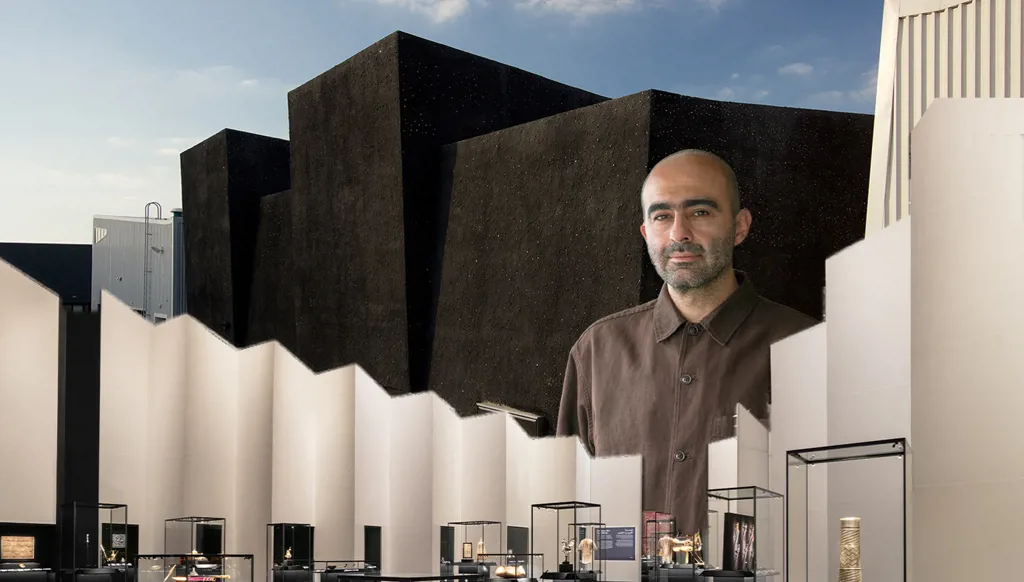
Iranian Architect Kaveh Dabiri (Photo by Mounir Rajicourtesy of OMA).
Tehran underwent major urban, political, and social transformations during the 1980s and 1990s, which I could not fully understand at the time.
I studied architecture in Iran, and towards the end of my studies, I began to notice a gap between the study of architecture and the study of the cities and contexts in which projects emerge. I realized that architecture is not an isolated product, but rather the result of political, social, economic, and other factors. This realization led me to study urban planning in Delft, where my interest in OMA and its approach to thinking about contemporary cities grew.
Living and working in different countries reinforced my conviction that every context has its own specific characteristics, even when countries appear similar. Therefore, I avoid generalizations and believe that understanding the particularities of each place is essential to any project.
Concrete project at Alserkal Avenue (Photo by Mohamed Somji).
What connects these fields is the use and organization of space, although each has its own characteristics. Exhibition design, for example, differs from architecture because it is temporary by nature, offering greater flexibility and allowing us to explore possibilities that may not be feasible in traditional architecture.
In architecture and urban planning, considering the context is crucial. When you examine the social, political, urban, and spatial context, you begin to ask fundamental questions: Why does this project exist? Why here? What forces are behind it?
JAX is an existing industrial site, and working with existing contexts and buildings is something I value greatly. There is a perception that projects in these countries are always built from scratch, but at JAX, we did not simply propose new buildings. Instead, we worked with what was already there.
What matters is that the site was not just a collection of buildings and physical infrastructure. It was already a lively area actively used by the art scene. Our goal was therefore to enhance what existed and give it new life, rather than reinvent it entirely. I see this as a kind of natural evolution of a phenomenon that was already underway.
JAX District. Photo by Marco Cappelletti.
The two editions differed in their content and exhibitions, but both were enjoyable experiences. One of their most distinctive aspects was the collaboration with a diverse team of curators, artists, and specialists. The final result was the product of collective work and intensive coordination, which gave the experience its value.
Islamic Arts Biennale 2025. Photo by Marco Cappelletti.
I see my current role at OMA as a continuation of the previous phases of my career. I have always believed in the way OMA works, how we approach projects and contexts, and our curiosity about different countries.
I see this phase as part of a long journey filled with new challenges and visions. I am interested in continuing to work in different contexts, understanding the particularities of each environment, and pursuing cultural and artistic projects without limiting myself to them, because OMA is a multidisciplinary firm that works across various fields.
Over the past decades, there has been growing interest in developing cultural programs across the Arab world, particularly in the arts, with museums and exhibitions serving as ways to engage local communities.
In Saudi Arabia, there is a strong local artistic movement. I do not see this movement as new, but rather as one that is receiving greater attention today, with increased efforts to showcase it to the public through museums and cultural spaces.
I believe architecture plays an important role. More importantly, however, understanding why a project exists and the factors behind it helps produce solutions that are more relevant to their context, taking into account the political and economic conditions and ambitions of each country.
Thank you for subscribing to our newsletter