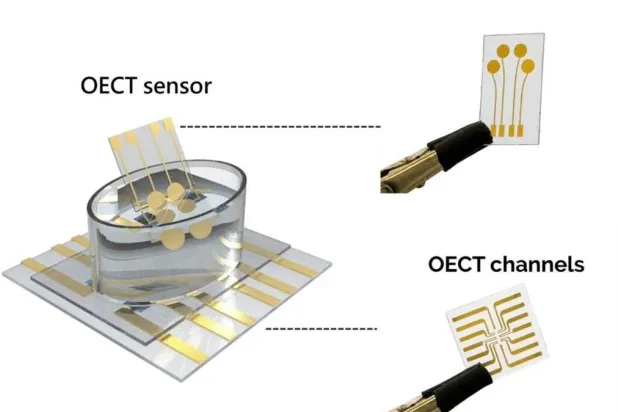
Researchers at King Abdullah University of Science and Technology (KAUST), in collaboration with the University of Oxford, have developed a blood-based electronic sensor capable of detecting molecular signatures associated with Parkinson’s disease. The study was published in Science Advances. The technology uses a highly sensitive electronic sensor developed at KAUST to simultaneously detect three different forms of alpha-synuclein, a protein closely associated with Parkinson’s disease. The sensor can detect these proteins at extremely low concentrations that are difficult to measure using conventional analytical techniques. The approach first isolates tiny packages released by nerve cells into the bloodstream before their protein contents are analyzed using the electronic sensor. At the heart of the technology is a transistor that amplifies very small biological signals into much larger electronic signals, allowing all three forms of alpha-synuclein to be measured within 40 minutes. Parkinson’s damages dopamine-producing neurons, leading to problems with movement, balance, and other bodily functions. It is currently diagnosed largely through clinical assessment, often after characteristic movement symptoms have emerged. Detecting disease-related proteins originating from the brain could offer an earlier window into the disease but measuring them in blood is extremely difficult because more than 95 percent of circulating alpha-synuclein originates from red blood cells, creating heavy background noise. Saudi Arabia’s healthcare system is placing increasing emphasis on prevention and earlier detection as people live longer. Life expectancy in the Kingdom has risen to 79.7 years, approaching the Saudi Vision 2030 target of 80, while the proportion of older people is expected to grow significantly in the coming decades. Against this backdrop, technologies that could eventually help identify age-related diseases such as Parkinson’s earlier could become increasingly relevant to long-term healthcare. In a blinded evaluation involving 59 participants from the Oxford Discovery cohort, the platform achieved 90.9 percent accuracy in distinguishing disease-associated profiles from healthy controls. The study included people diagnosed with Parkinson’s disease, healthy controls, and individuals with isolated REM sleep behavior disorder, a condition which is associated with an increased risk of developing Parkinson’s or related neurological disorders. Researchers found distinct patterns in the different forms of alpha-synuclein across the groups, suggesting that measuring them together could provide more useful diagnostic information than relying on a single marker. Associate Professor of Bioengineering at KAUST Sahika Inal said: “Changes associated with Parkinson’s can begin long before a clinical diagnosis, but detecting those changes through something as accessible as blood remains extremely challenging.” “Our approach allows us to detect several forms of alpha-synuclein together at extremely low concentrations. These early results are encouraging, and the next step is to validate the technology in much larger groups of patients,” he added. The researchers caution that the technology is not yet a standalone clinical blood test. The current study represents a retrospective evaluation in an initial cohort, and larger, prospective, multicenter clinical studies will be needed to establish its long-term predictive value before the platform could be used routinely in healthcare.