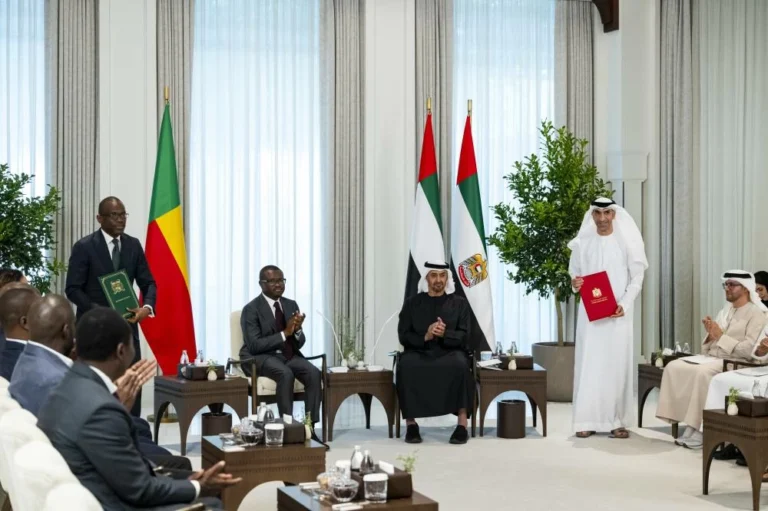
Abu Dhabi: At the invitation of the Federal President of the Federal Republic of Germany, His Excellency Frank-Walter Steinmeier, the President of the United Arab Emirates, His Highness Sheikh Mohamed bin Zayed Al Nahyan, visited Germany from 9 to 11 September 2026. During this first State Visit from a President of the United Arab Emirates to Germany, His Highness Sheikh Mohamed bin Zayed Al Nahyan also met His Excellency Friedrich Merz, Federal Chancellor of the Federal Republic of Germany.The leaders acknowledged that the State Visit takes place at a defining moment for both countries and for the wider international order. Amid heightened regional and geopolitical volatility, both sides underscored the growing importance of reliable, like-minded partners, and affirmed their determination to stand together in defense of the international order.The State Visit reemphasized that the German-UAE partnership is propelled by the shared commitment to peace, security, economic prosperity, the development and use of future technologies, and sustainable development.During the State Visit, His Highness Sheikh Mohammed bin Zayed Al Nahyan and Federal Chancellor Friedrich Merz announced the establishment of a Strategic Dialogue format, intended to re-vitalize the Comprehensive Strategic Partnership, founded in 2004.The Strategic Dialogue will steer the progress of deepened cooperation across multiple sectors including international and regional security, defense, trade and investment, energy and climate, emerging technology, digitalization, economy, transportation, environment, culture and education and ensure that concrete outcomes for mutual benefit will be achieved. They affirmed that the Strategic Dialogue represents a lasting investment in the relationship, providing the structure through which that vision will be translated into sustained, concrete cooperation.The two sides affirmed their commitment to deepening bilateral trade and investment ties and expanding cooperation across priority sectors. As a concrete expression of that commitment, His Highness Sheikh Mohamed bin Zayed Al Nahyan and His Excellency Federal Chancellor Friedrich Merz welcomed the signing of a Joint Declaration of Intent (JDoI) on the establishment of the German-UAE Investment Council as a platform to advance investments and strengthen engagement between the public and private sectors. They also welcomed the outcomes of the UAE-Germany Business Forum, as well as the resumption of the Joint Economic Committee, underlining their support for closer economic co-operation, investments, and joint projects. In particular, both leaders welcomed the signing of 29 business-to-business MoUs and agreements between UAE and German companies, with a total value exceeding EUR 9.356 billion, reflecting the growing depth of private-sector cooperation between the two countries.The two leaders welcomed the announcement of a UAE investment package totaling EUR 40 billion in Germany, reflecting the shared ambition of both countries to deepen their strategic partnership and the UAE’s confidence in Germany as a leading destination for investment, innovation and industrial growth. The package is expected to contribute to strengthening industrial competitiveness, advancing technological leadership and supporting long-term economic growth in Germany. The package includes investments in advanced digital infrastructure, including the development of new state-of-the-art data centres with a capacity of approximately 1 GW. Germany underscored its commitment to fostering a favourable environment for their implementation.Beyond the EUR 40 billion package, the two leaders also welcomed plans for further corporate investments and partnerships between UAE and German companies, including initiatives involving Covestro, RWE, ADNOC and Masdar. These initiatives build on the strong foundation of existing UAE investments in Germany, including XRG’s approximately EUR 15 billion investment in Covestro, and underscore the growing depth and ambition of the economic relationship between the two countries.Both sides acknowledged the continued growth in the bilateral non-oil trade, which reached USD 15.5 billion in 2025, an increase of over 14% compared to 2024, while cumulative investment flows between the two countries exceeded USD 10 billion over the 2021-2025 period. They further welcomed progress in the negotiations on the UAE-EU Comprehensive Economic Partnership Agreement.The UAE is currently negotiating with the EU, the world’s largest internal market, the terms of a Free Trade Agreement (FTA). Germany and the UAE support reaching a comprehensive, commercially ambitious agreement. The strengthening of the EU-UAE bilateral trade relations through a comprehensive and ambitious FTA will bring economic benefits to both sides.Both sides affirmed that increased cooperation in defense and defense technology constitute a key pillar of the relationship and commended the signing of a Letter of Intent (LoI) concerning the exploration of Defense Cooperation, supported by a high-level Defense Roundtable, and the signing of a LoI on Police and Security Cooperation. They agreed to elevate this cooperation beyond a supplier-and-recipient dynamic toward a broader, more strategic partnership.Both leaders reaffirmed their deep and enduring partnership in the energy sector, built on trust and a shared commitment to strengthening energy security and system resilience. Building on the longstanding Emirati - German Energy Partnership, they recognised the strategic value of close cooperation at a time of increased global energy volatility, welcomed the continued strength of cooperation across all forms of energy, underscored the role of the UAE-Germany partnership in supporting secure, diversified, and affordable energy supplies for their economies and for Europe more broadly, and expressed their shared intention to deepen it further through partnerships between leading companies on both sides.The leaders welcomed the expansion of strategic, long-term cooperation across the full energy value chain, encompassing conventional and emerging energy resources, including LNG, renewables, and hydrogen. They noted with satisfaction the growing contribution of bilateral flagship projects involving leading UAE and German companies, reinforcing security of supply and system resilience, and supporting industrial competitiveness.Both leaders welcomed the ongoing development of the Global Energy Efficiency Alliance (GEEA) and reaffirmed their commitment to strengthening international cooperation on energy efficiency as a key enabler of the global energy transition. Furthermore, as founding members of the International Renewable Energy Agency (IRENA), both sides reaffirmed the importance of the Agency’s role in advancing the global energy transition and welcomed further close cooperation. Germany further welcomed the UAE’s leadership in advancing efforts to reduce methane emissions from oil and gas sector and its leadership in launching Oil and Gas Decarbonization Charter (OGDC) at COP28.They likewise affirmed the importance of advancing industrial cooperation and expanding collaboration in advanced industries and manufacturing as a key pillar of long-term, mutually beneficial economic growth. In this context, the leaders underscored the value of deeper partnerships between companies on both sides, including through investment, innovation, and joint development, to strengthen industrial capacity, enhance competitiveness, and support resilient and future-ready supply chains.In the field of critical technology, both sides reaffirmed their commitment to expanding cooperation in artificial intelligence and emerging technologies, fostering exchange, investment, research and development, including joint development in these critical sectors.To take into account the UAE’s leading role in advanced technologies, His Highness Sheikh Mohammed bin Zayed Al Nahyan and the Federal Chancellor Friedrich Merz welcomed the Joint Declaration of Intent (JDoI) on the exploration of cooperation on Data Hosting and Information systems through the establishment of Data Embassies.This cooperation will explore a new model of technology diplomacy through secure and resilient digital infrastructure and strengthening the foundations of trusted digital cooperation between the two countries.The two leaders underscored the strategic importance of food security and sustainable agriculture and highlighted opportunities to draw on the UAE’s leadership in advancing innovative and technology-enabled food systems, together with Germany’s advanced technological and industrial capabilities. They noted the scope for bilateral engagement across modern agriculture and agricultural value chains, including in agricultural technologies and key inputs such as fertilizers.To take into account the two nations’ joint commitment to sustainability, the two leaders also commended the preparations for the 2026 United Nations Water Conference, to be co-hosted by the UAE and Senegal, in Abu Dhabi from 8 to 10 December 2026, and highlighted its role in strengthening partnerships, mobilizing investment, and advancing innovative, practical and scalable solutions, while underscoring its importance as a platform for advancing global water action and accelerating progress towards Sustainable Development Goal 6. The two sides also welcomed the signing of the JDoI on Cooperation in the Field of Environment.The UAE welcomed Germany’s leadership as co-chair of the Interactive Dialogue on "Water in Multilateral Processes,” and underscored the importance of the dialogue in advancing inclusive, action-oriented and multilateral approaches to global water challenges.The UAE and Germany enjoy strong and longstanding relations in civil aviation, supported by significant air connectivity and growing economic, trade, tourism and people-to-people ties. Building on these relations, the German side agreed to add an additional fifth point to the route schedule, permitting one UAE national carrier to operate an agreed number of frequencies to the fifth point, in additional to the four existing points in Germany, which will be capped at the current number of frequencies for this carrier.Both sides welcomed the signing of a number of further agreements on the occasion of the visit, including the facilitation of UAE citizens' entry at German airports through the EasyPASS system, an Agreement on Mutual Legal Assistance in Criminal Matters, and looked forward to the early conclusion of the remaining instruments under negotiation, including on the avoidance of double taxation.Cultural cooperation featured prominently in the discussions. Both leaders agreed to strengthen cultural and people-to-people ties, including through collaboration in culture, literature, heritage and creative industries. The shared respect for the cultural, historic, and academic achievements of the respective countries was underlined by the signing of a comprehensive MoU on enhancing cultural cooperation.The two sides exchanged views on key regional and international developments. Recognizing the willingness to contribute to peace, stability and security in die Middle East, the two leaders emphasized the need for diplomacy and dialogue.His Highness conveyed his sincere appreciation for Germany's steadfast support and solidarity in the face of the Iranian aggression against the UAE, commending it as a reflection of the enduring friendship and strategic partnership between the two nations. The Federal Chancellor expressed Germany’s firm stance in solidarity with UAE and other regional partners.The two leaders condemned in the strongest terms the egregious attacks by the Islamic Republic of Iran against the UAE and other regional states, including against civilian infrastructure, in clear breach of their sovereignty and territorial integrity and in flagrant violation of international law, including the UN Charter. The leaders further condemned Iran’s de facto closure of the Strait of Hormuz and its threats and attacks on merchant and commercial vessels, emphasizing the critical importance of upholding international law, including the right of transit passage, in international waterways, recalling UN Security Council resolution 2817 (2026). In this regard, the leaders demanded that Iran refrain from any actions or threats aimed at closing, obstructing or otherwise impeding the right of transit passage through the Strait of Hormuz or against merchant or commercial vessels in and around the Strait of Hormuz, recalling the decisions and outcomes of the Council and committees of the International Maritime Organization.Furthermore, they reiterated the need to prevent Iran from acquiring any nuclear weapon, as well as to comprehensively address and contain the full spectrum of Iran’s threats including its missile programme, its unmanned aircraft systems and other related technologies, as well as its use of and support for proxies and non-State actors in the region and beyond.The leaders reaffirmed their shared commitment to achieving a negotiated, comprehensive, just, and lasting peace based on the two-State solution, leading to the realization of a sovereign, independent and viable Palestinian State living side by side with Israel, in peace and security, based on the 4 June 1967 lines, in accordance with international law and relevant United Nations resolutions. Both sides underscored the importance of advancing the implementation of the Comprehensive Plan to End the Conflict in Gaza and its Roadmap, in line with UN Security Council resolution 2803 (2025), as the way to achieve the disarmament of Hamas, the withdrawal of Israeli forces, as well as the reconstruction of Gaza and the reunification of the Occupied Palestinian Territory under a reformed Palestinian Authority (PA). Both sides called on Israel to abide by its commitments from the Sharm Al Sheikh protocol, on Hamas to cease all military operation, and on all parties to support conditions for peace and security for Palestinians, Israelis and the broader region. In this regard, the leaders expressed their categorical rejection of any unilateral measures aimed at altering the status of the Occupied Palestinian Territory, changes to the historical and legal status quo in Jerusalem, as well as actions leading to territorial and demographic changes, including the forced displacement of the Palestinian civilian population.Both leaders reaffirmed their strong commitment to supporting a comprehensive, just and lasting peace in Ukraine in line with international law including the principles of the UN Charter, and underscored the importance of sustained diplomatic efforts to support a negotiated settlement and alleviate the humanitarian consequences. The leaders strongly condemned increasing attacks in Ukraine, which have resulted in an increasing number of civilian casualties and injuries, and the destruction of critical infrastructure. They agreed on the urgent necessity to reach a ceasefire in the Black Sea to facilitate grain exports and ensure global food security.Germany thanked UAE for facilitating talks between Ukraine and the Russian Federation. They agreed on joint immediate humanitarian and development assistance for the Ukrainian people for the upcoming winter with a focus on critical decentralised infrastructure for vulnerable communities; support for children, youth and families; and food security. Additionally, both sides also intend to explore a more comprehensive joint partnership focused on recovery and development initiatives to be announced in connection with the next Ukraine Recovery Conference in 2027. The two leaders welcomed the most recent prisoner exchange between Ukraine and the Russian Federation, facilitated by the United Arab Emirates, which brings the total number of prisoners exchanged to 7,997 since the beginning of the war. They also discussed avenues for cooperation in support of Ukraine's recovery, across all fields, and Germany welcomed the CEPA agreement between the UAE and Ukraine, noting its potential to contribute to Ukraine’s long-term stabilisation and reconstruction.Both leaders condemned attacks against civilians and humanitarian personnel and convoys in Sudan. They urged the Sudanese Armed Forces (SAF) and the Rapid Support Forces (RSF) to immediately cease all military operations which continue to put civilians at risk, including drone strikes and impediments to humanitarian access. Both leaders reiterated their call for an immediate and unconditional humanitarian truce, leading to a permanent ceasefire and an inclusive and transparent transition to an independent civilian-led government that reflects the aspirations of the Sudanese people, free of control or influence by any party or actors that fuel violence and instability across the region. Both sides underscored the need for a full arms embargo that applies across the entire territory of Sudan. Both leaders commended international and regional efforts, including those of the Quad and Quintet, and the outcomes of the Sudan conference in Berlin.Both leaders expressed their solidarity with Lebanon and reaffirmed their commitment to its unity, sovereignty, and territorial integrity. They expressed their support for the Government of Lebanon's efforts to consolidate arms under state authority and for all efforts to promote the prosperity, stability, and well-being of the Lebanese people. They welcomed the trilateral framework agreement between Lebanon and Israel and hoped that the agreement serves as a positive step towards enhancing regional security and stability. Both leaders underscored the importance of the full implementation of UN Security Council resolution 1701 (2006) and the safety and security of UNIFIL personnel.The leaders stressed the importance of preserving Syria’s unity, sovereignty, and territorial integrity. They underscored the need for all parties to respect international law and the 1974 Disengagement Agreement, and to refrain from actions that could threaten regional security and stability. The leaders expressed their hope for continued and demonstrable commitments to inclusive governance as an essential step in supporting Syria’s long-term stability and recovery.