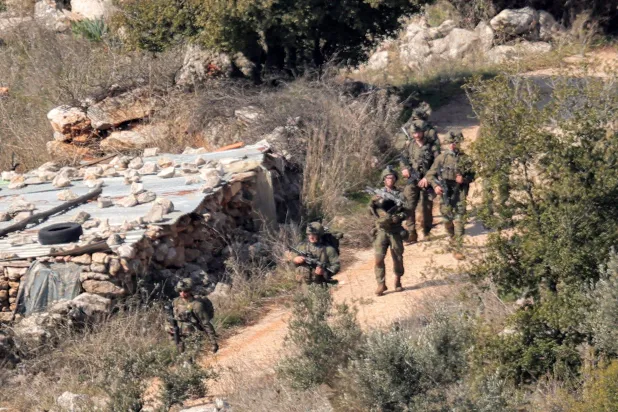
Repeated Israeli incursions into the Arqoub region of southeastern Lebanon, along the border with Israel and Syria, have raised fears that Israel was planning on expanding its control and further restricting the lives of residents. These developments have prompted locals to issue warnings, the latest of which came in a statement by an Arqoub committee that highlighted "incursions, alterations of terrain, and the clearing of roads" in the towns of Kfar Shouba, Shebaa, Habbariyeh, and Halta, all of which are located on the western slope of Jabal al-Sheikh. The warning followed repeated Israeli incursions into the area, including the searching of homes in Kfar Shouba last week. The committee warned against “a recurrence of past events that led to the occupation of the Shebaa Farms and the Kfar Shouba Hills,” pointing to “a historical lack of action or disregard by successive authorities and governments.” It stressed “the need for swift and urgent intervention through the Arab League, United Nations, and UN Security Council to halt this aggression, these incursions, and the renewed attempts to encroach upon Lebanese territory.” These operations are taking place within the context of ongoing Israeli movements over several months across southern border villages, specifically within unoccupied areas adjacent to what Israel calls the "Yellow Line." According to retired General Khalil Gemayel, these actions carry "military, tactical, and security dimensions that extend far beyond searching for Hezbollah weapons or facilities." "The Israeli incursion into Kfar Shouba and its surrounding villages, alongside the house searches, cannot be viewed simply as a transient military maneuver or a limited security operation," he told Asharq Al-Awsat. These movements involve "three interconnected dimensions," he said. Israeli forces conduct a patrol in the village of Kfar Shouba in southern Lebanon on February 17, 2025 (AFP) The first is "expanding the scope of maneuver and field reconnaissance; entering the village outskirts, advancing between houses, and conducting searches allows Israeli forces to gather direct intelligence on the terrain, corridors, roads, and residents." He added that these operations also aim to "erase as much of the villages' urban landscape and vegetation cover as possible, under the pretext of preventing Hezbollah from rebuilding its military capabilities in areas close to where Israeli units are stationed." Gemayel noted that the second dimension involves "imposing a new security reality on the ground," explaining that "Israel is no longer satisfied with stationing itself in elevated positions and fixed military outposts on commanding hills that stretch from the sea to Jabal al-Sheikh to shield northern settlements.” “Instead, it is seeking to expand its capacity to execute recurring ground operations within a geographical buffer that grants it greater freedom of movement and intervention,” he explained. He said that "this does not necessarily mean it has decided to advance to occupy additional villages," but rather indicates "its desire to control and monitor the forward border area in accordance with its security interests, by creating a buffer zone held under fire where Israel applies the theory of flexible defense outside its occupied and fixed defensive lines." The third dimension, it involves "pressuring the population and preventing a return to normalcy by searching homes, blocking farmers from accessing their fields, and restricting movement, thereby maintaining security, economic, and social pressures on dozens of unoccupied villages and complicating the resumption of regular activity." Gemayel cited "the restrictions that farmers and shepherds in Kfar Shouba and Halta face regarding access to their lands and pastures." Retired Brigadier General George Nader viewed the "repeated Israeli incursions into southern villages, not as limited military operations or random movements, but rather as a prelude to cementing Israeli military control and widening its operational reach inside Lebanese territory." "Israel is seeking to encroach upon more land and impose new realities on the ground, either to improve its negotiating leverage following the Israeli elections, or to pave the way for expanding its military operations into areas beyond the Litani River,” he told Asharq Al-Awsat.