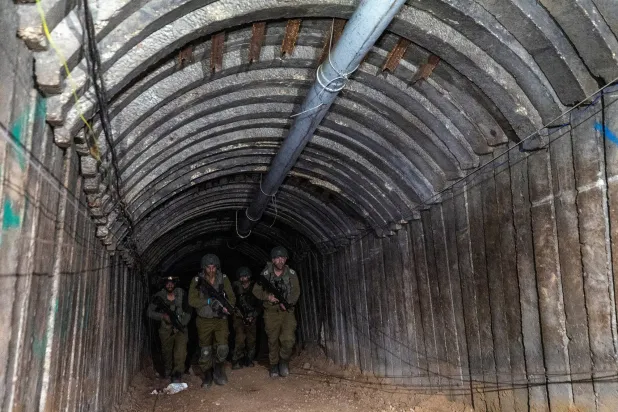
Years of a devastating war have failed to dismantle Hamas’ vast tunnel network in Gaza, with Israel continuing to uncover underground passages even in areas under its military control. Recent Israeli announcements have detailed new discoveries on both sides of the Yellow Line, established under the October 10, 2025, ceasefire agreement. The boundary initially left Israel controlling about 50% of Gaza, a share that has since expanded to more than 65%. The latest operation, described as the first of its kind since the ceasefire, targeted a Hamas tunnel west of the Yellow Line and Salah al-Din Road, near the southern side of the Netzarim Corridor toward central Gaza. Israeli forces have also reported destroying several tunnels within areas they control, underscoring the complexity of an underground network that has proved more extensive and resilient than anticipated. Origins of the Tunnel Network Hamas first used a tunnel in a military operation on September 26, 2001, a year after the outbreak of the Second Intifada. The group detonated explosives inside a tunnel approximately 150 meters long beneath a military tower at the Termit outpost in Rafah, southern Gaza, killing and wounding several Israeli soldiers. Israel initially paid limited attention to the tactic, quickly sealing and destroying the tunnel using rudimentary methods rather than the advanced technology employed today. Hamas subsequently repeated the approach in other operations, including one in 2006 in which Israeli soldier Gilad Shalit was captured. After taking control of Gaza, Hamas devoted considerable resources to developing tunnels for defensive and offensive operations, as well as smuggling weapons and military equipment. Commercial tunnels also proliferated along the Rafah border after Israel imposed a sweeping blockade on the territory. During the 51-day Gaza war in 2014, Hamas surprised Israeli forces with a series of cross-border tunnel operations, allowing its fighters to attack Israeli troops at close range. The attacks heightened fears among residents of Israeli communities surrounding Gaza and prompted demands for stronger defenses against underground infiltration. Israel subsequently built a technologically advanced border barrier equipped with aboveground and underground detection and protection systems. However, during the October 7, 2023, attack, Hamas breached the new barrier using explosives designed to destroy sections of it and aerial means, including paragliders. Tunnels, meanwhile, remained primarily defensive structures and facilities for command and control, although Hamas field commanders were later forced to abandon some of them after they came under attack. Israeli Assessments Israeli Southern Command officers have recently acknowledged that Hamas’ military arsenal, particularly its tunnel network, has not been completely eliminated. They have also indicated that further measures are needed to address the future of the group’s weapons. Amichai Mitelman, of the civil engineering department at Ariel University, estimated in a report published recently by Israel’s Maariv newspaper that a substantial portion of Hamas’ tunnels remains intact. He cautioned that no single method could destroy the entire network. According to Mitelman, estimates of the total length of Gaza’s tunnels before the October 7 attack ranged from 500 to 1,000 kilometers. Some tunnels were between 30 and 40 meters deep, with branching passages of varying widths, he explained. Efforts to destroy the network by flooding tunnels with seawater or detonating large quantities of explosives have failed to eliminate it completely. Filling tunnels with concrete has recently proved more effective, he said, although the method is costly and labor-intensive. The Qassam Engineers The underground network has remained a major challenge for Israel throughout the war, which has continued at a limited level despite the ceasefire. Israel has demanded the complete destruction of Hamas’ tunnels under the ceasefire agreement, subject to monitoring by Israel, the United States and mediating countries. The fate of Hamas’ other weapons, including rockets, has also become a central issue. During operations to recover Israeli hostages, particularly the remains of those killed, it emerged that some had been buried in small tunnels and branches that Israeli forces had failed to detect. Some of these passages remained intact within tunnel systems the military had believed it had destroyed. Videos released by Hamas’ armed wing, the Izz al-Din al-Qassam Brigades, featuring commanders and fighters killed during the war, have also shed light on the construction of the tunnels and the development of the group’s rocket arsenal. The footage suggests that much of the work relied on local expertise and manual labor rather than exclusively on weapons smuggled from Iran or elsewhere, as is often assumed. This has also prompted Israeli demands to dismantle Hamas’ weapons-manufacturing workshops. The videos indicate that many of those responsible for tunnel construction and rocket development, known within the group as the “Qassam engineers,” did not hold formal engineering qualifications. While a small number had engineering degrees, most had studied other subjects, and some had no academic qualifications. Many were construction workers or technicians whose practical skills enabled them to oversee the development of the underground network over many years. They supervised excavation teams largely composed of younger Qassam recruits. The so-called engineers assessed soil conditions, identified areas of structural strength and weakness, and determined tunnel routes before excavation began. Hamas sources told Asharq Al-Awsat that tunnel construction and preparation followed what they described as professional engineering practices, using various types of equipment operated by skilled technicians. The sources credited these workers with playing a central role in developing what Hamas considers a strategic military asset. They acknowledged that construction had faced serious difficulties over the years, with numerous workers killed during excavation and others suffering paralysis or other injuries following soil collapses and unexpected incidents. Security challenges also complicated the work, including alleged Israeli attempts to recruit informants from among faction members, tunnel workers and others to identify underground locations. Other Hamas sources said the group’s rocket industry similarly relied on domestic development. According to these accounts, engineers from Gaza received training and studied relevant subjects at universities and other institutions before returning to train additional personnel, expanding the number of people capable of manufacturing and developing weapons. The sources maintained that explosives were also manufactured and adapted locally to meet operational requirements, including those used to destroy sections of Israel’s border barrier during the October 7 attack. They credited the engineers with adapting weapons to changing battlefield conditions. The same approach, they added, extended to other locally developed weapons, including the Yassin 105 anti-armor projectile, which Hamas used extensively against Israeli forces during the war.