Israel is tightening its siege on Ali Al-Taher hill, revealing its plan through military escalation and explosions in southern villages to expand the “yellow line” and extend the security zone to new hills. Its goal is to confine Hezbollah to positions that would make it easier to encircle the group militarily, in parallel with the financial and political blockade imposed by the United States through sanctions linking Hezbollah to Iran’s Revolutionary Guard, in addition to demands placed on the Lebanese state to decisively remove Hezbollah’s weapons and occupy its positions, particularly Ali Al-Taher, as a condition for resuming negotiations in Rome.
Israel is also amplifying Hezbollah’s capabilities in Ali Taher in an attempt to alter the course of negotiations over the occupied areas in the south. It has therefore raised the bar on its conditions for participating in the eighth round of Rome negotiations, while Hezbollah is providing it with justification by limiting its confrontation to the hills and refusing to discuss handing them over to the Lebanese army. According to diplomatic sources, this issue is not separate from the confrontation with Iran.
Benjamin Netanyahu is seeking to convince Washington to launch a broad operation in the Ali Taher hills, extending to what Israel considers fortified Hezbollah positions in Jabal al-Rihane and the heights of Iqlim al-Tuffah, which it claims pose a threat to Israel’s security. This would consequently isolate the occupied southern region from the negotiations, including the experimental areas. However, despite tightening the noose on Hezbollah, the Americans have not given the green light for such an operation, although they might agree if it remains confined to the south and does not expand to Beirut.
The matter is not limited to Ali Al-Taher. The goal sought by the United States is to end Hezbollah or, at least, weaken it so that it no longer remains a decisive force in the country. According to diplomatic sources, this American approach is not altered by statements from U.S. officials or ambassadors regarding Hezbollah, including Tom Barrack’s remarks that the negotiation table in Lebanon “should include Iran and Hezbollah.” The sources say this does not mean openness toward Hezbollah, nor does it indicate a new American orientation toward Lebanon.
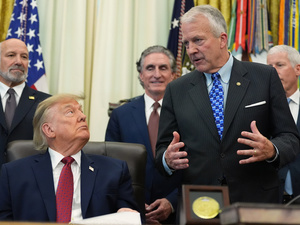
The sources recall what U.S. President Donald Trump said during his reception of President Joseph Aoun in Washington, when he told him that he could talk to Hezbollah if Aoun requested it.
Barrack’s remarks do not reflect a change in American policy, as he is known for his controversial statements, particularly regarding Lebanon. According to the sources, what remains unchanged is that the Americans have informed the Lebanese state that avoiding an imminent Israeli war requires the state to move forward with dismantling Hezbollah’s structure and military installations and entering its sites, whether in the experimental areas or north of the river, particularly Ali Al-Taher hill.
The sources point to the latest U.S. Treasury Department decisions, which reclassified Hezbollah and imposed sanctions on its money-transfer network, meaning Washington has begun treating Hezbollah as an executive arm of Iran’s Revolutionary Guard.
As for Hezbollah’s position, despite Mahmoud Qmati’s remarks about the possibility of negotiating with the Americans, Hezbollah refuses to hand over any site or installation to the state, as well as heavy or medium weapons. Its message, therefore, is to circumvent state decisions and present itself as the decisive party, with any negotiations having to take place directly with it.
For now, all doors remain closed to resolving the Ali Taher issue and allowing the Lebanese state to negotiate from a position of strength. Despite Lebanese diplomatic efforts and ongoing contacts, no breakthrough has been achieved to prevent a new devastating war in the south. Information indicates that Israel is preparing to attack Ali Taher and the high hills it occupied before the 2000s.
This means the ceasefire could collapse, at least in the south, with the possibility of a broad response from Hezbollah, unless Israel manages to gradually nibble away at the territory in the area, an approach currently being pursued through shelling and attempts to advance and penetrate.
Disclaimer: The opinions expressed by the writers are their own and do not necessarily represent the views of Annahar.
Thank you for subscribing to our newsletter