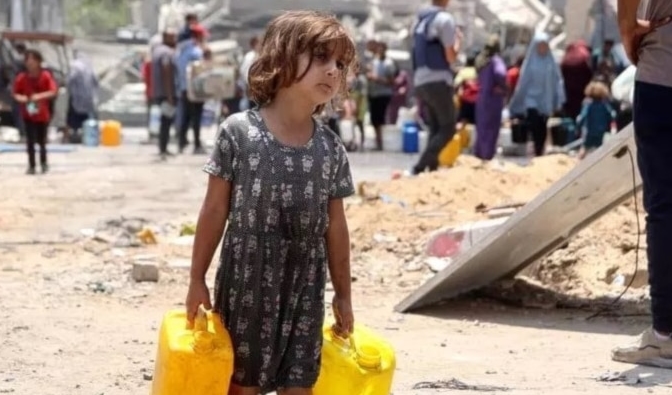
Israel needed just one week to come up with a pretext for closing Gaza’s crossings to commercial goods trucks. The closure came as the World Food Programme (WFP) announced cuts to aid for displaced Palestinians, leaving 500,000 people without their monthly assistance. Gaza’s markets have since shown the first signs of starvation. Over five days, supplies of fruit and vegetables dwindled until shops ran out entirely. Prices of goods hoarded by major traders, including garlic and onions, soared tenfold. The crisis began with a complaint from a trader to the Israeli coordinator responsible for goods entering Gaza. The trader alleged that Hamas’s economy ministry had imposed a 10,000-shekel tax on every truck entering the strip. Suspicious news pages later circulated the claim. The Israeli coordinator’s office then announced the cancellation of arrangements for commercial trucks to enter Gaza. The timing coincided with Israel’s election season. Since March, Israel has also reduced the number of aid and commercial trucks entering Gaza under the ceasefire agreement signed on October 10, 2025, from 600 to an average of 200 a day. Supplies of basic goods, including vegetables, fruit and meat, have fallen, pushing average prices beyond what 70% of the population can afford. “Prices for everything have risen at least threefold,” fruit and vegetable trader Arafat Ashour told Al-Akhbar. A kilogram of onions that once sold for 1.5 shekels, about 50 cents, now costs six shekels. Locally grown grapes have risen from five shekels a kilogram to at least 15. The WFP’s announcement that it would cut monthly assistance for 500,000 people has further worsened the crisis. The agency, presented internationally as an alternative to the UN Palestinian refugee agency UNRWA, has reduced food assistance by about one-third, citing a funding shortfall. It says it urgently needs $450 million to sustain critical operations in Gaza and the occupied West Bank between October 2026 and March 2027. The cuts will reduce the number of people receiving food and cash assistance in Gaza from 1.6 million to 1.1 million. Daily meals provided by the agency will also fall from 250,000 to 150,000. About 80% of Gaza’s population remains unemployed, limiting people’s ability to buy fresh food, protein and cooking supplies. WFP figures show that around 1.4 million people, nearly two-thirds of Gaza’s population, still face high levels of acute food insecurity. The UN Office for the Coordination of Humanitarian Affairs (OCHA), in a report published in the middle of this month, said funding shortages, reliance on a single crossing for humanitarian and commercial shipments, and delays in inspections, customs clearance and cargo handling were restricting supplies and disrupting aid deliveries. “In-kind assistance remained insufficient to meet household food needs,” the report said. A monthly food parcel and 25 kilograms of flour cover only about half the minimum caloric needs of recipient households. Gaza has neither the economic resilience nor the reserve stocks to meet demand for even a day. The impact on daily life has been swift. Gaza has neither the economic resilience nor the reserve stocks to meet demand for even a day. The war has transformed the strip from a largely self-sufficient agricultural producer, once exporting large quantities of fruit to the occupied West Bank and European markets, into a place unable to produce enough food for its own population. Economic expert Mohammad Abu Jayab told Al-Akhbar that Israel had made Gaza increasingly dependent on imports, even for basic produce such as tomatoes. It has taken over 70% of the land that once served as Gaza’s agricultural breadbasket and destroyed more than 500 factories and economic facilities. “What we are experiencing today is the result of policies carefully designed over years of genocidal war,” Abu Jayab said. “Starving an entire population requires little more than closing the Karam Abu Salem crossing, citing Jewish holidays or alleging Hamas interference in traders’ work.” Economic analyst Ahmad Abu Qamar said there was a vast gap between the needs of roughly two million displaced people and the volume of commercial goods and humanitarian aid Israel allows into Gaza. A July 23 analysis by the Integrated Food Security Phase Classification (IPC), an international initiative working with UN agencies and food security organizations, projected that about 74,200 children aged six months to five years would need treatment for acute malnutrition by April 2027. More than 11,400 could suffer from severe acute malnutrition, Abu Qamar said. Political activist Mohammed Diab described the current situation as the “engineering of starvation.” In a Facebook post, he said this did not necessarily mean a return to earlier periods when basic goods were almost entirely unavailable. Instead, the current strategy restricts essential supplies and allows them into Gaza at irregular intervals and in limited quantities. The result, according to Diab, is persistent scarcity and high prices that leave more than 80% of residents unable to afford basic goods. International aid cuts are deepening the crisis, with further consequences for relief organizations running community kitchens and providing food to displaced families. This is an edited translation of a report originally published in Arabic.