The wheels of Israel’s political machine are turning. But that doesn’t mean they’re going anywhere soon.
In the latest elections, Prime Minister Benjamin Netanyahu lost the parliamentary majority that kept him in power over the past four years. But his main rival, Gadi Eisenkot, still faces a difficult task in unseating Israel’s longest-serving leader after being tasked with forming the next government.
On paper, Eisenkot has a clear majority, with 67 of 120 seats in Israel’s legislature, the Knesset. But those seats come from six ideologically diverse parties, from right-wing to Arab parties. That’s the challenge that Eisenkot, a neophyte politician, must address as he aims for the premiership: how to make these parties cooperate to both support him and help him govern.
For decades, Netanyahu commanded the loyalty of the political parties within his bloc. Even if they challenged him, he was adept at managing the disagreements and holding his coalition together.
Eisenkot has no such experience, and though he has veteran politicians within his bloc, he must now find a way to lead them toward a common goal: forming a government to replace Netanyahu.
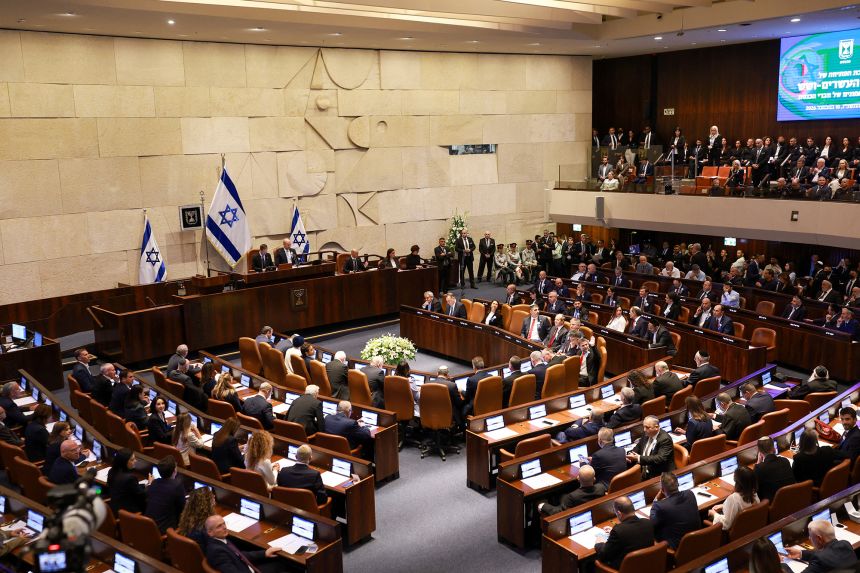
Parliament members attend the Knesset opening ceremony.
Ronen Zvulun/Reuters
How is a government normally formed?
In most elections in Israel – and in just about any parliamentary democracy – one party emerges with the clear backing of a majority of the parliament. In Israel’s Knesset, that amounts to at least 61 out of 120 seats. The leader of that party becomes the prime minister.
After the 2022 election, Netanyahu emerged with 64 seats. He then gained four more seats when an additional party joined his coalition. That gave him a commanding 68-seat majority, and the government lasted its entire term for the first time since 1988.
Netanyahu now has only 46 lawmakers supporting him, leaving him far short of the majority needed to govern. Eisenkot has 67 seats backing him, but it gets complicated because not all of those parties have agreed to work together.
Could Israel get a government that doesn’t have a parliamentary majority?
The election produced a complicated deadlock, leaving neither side with a clear path to forming a government.
Netanyahu’s 53-seat pre-election bloc shrank to 46 seats in the 120-seat Knesset after United Torah Judaism, an ultra-Orthodox party long loyal to the prime minister, declined to support him. The opposition won 67 seats, but 19 of those belong to the two Arab parties – the Joint List and Raam. That makes them pivotal to any attempt to replace Netanyahu.
However, many Jewish Israelis, including some of those opposed to Netanyahu, do not consider the Arab parties to be legitimate partners. Still, the Arab parties could support what’s called a minority government from the outside, providing it with a parliamentary safety net.
A demonstration by right-wing protesters outside the Israeli parliament in Jerusalem on Tuesday.
Ahmad Gharabli/AFP/Getty Images
A minority government holds fewer than the 61 parliamentary seats needed to support a stable coalition but remains in power after securing the backing of Knesset members who don’t sit in the cabinet. Israeli law requires only a simple majority to install a government, so a government can take office if its opponents are divided and abstain from voting. Removing one is harder: It requires a constructive majority of more than half the lawmakers who support an alternative government.
Gadi Eisenkot’s plan is to form what he calls a “national emergency government”: a minority government made of the four Jewish opposition parties, which together hold 48 seats: his own Yashar, Together – led by former prime ministers Naftali Bennett and Yair Lapid; Avigdor Liberman’s Yisrael Beiteinu, and the left-wing Democrats, led by Yair Golan. The Arab parties wouldn’t be part of the coalition but would guarantee majority parliamentary support to keep it in power, in exchange for various concessions.
Israel has had minority governments in the past, but never immediately after an election. Yitzhak Rabin’s second government became a minority government after the ultra-Orthodox Shas party left his coalition in 1993. The government survived two more years with support from outside Arab parties.
Another possible variable is seeking the support of United Torah Judaism (UTJ), an ultra-Orthodox party. Though it is a traditional ally of Netanyahu, the party refused to recommend him during the post-election presidential consultations, opening a possibility that it could abstain from voting or even support an Eisenkot-led minority government, widening his safety net beyond the Arab parties. But it would likely demand concessions from Eisenkot.
Avigdor Liberman, leader of the Yisrael Beiteinu party, speaks to the media at at the Knesset on Tuesday.
Kobi Wolf/Bloomberg/Getty Images
Who is blocking Eisenkot’s plan and could the ultra-Orthodox parties become kingmakers?
Eisenkot’s main obstacle now is Avigdor Liberman. The former minister of defense, foreign affairs and finance refuses to join any government dependent on the Arab parties, arguing that a minority government will be short-lived and will only strengthen Netanyahu.
Instead, he is proposing a different route: a 61-seat coalition that includes the ultra-Orthodox parties and excludes the Arab parties. He believes that once it is formed, some lawmakers from Netanyahu’s Likud party could defect.
Liberman has dropped his longstanding veto on the ultra-Orthodox parties, but his plan collides with one of the opposition’s core commitments: ending the blanket draft exemption for ultra-Orthodox men from mandatory military service. The ultra-Orthodox parties want to entrench that exemption, while Eisenkot, Liberman and others campaigned for universal service. Any deal would require a major ideological concession, and still appears distant, as Shas remains loyal to Netanyahu, even as UTJ signals an opening.
Liberman’s strategy risks undermining Eisenkot’s minority-government route, but the two are coordinating their next moves. Even before forming a government, the opposition plans to use its parliamentary majority to take control of the Knesset by replacing Netanyahu’s appointed speaker and other parliamentary officeholders, then begin advancing legislation.
Could Eisenkot and Netanyahu share power in a unity government?
Netanyahu has been applying heavy pressure against any Jewish-Arab political cooperation. In recent days, he has released two videos calling for a “national unity government.” But he only wants it on his terms: he insists on remaining prime minister and including his entire right-wing and ultra-Orthodox bloc.
Unity governments are traditionally formed by Israel’s two largest parties following a political deadlock. After the 1984 elections, Labor’s Shimon Peres and Likud’s Yitzhak Shamir famously governed together and shared the premiership under a rotation agreement. After the 1988 elections, they joined forces again.
Netanyahu has also led two such arrangements recently. In 2020, during the Covid crisis and after three inconclusive elections, Benny Gantz joined him for an emergency government. Gantz was supposed to take over and become prime minister after 18 months. But Netanyahu looked for a way out before stepping aside, forcing new elections by refusing to pass a state budget.
Israeli Prime Minister Benjamin Netanyahu and his wife Sara Netanyahu at the Knesset on Tuesday.
Ronen Zvulun/Reuters
After the October 7, 2023 attack, Gantz and Eisenkot joined a war cabinet. The two resigned after eight months, citing frustration with Netanyahu’s handling of the Gaza war and lack of strategy.
Eisenkot has rejected Netanyahu’s national unity rhetoric as a “pathetic spin.” If Netanyahu genuinely wants to cooperate, he said, he should break with his extremist partners and join a government led by Eisenkot.
While Netanyahu appears unwilling to separate from his entire bloc, some analysts believe he may eventually be willing to part ways with National Security Minister Itamar Ben Gvir, but not with Finance Minister Bezalel Smotrich and the ultra-orthodox parties. So far, he has given no indication he would make such a concession, and the opposition sees his unity appeals mainly as a tactic to undermine a government that could replace him.
Can Netanyahu still hold on?
For now, he remains in office as caretaker prime minister until a new government is sworn in.
Eisenkot has 28 days from last Sunday to negotiate with his bloc over cabinet posts, budgets and policies. He can ask for a 14-day extension. If he fails, the mandate passes to another candidate for 28 days.
If Netanyahu gets the mandate, he will likely try to lure a party or individual lawmakers from the opposition to join his bloc. Eisenkot, Bennett, Liberman, and Golan have all declared they will not join him. With his bloc eight seats short, Netanyahu would need eight individual defectors, setting a high bar.
But time is on his side. If he fails, the mandate returns to the Knesset for another 14 days to try and suggest another candidate. If that fails as well, the political deadlock will lead Israel to another round of elections. During that period, Netanyahu would remain as caretaker prime minister.
The post Israel faces political chaos as Netanyahu’s grip on power weakens. What will it take to end the disarray? appeared first on Egypt Independent.