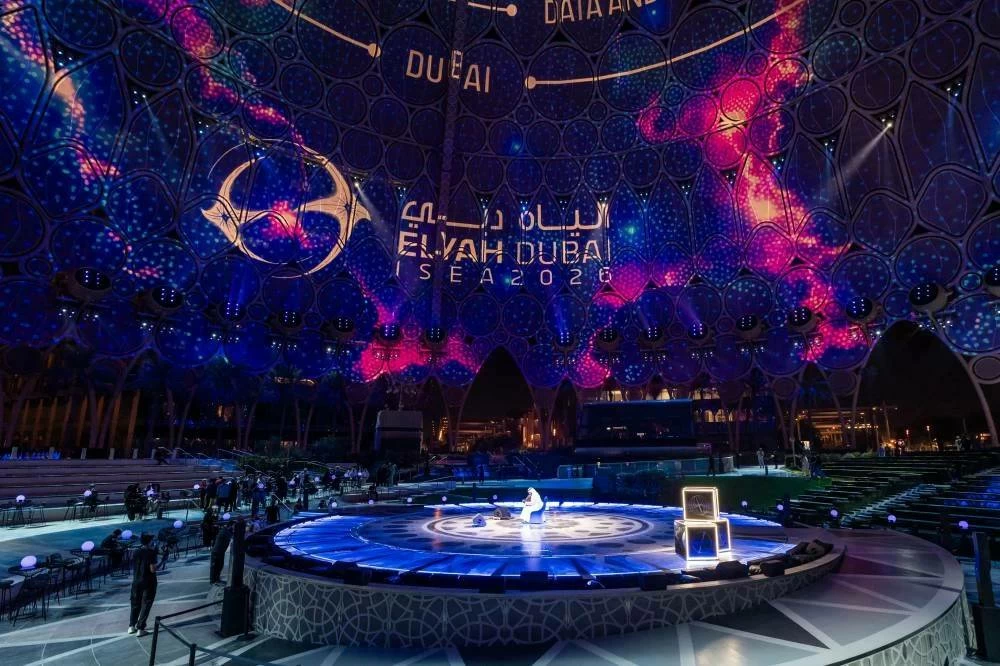
Dubai: The 31st International Symposium on Electronic/Emerging Art (ISEA2026 Dubai), organised by Dubai Culture and Arts Authority (Dubai Culture) in partnership with Zayed University under the theme ‘ELYAH: Constellating Place, Data, and Identity,’ hosted a series of discussions and workshops under its Special Tracks programme.
The sessions explored the future of digital art archiving, the influence of artificial intelligence and emerging technologies on artistic practice, and the role of creativity in raising environmental awareness. They also examined the connections between technology, identity and cultural memory.
Bringing together artists, researchers and experts from around the world, the programme supports the objectives of Dubai Culture’s Digital Arts Roadmap and its efforts to strengthen Dubai’s position as a global cultural reference, a leader in innovation, a driver of the creative economy, and rooted in Emirati heritage.
The Special Tracks discussions set the stage for the main sessions of the Online Academic Programme, which begin on 10 November. They reflected the diversity of perspectives presented at this edition of ISEA, the largest in the symposium’s history, and highlighted the importance of collaboration among cultural, academic and research institutions in responding to rapid digital transformation.
The sessions examined new approaches to preserving and documenting artworks and making them accessible to future generations. The workshops gave participants opportunities to explore creative coding, speculative design and artistic experimentation, while exchanging ideas about the evolving relationship between people, technology and the environment.
Maitha Ali Al Blooshi, Director of the Emerging Arts Department at Dubai Culture and Executive Director of ISEA2026 Dubai, highlighted the opportunities offered by the Special Tracks programme for artists and specialists to exchange expertise, explore collaboration and develop their creative practices.
Al Blooshi said: “The diversity of sessions and workshops reflects the expanding scope of digital arts and their connections with scientific and cultural disciplines. These exchanges offer fresh perspectives on our relationship with technology, the environment and memory, and demonstrate the value of international collaboration in encouraging research and experimentation. They also help us explore how emerging technologies can support the creation, exchange and preservation of knowledge.”
She added: “Hosting ISEA2026 enables Dubai to strengthen connections among creative practitioners from around the world. This supports Dubai Culture’s efforts to build an integrated digital arts ecosystem, encourage innovation and create opportunities for new experiences and projects that enrich the cultural and creative landscape.”
The New Media Art Archiving Summit was a highlight of the Special Tracks programme, with sessions examining artificial intelligence, emerging technologies, sustainability and approaches to preserving and documenting digital artworks.
In ‘Constellating Memory: From Digital Archives to Living Knowledge Systems,’ Adina Hempel, Associate Professor and Director of the Zayed Institute for Architecture, Heritage and Arts at Zayed University, highlighted the importance of preserving the cultural connections and knowledge documented in archives. She also explored digital approaches that reflect the communities and contexts in which knowledge is created.
In ‘Shaping New Media Art Trajectories: Interdisciplinary Strategies for Collections’, Anna Schäffler, Andreas Weisser and Lisa Long discussed how conservation methods can evolve through interdisciplinary practices that account for changes in digital artworks over time.
In ‘The Evolving Archive of Digital Art (ADA) Towards the shared AI-supported Living Archive’, Oliver Grau presented the development of the Archive of Digital Art and examined the role of AI in advancing digital archives. He highlighted the importance of collaboration between museums and specialised institutions, as well as sharing resources for preservation and documentation.
Sandra Alvaro and Bonnie Mitchell explored how emerging technologies can improve archival workflows, strengthen documentation tools and support the long-term preservation and accessibility of digital artworks in ‘Roundtable: The Use of AI in the Field of New Media Art Archiving’.
The ‘Ecological Futures Lab: Navigating by New Stars’ track explored how art and technology can deepen understanding of environmental challenges and help envision the future. Its sessions and workshops brought together scientific research and creative imagination.
In ‘Solarpunk Spell Seeds: A Living Method for Ecological Futures Sensing,’ Jodi Rose examined how artificial intelligence, storytelling and speculative design can help imagine alternative ecological futures, encouraging critical reflection and collective experimentation.
The lab also featured ‘Sensing the Data, Practicing the Care’, presented by Aura Bălănescu, Paul Babencu, Livia Mateiaș and Marius Jurca. The session explored an initiative developed by the smART+TECH+NATURE LAB at the Faculty of Arts and Design, West University of Timișoara, Romania. The initiative combines artificial intelligence with biological and atmospheric sensing technologies to translate environmental data into artistic experiences, deepen understanding of the relationship between people and ecological systems, and encourage environmental awareness and shared responsibility.
The Special Tracks sessions also examined the relationship between cultural identity and technology, exploring how digital tools can offer new interpretations of human memory and contemporary expressions of cultural heritage.
These included ‘Soul Compass: Photogrammetry, Ancestry, and the Search for Meaning’, featuring Maziar Ghaderi and John Olabode and moderated by Mona Ayyash.
In ‘Geometric Patterns with Creative Coding’, Selçuk Artut explored the connections between drawing, geometry and programming, demonstrating how traditional geometric constructions can be transformed into computer-generated images.
Bin Youn and Ng Yi Kee presented ‘Counting Cultural Stars: Transforming Cultural Texts into Volumetric Constellations’, exploring how culturally significant words can be transformed into three-dimensional visual constellations, connecting language, memory and artistic expression.
Meanwhile, ‘ELECTRONIC YORUBA’, presented by Ifeloluwa Christopher, brought together traditional Yoruba rhythms and contemporary sound technologies through electronic sampling and live beat-making. ‘Immigrating Objects: Dialogues Across Cultures’, moderated by Nir Jacob Younessi, explored cross-cultural exchange.
Running until 15 November, the symposium explores four principal themes: ‘Celestial Dialogues,’ ‘Charting Constellations,’ ‘Eco-Tech Futures’ and ‘Starlinked Worlds.’ Sessions examine the relationships between place, memory, identity and emerging technologies, alongside environmental responsibility and the future of human interaction in the digital world. Together, they consider how art can deepen understanding of technological change and its impact on societies and cultures.
The symposium combines an in-person Artistic Programme featuring more than 100 artworks across Dubai with an Online Academic Programme accessible to international audiences. The Artistic Programme includes installations, performances, visual presentations and interactive experiences.
The Online Academic Programme comprises 145 academic papers, more than 50 artist and practitioner talks and conversations, and over 10 workshops. It also includes four special tracks featuring more than 45 workshops, panel discussions and presentations, seven Eco Lab workshops, and more than 20 institutional presentations.