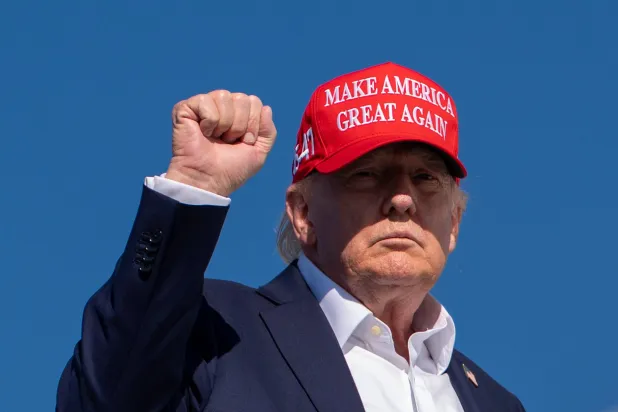
Has MAGA fever finally begun to fade? Will the American right abandon the Make America Great Again slogan and Donald Trump's populist ideology in favor of a more traditional brand of conservatism? Following a crushing defeat in midterm elections that revolved almost entirely around one man, many Republicans have begun questioning the party's future and what role, if any, Trump should play in shaping it. The Wall Street Journal, whose editorial pages have long represented the establishment right, called for "soul-searching" and urged Republicans to move away from the ultranationalist, identity-driven rhetoric that helped return the 80-year-old Trump to power. In an editorial titled "The Trump Reckoning Arrives," the newspaper argued that tariffs and mass deportations were no substitute for higher real incomes. It added: "Playing to the bro MAGA base is no substitute for persuading Hispanics, independents and suburban swing voters who abandoned the party on Tuesday." "Still Your President" The White House, however, appeared far less inclined toward introspection. Its first post on X on Wednesday featured a stern-looking Trump accompanied by the words "Trump is still your president," a reminder that he will remain in office until January 2029. But the American political calendar never stands still. Wednesday also effectively marked the beginning of the 2028 presidential campaign, which will culminate in the election of Trump's successor. The US Constitution bars Trump from seeking a third term. There was no realistic scenario in which Trump could have emerged from the midterm elections in a stronger political position. The scale of the Republican defeat on Tuesday night, which exceeded even some of the Democrats' most optimistic expectations, has accelerated the erosion of his political influence. Eyes on 2028 Vice President JD Vance, widely regarded as a potential contender for the White House in 2028, was careful not to confront his boss directly. In a lengthy, essay-like post on X on Wednesday, Vance wrote: "The reason we lost is the war." He immediately added: "The president himself said so last night." That was not entirely accurate. Trump had attributed the defeat partly to the war in the Middle East, while also arguing that Republicans had fielded weak candidates. Florida Governor Ron DeSantis described the outcome as an "extinction-level event" for the Republican Party, suggesting Republicans might have to wait until 2032 to regain control of Congress. Republican lawmaker Don Bacon wrote on X that the party "needs to reclaim our Reagan principles." He added: "Voters rejected populism, chaos, Putin and tariffs." Former congresswoman Marjorie Taylor Greene, a far-right figure who has turned against Trump, went further. "If the GOP wants any chance in the future, it will have to kick Donald Trump out of the party," she said. Matthew Boyle, a prominent figure at the far-right news outlet Breitbart, wrote on X that "Republicans need to get back to basics." "No more endless wars," he said. On the economy, which he identified as the top issue, Boyle called for policies that benefit ordinary Americans rather than special interests. He also urged Republicans to "be sane with immigration enforcement." Criticism Without Naming Trump For now, however, criticism remains relatively muted. Only a handful of conservative figures, whether moderates or hardliners, have been willing to attack Trump by name. After all, the Republican Party has tied its political fortunes almost entirely to Trump since 2016. "The big question is, are some of these Republican leaders in the House and Senate going to distance themselves from Trump?" Amy Dacey, a former Democratic official who is now an expert at American University, told AFP. The same question applies to far-right influencers whose prominence and financial success have been closely linked to Trump's popularity. Dacey said a devastating electoral defeat could diminish their influence, but it would by no means eliminate those associated with the MAGA movement. Some of MAGA's online supporters have already attempted to shift the blame elsewhere. "Great work, neocons," Jack Posobiec wrote sarcastically on X, referring to the neoconservative wing of the Republican Party, known for its interventionist foreign policy and hawkish stance toward Iran. Nevertheless, it may only be a matter of time before the divisions become more pronounced. Former congressman Bob Good wrote on the same platform: "Gotta start by acknowledging that Trump was and is the problem. Quietly whispering it won't do it."