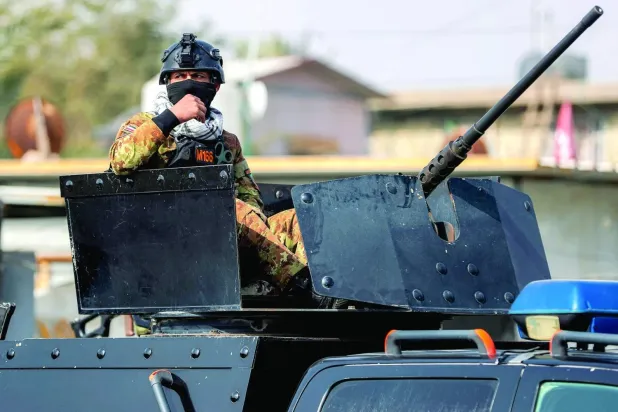
Iraqi officials warned Wednesday of an ISIS resurgence after a series of attacks on security forces in rural areas north of Baghdad left several personnel dead or wounded, prompting authorities to impose a nighttime curfew in parts of Kirkuk province. Security sources said the second battalion of the Popular Mobilization Forces’ 61st Brigade came under armed attack late Tuesday in the village of Al-Barghaliya–Al-Dandish in Hawija district, southwest of Kirkuk. A sniper disabled a thermal imaging camera at a military position, triggering search operations in the village and surrounding areas to track down the attackers. The assault came a day after an attack on the Federal Police’s Ninth Brigade in the same village killed one person and wounded four others. Several thermal imaging cameras were also destroyed, according to a security source. The Federal Police Command identified the slain officer as Bakr Majid Mohammed, who was killed while confronting ISIS militants attempting to storm his guard post in Al-Barghaliya in Hawija district. The position falls within the operational area of the third battalion of the Ninth Brigade, Federal Police Third Division. Nighttime curfew In response to the attacks, Federal Police authorities imposed a curfew across Hawija and its villages from 6 p.m. to 6 a.m. The restrictions prohibit movement during those hours, with tighter controls on motorcycles, cars and cargo motorcycles. The latter may operate only in essential cases with official authorization. Residents were urged to comply with the measures and cooperate with security forces, while authorities warned that violations could result in legal action. Security was also tightened around farms and villages near Federal Police positions, with restrictions on the movement of farmers whose land lies close to security deployments. Ahmed Ramzi Koprulu, chairman of the Kirkuk Provincial Council’s Security and Defense Committee, said that the Hawija attack underscored the continuing threat posed by ISIS sleeper cells. He called for stronger intelligence gathering and intensified security operations to prevent further attacks. Speaking to Shafaq News, Koprulu stressed the need to prevent militants from regrouping or exploiting remote areas to target security forces and civilians. He also urged closer coordination and intelligence-sharing among security agencies. On Monday, ISIS claimed responsibility for an attack southwest of Kirkuk city that killed an Iraqi police officer and wounded others. It was the group’s first attack on Iraqi security forces since US troops completed their withdrawal from Iraq on Sept. 30, bringing their military mission in the country to an end. On the day of the withdrawal, Iraqi Prime Minister Ali al-Zaidi called for heightened vigilance, constant readiness and closer coordination among security forces. He also asked security agencies to update their operational plans, procedures and databases and make greater use of modern technology to maintain stability nationwide. How serious is the threat? Despite the recent violence, security experts played down ISIS’s ability to regain control of territory. Security analyst Sarmad al-Bayati told Asharq Al-Awsat that the group, or what remains of it, could still threaten military units in some areas because it possesses weapons and explosive belts. However, he argued that it no longer poses a threat to Iraq’s overall national security. Bayati described the Hawija incidents as limited attacks by sleeper cells, suggesting they could nevertheless be used for political purposes amid the debate over the US withdrawal and efforts to disarm armed factions. Security expert Mukhlid Hazem also dismissed the prospect of ISIS staging a resurgence on the scale of its 2014 offensive. He said the group’s capabilities were now largely confined to deploying small armed units in scattered areas, while Iraqi security forces worked to contain them through preemptive operations. “The organization’s attacks coinciding with the US withdrawal are merely an attempt to demonstrate that it still exists,” Hazem told Asharq Al-Awsat. He added that ISIS was no longer capable of carrying out attacks in city centers, even where it retained local support networks. Still, he urged caution over the possibility of larger militant groups attempting to mobilize. Political science professor Abbas Abboud pointed to significant improvements in Iraq’s intelligence capabilities compared with previous years, arguing that these advances reduced the likelihood of ISIS expanding its operations. He cautioned, however, that threats could also emerge from other terrorist groups enlisted by various parties to advance specific objectives.