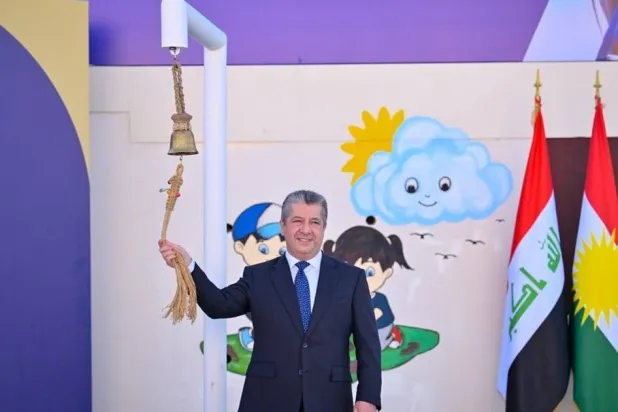
Iraq’s Federal Supreme Court on Sunday postponed consideration of two lawsuits challenging the continued legitimacy of the Kurdistan Region’s parliament and government, setting Oct. 26 as a new date for a ruling. The cases seek the dissolution of the regional parliament and an end to the government’s full powers following nearly two years of political deadlock that has prevented the legislature elected in October 2024 from functioning normally. Meanwhile, Kurdistan Region Prime Minister Masrour Barzani, speaking at a ceremony marking the start of the 2026-2027 school year in Erbil on Sunday, called for the rule of law to prevail throughout Iraq. “All weapons outside the authority of the state, the government and legitimate institutions must be disarmed,” Barzani said. Armed factions have made their own disarmament conditional on the decision also applying to the Kurdish Peshmerga and on the force being placed under the orders of Iraq’s commander-in-chief rather than the regional government. Kurdish authorities reject that demand, citing Article 121(5) of Iraq’s constitution, which grants the regional government responsibility for establishing and organizing internal security forces, including police, security services and regional guards. Barzani also urged members of the Kurdistan Parliament to “end their boycott of sessions and fulfill their national and oversight duties,” stressing that reactivating parliament was the “first and essential step” toward forming a new regional government. Political deadlock The Kurdistan Region has been mired in political paralysis since its October 2024 parliamentary elections. The new legislature has met only once, in January 2025, and has failed to elect a permanent speaker or pave the way for the formation of a new government. The Kurdistan Democratic Party (KDP), led by Masoud Barzani, won 39 of the 100 seats, while the Patriotic Union of Kurdistan (PUK), headed by Bafel Talabani, secured 23. The New Generation Movement came third with 15 seats. Deep disagreements between the KDP and PUK over the composition of the government and distribution of senior posts have stalled the process. Former regional lawmaker Ali Hama Salih filed the two lawsuits with the Federal Supreme Court. The first challenges the constitutionality of allowing the current parliament to continue after it failed to perform its legislative duties following its inaugural January 2025 session. The second seeks to strip the Kurdistan Regional Government of its full governing mandate and reduce it to caretaker status, barring it from making strategic decisions or entering into long-term contracts and legal commitments. Court weighs cases Commenting on the postponement, Kurdish writer and adviser Kifah Mahmoud said the Federal Supreme Court appeared to want more time to examine the situation and consult the parties to the cases. Mahmoud told Asharq Al-Awsat that governments normally assume caretaker status once a parliament’s term ends, but argued that Kurdistan’s circumstances were different because the current government had continued implementing strategic road, water and electricity projects despite financial difficulties. He attributed part of the political impasse to one party seeking greater gains than its parliamentary representation warranted, an apparent reference to the PUK. Mahmoud nevertheless described negotiations between the KDP and PUK as “positive,” saying they could lead to a coalition government. KDP spokesman Mahmoud Mohammed separately confirmed that his party was holding “serious and intensive” talks with political forces to resolve outstanding issues. He said meetings between the KDP and PUK would continue away from media spotlight in an effort to reactivate parliament and move ahead with forming a new Kurdistan Regional Government. The resumption of parliamentary activity, he added, would depend on the outcome of those talks.