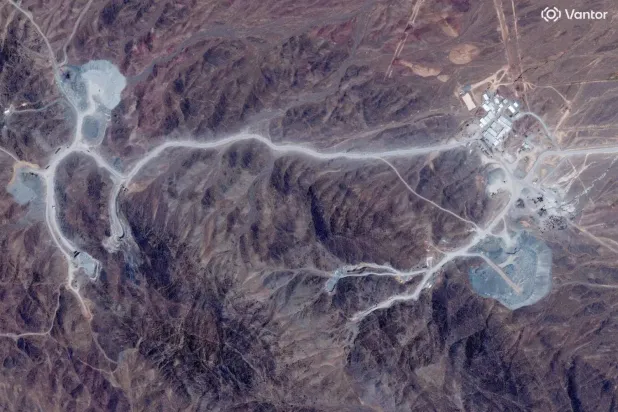
Iran on Tuesday vowed to retaliate against any US strike on its fortified Pickaxe Mountain nuclear facility, following US President Donald Trump’s threat to target the site. Major General Ali Abdollahi, chief of staff of Iran’s armed forces, warned that any new war against Iran would escalate and engulf the entire region. “The outbreak of any new war against Iran would inevitably spread its fire to engulf everyone,” he said. Addressing Trump, he stated that Iran’s strategic moves remain entirely independent of American domestic politics and upcoming elections. Concerning Israeli reports saying Iran’s nuclear program had entered an advanced stage, Abdollahi dismissed the allegations as a delusional tactic meant to instill fear, according to the state-run ISNA news agency. He criticized "the profound hypocrisy of a regime possessing hundreds of nuclear warheads mocking international law while making baseless accusations against Iran's peaceful nuclear activities." The chief of staff also warned the International Atomic Energy Agency (IAEA) to stop acting as a “wolf in sheep's clothing,” affirming that the Iranian military is currently stronger and more prepared than ever to counter threats at any level. Later during a visit to the Army's drone production lines, Abdollahi highlighted the expansion of drone manufacturing capabilities and praised efforts to establish and expand multiple drone production lines, saying the systems he saw demonstrated the Armed Forces’ readiness, motivation and capacity for innovation. “Our enemies possess modern and new equipment, and if necessary, we must respond to the enemy with different methods and asymmetric equipment,” he said. Abdollahi threatened to neutralize the impact of the enemy's expensive and advanced equipment with a wide range of inexpensive yet effective equipment, “which will be annoying, worrying, and costly for the enemy.” In a related development, Iranian Foreign Ministry spokesperson Esmaeil Baghaei warned that Tehran would not leave any US military attack unanswered. He said Iran would respond with equal or greater force, rejecting suggestions that Washington could strike the country without facing retaliation. Speaking at his weekly press conference, Baghaei argued that Iran’s actions over the past two years demonstrated its determination to respond to military aggression. He also responded to media reports saying Israeli officials had discussed another war against Iran with regional parties, noting that Tehran was constantly assessing potential threats. “We live with this possibility and face it day and night,” he said. Last Thursday, Trump said the US may have to target Pickaxe Moutain. In an interview with Newsmax, Trump also said he would not use a nuclear weapon in the war on Iran, which began in February with US-Israeli strikes. The President said the US wanted to make sure Iran will never have a nuclear weapon “because if they had it, they would use it.” “Their nuclear is buried under millions of tons of mountain. Now we're looking at Pickaxe Mountain. We may have to go there. We'll take a shot at that one. We'll knock it out fast,” Trump told the news outlet. He did not say if he had authorized the use of GBU-43/B Massive Ordnance Air Blast Bomb, also known as the “mother of all bombs,” against Iranian energy infrastructure and nuclear sites. He did say the MOAB bomb was not a nuclear bomb. Lavrov in Tehran Baghaei said Russian Foreign Minister Sergei Lavrov’s visit to Tehran on Monday was part of regular consultations between the two countries. He noted the visit had been planned for months and aimed to discuss bilateral relations and regional and international developments. Baghaei said Tehran had not entered nuclear negotiations with Washington and thus had no details of such talks to discuss with Russia or other countries. Baghaei noted that Tehran would continue pursuing diplomatic opportunities despite its longstanding distrust of Washington. During his visit to the Iranian capital, Lavrov called for conditions in the Strait of Hormuz and the wider region to return to what they were before the US-Israeli war on Iran. Later at a joint press conference, Iranian Foreign Minister Abbas Araghchi blamed US and Israeli military attacks for instability in the Gulf and the Strait of Hormuz, as well as recent security incidents in the Caspian Sea involving attacks on Iranian and Russian vessels and port infrastructure. Meanwhile, the conservative newspaper Khorasan, associated with Parliament Speaker Mohammad Bagher Ghalibaf, rejected a settlement on US terms, favoring preparations for renewed fighting, retaining Iran’s strategic leverage and keeping open the possibility of a negotiated settlement.