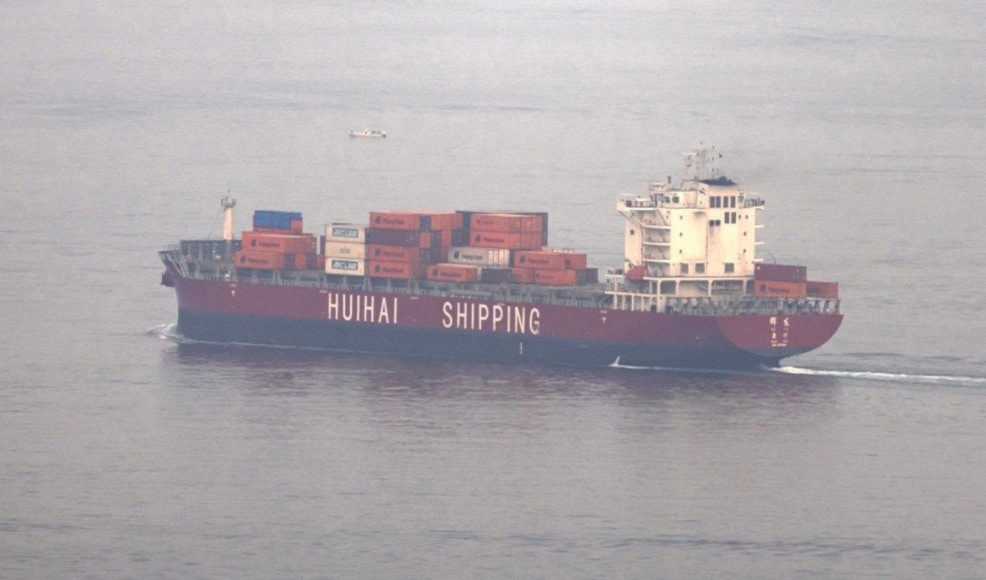
Tensions have flared again in the Strait of Hormuz, with Iran significantly escalating attacks on vessels it describes as “violators.” The escalation undermines US President Donald Trump’s claims that Washington has established full control over the strategic waterway. The Islamic Revolutionary Guard Corps (IRGC) said on Tuesday that a “violating container ship” had struck a naval mine in the strait and sunk. International maritime sources reported that two other container ships, with capacities of 50,000 and 19,000 tons, were hit by “unknown projectiles” on Monday. International shipping data show that 24 vessels were attacked in the strait and surrounding waters in the two weeks to October 11, the highest number since hostilities began in late February. The Financial Times recently reported that ships transiting Hormuz were facing the fiercest attacks since the war began. Iran appears to be targeting commercial vessels transferring oil between ships in and around the strait to disrupt energy shipments. The attacks have intensified following reports in recent weeks of increased traffic along Hormuz’s southern route, facilitated and coordinated by the US. By stepping up its operations, Tehran aims to retain the initiative and strengthen its leverage through its continued ability to disrupt maritime traffic. It seeks to thwart US efforts to lower oil prices ahead of the November 3 congressional midterm elections. Another objective is to derail Washington’s strategy of using military pressure and naval deployments to force Iran into an agreement before the vote, allowing Trump to claim a political victory. Washington’s rejection of Iran’s proposed “seven-day plan,” coupled with its insistence on Iranian nuclear concessions before taking any steps of its own, has given Tehran further incentive to escalate maritime attacks, maintain its leverage and introduce new conditions into negotiations. The escalation raises the cost for Washington of maintaining the status quo and sends a clear message that maritime security in the region cannot be guaranteed without an agreement. Tehran considers renewed war highly likely and is accelerating preparations. Omani Foreign Minister Badr Al-Busaidi announced on Tuesday, during a visit to Islamabad, that Tehran and Muscat had concluded talks on a transit system for the Strait of Hormuz. Implementing the understandings and resuming shipping and navigation, he said, depended on the outcome of broader negotiations between Iran and the US. He opposed further escalation and stressed the need to sustain diplomacy to achieve lasting peace. Meanwhile, rising tensions between Saudi Arabia and Yemen’s Ansar Allah movement are widening the regional crisis, while speculation continues over the possibility of a new US-Israeli war against Iran. Tehran considers renewed war highly likely and is accelerating preparations. These include fortifying and reinforcing nuclear facilities, a process acknowledged by US media; identifying new targets in the event of another war, including artificial intelligence centers in regional countries and undersea cable networks, as explicitly indicated by Mohsen Rezaei, secretary of Iran’s Supreme National Security Council; and rapidly expanding Iran’s military arsenal in both quantity and capability. The IRGC said Iran had acquired “highly advanced weapons” since the previous war. Its spokesman, Hossein Mohebi, said Iran had relied largely on older-generation weapons during the 40-day war but had since obtained much more advanced systems. Mohebi offered no details about the weapons or how Iran had acquired them. He warned that Tehran was prepared to respond to any new aggression with greater force than ever before, adding that the consequences for the US would be “far more painful” this time. This is an edited translation for an article published in Arabic.