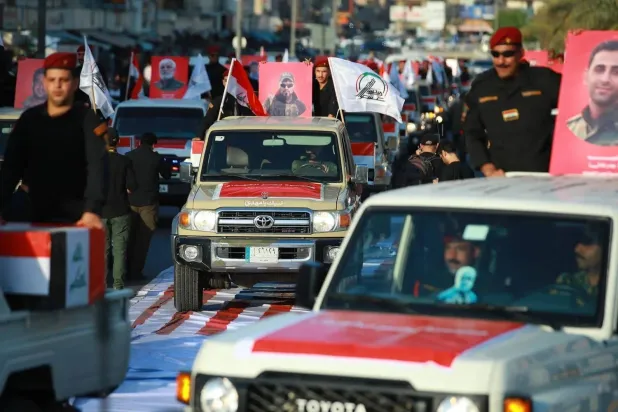
As Iraq’s government steps up celebrations marking the end of the international coalition’s mission and the US withdrawal, an Iran-aligned armed faction is demanding a smaller US mission in Baghdad and an end to what it calls “Washington’s economic dominance.” Since last Wednesday, authorities in Baghdad have mobilized resources for official celebrations of what they have designated “National Sovereignty Day.” Iran and its allies have hailed the departure of the last troops - mainly from an air base in Erbil, in the Kurdistan region - as a “victory,” even as some Iraqis voice concern over geopolitical challenges. An agreed timetable Prime Minister Ali al-Zaidi told a “Sovereignty Day” conference on Friday that Iraq’s foundations of “political, economic and security sovereignty” were taking firm hold. “Iraqis have passed every difficult test,” he told executive and legislative officials, saying the country had reached a moment when it was renewing its resolve to protect the state and its system of government. Al-Zaidi said Iraq’s restored sovereignty was reflected in the withdrawal of foreign troops and the complete end of the international coalition’s mission. He also cited an agreement for Turkish forces and Kurdistan Workers’ Party members to withdraw, an end to the presence of foreign armed groups in Iraq, and the unification of Peshmerga forces to strengthen unified security and military decision-making. He reaffirmed that Iraq would not be used as a launchpad for attacks on neighboring countries, and pledged to bring weapons under control in line with the constitution and the law, following an agreed timetable to address the factions’ status and integrate them into state institutions. Iraqi Prime Minister Ali al-Zaidi attends the Sovereignty Day Conference marking the withdrawal of US-led coalition forces from Iraq, in Baghdad, Iraq, October 1, 2026. Iraqi Prime Minister's Media Office/Handout via REUTERS The government had originally given the factions until Sept. 30 to surrender their weapons, coinciding with the end of the coalition’s mission. The groups had used the coalition’s presence to justify keeping their arms. The government later dropped that deadline and extended it to June 2027. Barzani in Baghdad Al-Zaidi’s speech made no mention of the role of foreign forces. Kurdistan Region President Nechirvan Barzani, however, praised the US-led coalition for helping Iraqis defeat ISIS. “Sovereignty means that the state has the final say,” Barzani said in a speech delivered in Arabic. Decisions on war and peace must rest exclusively with the state’s legitimate authorities, he added, and the constitution and federal system must be upheld. During that difficult period, the United States, the coalition and Iraq’s friends had stood by the country and provided help at the Iraqi government’s request, he said. “Today, as they leave Iraqi territory under the agreement concluded with the federal government, we will not forget that support and assistance,” Barzani said, adding that Iraqis would always regard it with appreciation and respect. “But true gratitude should evolve into assuming national responsibility in Iraq.” “The world’s largest embassy” The Nujaba Movement, led by Iran-aligned Akram al-Kaabi, warned against any continued US military presence, including through security companies or advisers. “Dealing on an equal footing requires the US Embassy to be like other embassies, rather than a vast security and military compound,” the movement said in a statement on Friday, describing it as the world’s largest embassy. Nujaba demanded an end to US dominance over Iraq’s economy and resources and to American interference in its political affairs. It also called for freeing Iraqi skies from US aircraft it described as attacking, and keeping US forces away from Iraq’s borders in Syria, Jordan and Kuwait. Iraqi Prime Minister Ali al-Zaidi delivers a speech during the Sovereignty Day Conference marking the withdrawal of US-led coalition forces from Iraq, in Baghdad, Iraq, October 1, 2026. Iraqi Prime Minister's Media Office/Handout via REUTERS After the withdrawal Experts and activists are questioning what comes next. Foreign troops stationed in Iraq under an agreement with its government had not undermined sovereignty in the first place, political activist Montadhar Naser said. “Nevertheless, their departure signals that Iraq no longer needs any outside force,” he told Asharq Al-Awsat. The authorities must now prove they can exercise full control on the ground, he said, while factions continue to defy the state and the law and push Iraq to the brink of regional military confrontations. Political science professor Talib Mohammed Karim said Iraq’s political groups agreed on sovereignty in principle, but differed over what it meant and how to achieve it. “The international community, meanwhile, engages with Iraq according to the extent to which it makes unified decisions through its institutions,” he told Asharq Al-Awsat.