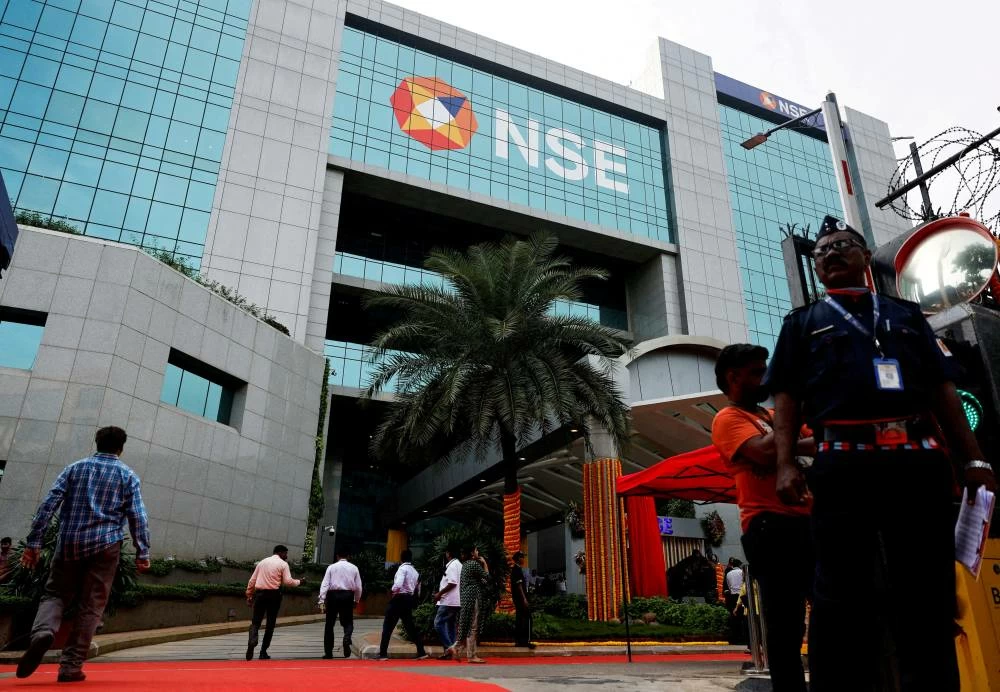
MUMBAI: The National Stock Exchange of India (NSE) will launch its $2.3 billion public offering on Wednesday amid investor caution over capital market firms because of declining derivative trading volumes, which have already impacted the offer price.The IPO for India's biggest bourse - set to be the country's third-largest ever - will begin with anchor investor bidding from institutional funds and is an offer-for-sale from existing private shareholders with no new capital being raised. Open subscriptions will begin on Thursday and close on September 21.Investors are being asked to value the world's largest derivatives bourse at a time when its biggest growth engine is slowing down, raising questions about how much of the exchange’s extraordinary derivatives-driven growth can continue.The NSE shares will be offered in a price band of 1,700 to 1,785 Indian rupees ($17.72 to $18.60), valuing the company at $46 billion, public filings showed on September 11.However, that is 15% to 20% lower than the valuation sought in pre-deal roadshows, according to two sources with direct knowledge of the matter who spoke on condition of anonymity, and is 40% lower than what private markets sales of NSE shares in 2024 indicated.Investors are reluctant to pay higher prices because of regulatory changes that have slowed growth in options trading and an overhaul of trading rules to align Indian markets with global standards. The NSE gains 80% of its revenue from trading of which 60% is options trading and those volumes have dropped 27% from their peak in 2024."NSE's high exposure to derivatives is a double-edged sword. Its dominant liquidity pool and scale are clear competitive strengths, but they also make earnings more sensitive to regulatory changes and shifts in trading activity," said Gary Tan, portfolio manager at Allspring Global Investments.Still, even at this valuation, NSE would be among the top 10 largest listed exchanges globally.At the lowered offer price, several global institutional investors, including sovereign wealth funds and long-only asset managers, have provided commitments, the two sources with knowledge of the matter said.That includes Abu Dhabi Investment Authority, Singapore's GIC, Fidelity, Carmignac, Norges Bank Investment Management and Life Insurance Corporation of India (LIC), they said.GIC, Norges, ADIA, Carmignac and Fidelity declined to comment when contacted by Reuters, while queries sent to LIC were not answered.In a press conference on Saturday, Sriram Krishnan, chief business development officer at NSE, pointed to a disconnect between the offer price and current shareholder expectations."Some of the shareholders feel that the NSE's valuation is much more than the valuation at which we are proposing to do the IPO. To them NSE is more valuable. There is some money on the table, possibly."OPTIONS SLOWDOWN TESTS VALUATIONThe NSE has seen a bottom-line impact from its reduced derivative trading volumes. The exchange's revenue from operations fell 3.1% in the fiscal year ending March 2026, while profit dropped 15.5%.According to Bernstein, Indian equity derivatives volumes are entering a phase of normalisation and they forecast growth will slow to about 5% in the fiscal year ending in 2027 due to regulatory measures on options trading.Still, the NSE's IPO valuation implies a forward earnings multiple of 35 to 38 times FY2028 earnings, higher than the 23 to 31 times earnings global exchange operators Nasdaq, CME Group, Deutsche Börse, HKEX and LSEG currently trade."The current pricing is factoring, options trading slowdown due to regulatory tightening and initial teething issues in the new mechanism to determine closing prices. Perhaps had the IPO launched at any other time, valuation could have been better," said Anubhav Dayal, founder of Hong Kong-headquartered fund manager Soach Global Corporation.His flagship fund is selling 20% of its NSE holding in the offering.In the past 15 months, the NSE has launched electricity futures, electronic gold receipts, natural gas futures and incorporated a national coal exchange.On Saturday, NSE's Krishnan pointed to these efforts as positives that outweigh any short-term concerns around derivative volumes."In the longer term, there will be so much diversification of revenue and as a natural consequence people will forget this current focus on index options," he said.($1 = 95.9500 Indian rupees)