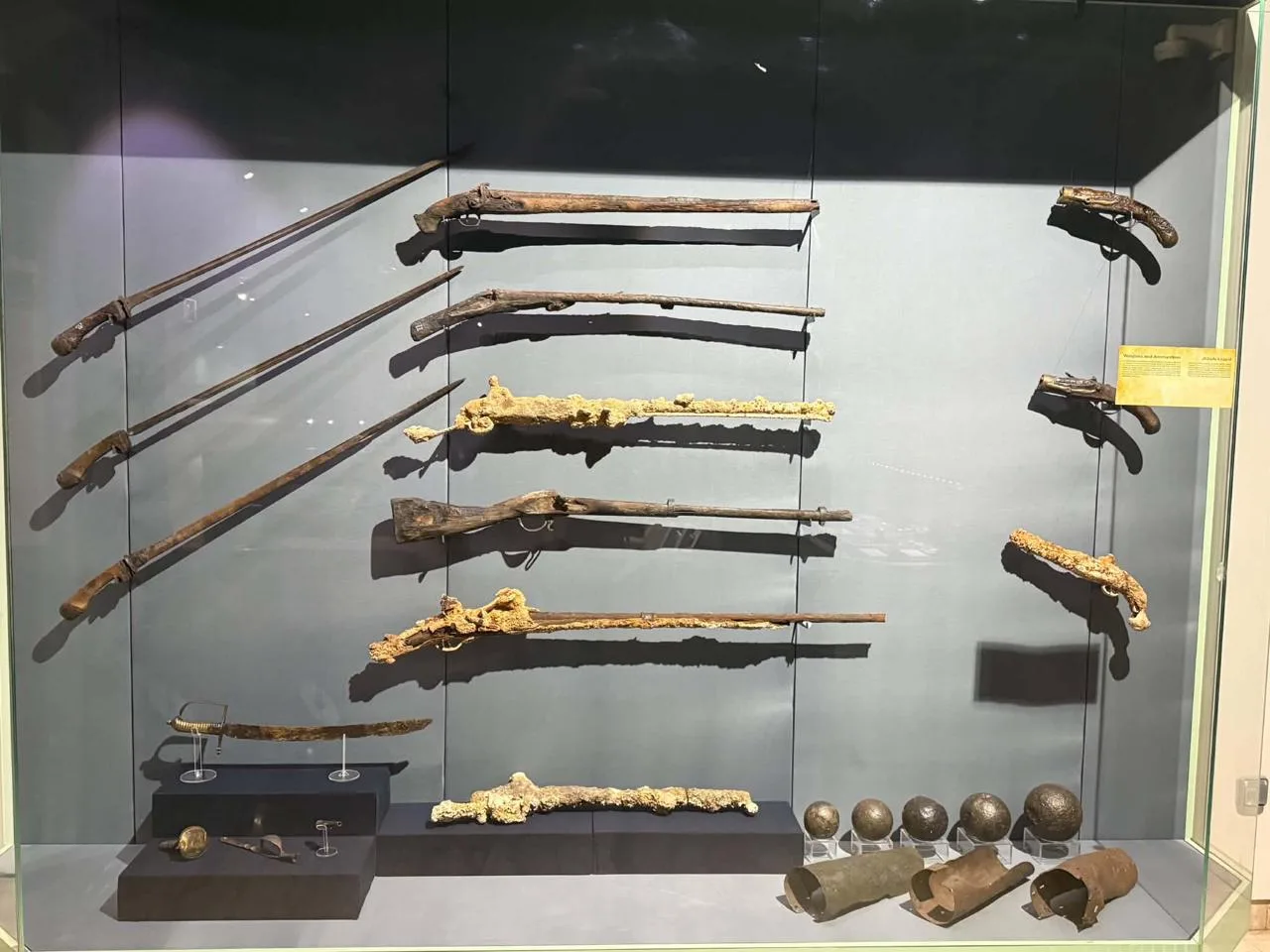
Cooking pots, silver spoons, a leather shoe and a set of brass apothecary weights are among the objects raised from the seabed off Egypt’s northern coast. Together they tell the story of the sailors who lived and died aboard Napoleon Bonaparte’s fleet more than two centuries ago.
The finds are on show at the National Museum of Egyptian Civilisation in Fustat, in an exhibition titled “Napoleon’s Fleet: Tales Told by the Sea”. It marks the 30th anniversary of the founding of Egypt’s Department of Underwater Antiquities.
In 1798, the French Directory sent an expedition to Egypt under General Bonaparte. The aim was to extend French influence in the East and undermine British interests. Egypt’s position between the Mediterranean and the Red Sea also threatened Britain’s trade route to India.
The fleet left Toulon on 19 May 1798 carrying soldiers, horses, artillery and provisions. It also carried scholars, engineers and artists tasked with studying Egypt and its antiquities. The fleet seized Malta on 9 June, then landed troops near Alexandria at the end of the month. The French army took the city on 2 July.
The expedition quickly met logistical difficulties. On 4 July, the transport ship Le Patriote struck reefs at the entrance to Alexandria’s Western Harbour and sank. Its cargo included timber, provisions, and scientific and medical equipment.
While Napoleon advanced inland, much of the French fleet stayed anchored in Abu Qir Bay. It was commanded by Vice Admiral François-Paul Brueys d’Aigalliers and had 13 warships. The flagship, L’Orient, displaced about 2,700 tonnes and carried 120 guns.
On 1 August, Rear Admiral Horatio Nelson found the French at anchor and attacked before nightfall. Some British ships slipped between the French line and the shore while others struck from seaward, trapping the French in a crossfire. Around 10 p.m., L’Orient exploded, lighting up the bay.
Fighting went on through the night and resumed on 2 August. It ended in a decisive British victory, with most French ships destroyed or captured. The defeat cut the expedition’s sea links with France, though it did not end the French presence in Egypt immediately.
Despite the size and firepower of their ships, the French were outmatched in training, discipline, speed of execution and manoeuvrability, the exhibition says.
Beyond weapons, the exhibits stress ordinary life aboard. Excavations have uncovered cooking utensils and oven bricks used to build galley facilities, along with ceramic plates and lead and silver forks and spoons.
Brass cup weights of the type known in France as “Pile de Charlemagne” were used with two-pan balances. They measured medicinal herbs and chemical powders for the ship’s pharmacist and surgeon. Diagnostic and surgical instruments were also recovered.
Other finds include bone, bronze and silver buttons, belt buckles, jewellery, watches and a leather shoe. The engraved symbols on the buttons point to the different military units serving aboard. The ships’ structure and equipment are also represented, including copper hull sheathing, nails, rigging fragments and bilge pumps.
A display of gold, silver and bronze coins includes French pieces from the reigns of Louis XIV, Louis XV and, mostly, Louis XVI. There are also coins from Malta, the Ottoman Empire, Venice, Spain and Portugal. The exhibition says some foreign coins may be linked to treasures Napoleon seized in Malta, but stresses this is a possible interpretation, not an established fact.
Research on the wrecks began in the 1950s and 1960s with Egyptian diver Kamel Abu El-Saadat. He used tips from local fishermen to locate wrecks and cannons and mark them on rough maps.
A new phase began in 1983 under French researcher Jacques Dumas, working with Abu El-Saadat and Egyptian and French authorities. In 1986, a mission led by Max Guérout found the wreck of Le Patriote and recovered 56 objects. In 1996, Franck Goddio resumed research using geophysical surveys, followed by excavations in 1998.
The exhibition identifies several wrecks. L’Orient’s remains lie scattered over more than half a square kilometre, and studies suggest it may have suffered two explosions in quick succession. The frigate La Sérieuse sank during the battle, reportedly while trying to block the British advance. The frigate L’Artémise ran aground, and her crew abandoned her and set her on fire to keep her out of British hands. The site still holds the remains of six or seven French vessels.
The post In photos: Egypt museum shows life aboard Napoleon’s sunken fleet appeared first on Egyptian Gazette.