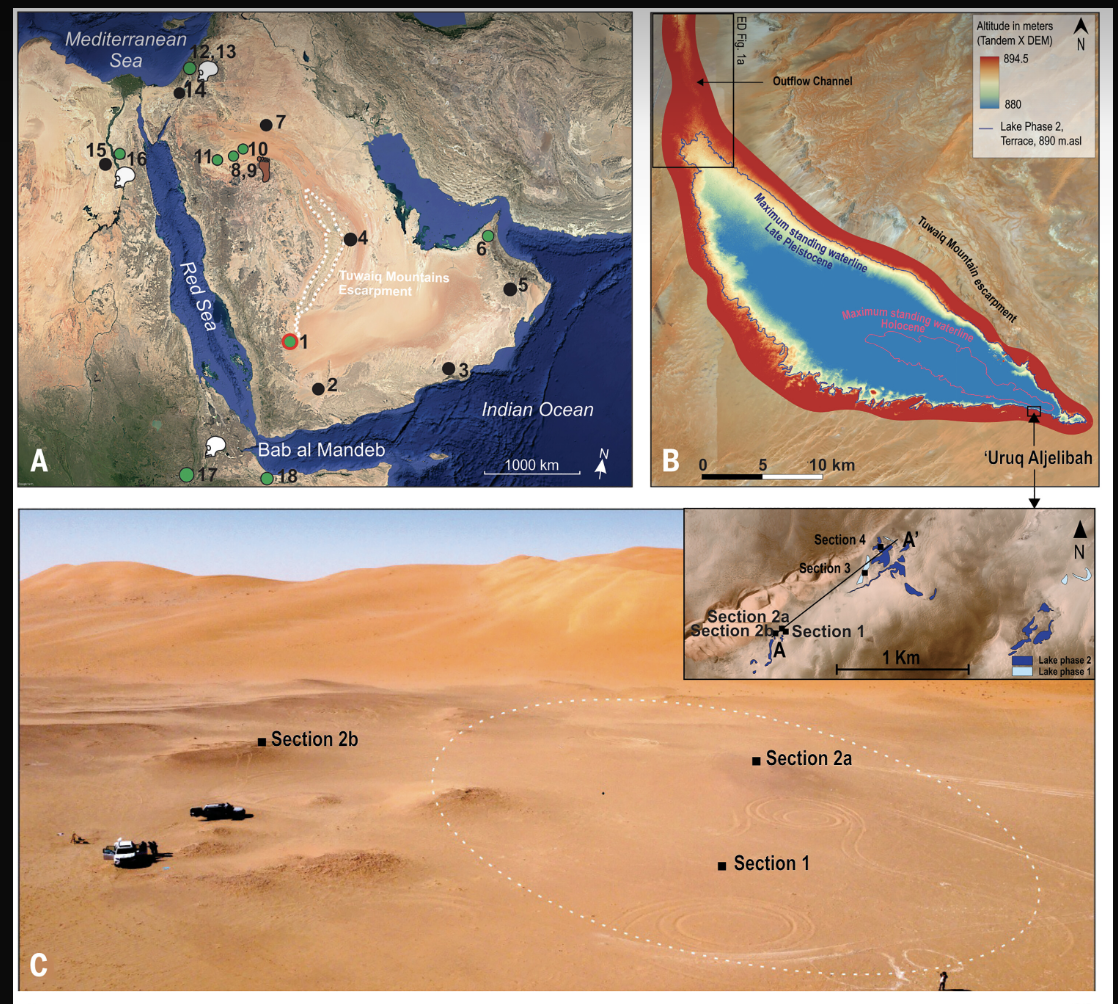
Around 125,000 years ago, parts of southern Saudi Arabia looked very different from the barren desert they are today. A vast freshwater lake occupied the Mundafan basin, surrounded by vegetation, grasslands and large animals, including hippopotamuses, giant long-horned buffalo, camels, gazelles and ostriches.
Along the shores of this ancient lake, Middle Paleolithic humans left behind thousands of stone tools and microscopic traces of plants, resins and animal tissues. A new study published in the journal Science suggests that some of these tools were components of composite hunting weapons, potentially coated with poisonous substances extracted from Acokanthera schimperi, a plant known for producing highly toxic compounds historically used to poison hunting weapons.
Chris Clarkson, a professor of archaeology at the Australian Research Centre for Human Evolution and the School of Environment and Science at Griffith University in Australia, and the study’s lead author, explains that scientists have long known that the Arabian Peninsula experienced repeated shifts between extremely dry and wetter conditions during the Ice Age. During these wetter intervals, lakes, rivers and grasslands emerged, potentially opening routes for human movement between Africa and Asia.
However, most archaeological sites in Arabia preserve too little evidence to reveal how people actually lived in these environments, what they ate, how they made their weapons or which plants they used.
The researchers therefore sought to establish whether these wetter periods did more than provide temporary migration corridors. Could they also have created environments where humans could remain for extended periods, exploiting water, food and plant resources while developing increasingly complex ways of life?
An ancient lake beneath today’s desert
To investigate these questions, the international research team combined geological, archaeological and biological evidence from ‘Uruq Aljelibah, a site on the southwestern edge of the ancient Mundafan basin.
Using satellite imagery, field surveys, sediment dating, fossil analysis and microscopic examinations of stone tools, including their wear patterns and preserved residues, the researchers reconstructed an ancient freshwater lake covering approximately 340 square kilometres and reaching a maximum depth of around 29 metres.
According to Clarkson, the lake’s relatively low salinity and stable conditions could have supported a diverse aquatic ecosystem. Rather than a short-lived seasonal pool, it was a substantial body of water capable of sustaining wildlife and providing resources for human communities.
Dating techniques placed the archaeological shoreline at approximately 125,000 years ago, when the Arabian Peninsula experienced significantly wetter conditions than it does today.
The team documented more than 500 plant and animal fossils across over 130 locations within the site. These included 132 hippopotamus bone fragments, along with remains of extinct buffalo, camels, Arabian oryx and gazelles, as well as more than 100 fragments of ostrich eggshell.
Researchers also collected 5,511 stone artefacts measuring more than two centimetres in length. Many were produced using the Levallois technique, a sophisticated method of preparing stone cores to produce flakes of predetermined shapes.
Some stone points displayed fractures consistent with the impact of striking a target. Others preserved traces of resin and plant fibres near their bases, suggesting that the stones had been attached to wooden shafts. Near their tips, researchers identified animal fats and collagen.
Taken together, these findings suggest that at least some of the stone points were used as hunting weapons rather than ordinary cutting tools.
More intriguingly, chemical analyses identified plant-derived compounds associated with toxic cardiac glycosides on several stone points. These compounds were linked to Acokanthera schimperi, commonly known as the arrow-poison tree.
Other tools carried traces of plants such as juniper, colocynth and ferns. On one stone point, potentially toxic plant compounds appeared alongside animal residues and impact-related fractures.
Clarkson explains that the combination of several independent clues strengthens the interpretation that these weapons may have been deliberately treated with poison. Their shape, evidence of attachment to shafts, impact damage, animal residues and potentially toxic plant compounds collectively make accidental contamination a less convincing explanation.
Nevertheless, the findings do not establish exactly how the poison was prepared, its concentration, how it was applied to the weapons or whether it was physiologically effective against the animals being hunted.
The impact fractures also cannot establish whether the weapons were thrown from a distance or used to stab animals at close range.
An ecological hub in the heart of the desert
The researchers found that life around the ancient lake involved much more than hunting.
Of the 89 stone tools examined for organic residues, 75 preserved traces of materials including plant fibres, leaves, wood, resins, fats, hair and feathers. Some even contained preserved fragments of palm leaves.
These findings suggest that the lake’s inhabitants cut and processed plants, worked with fibres, roots and wood, and potentially used these resources to prepare food and manufacture ropes, mats, weapon handles, adhesives, containers and other objects that rarely survive in the archaeological record.
Such organic materials usually decay over thousands of years, leaving archaeologists with an incomplete picture of prehistoric technology. Their preservation at ‘Uruq Aljelibah offers a rare opportunity to reconstruct activities that stone tools alone cannot reveal.
In this respect, Clarkson explains, the lake was not simply a place where people came to drink water or wait for animals. It functioned as an ecological hub where hunting, toolmaking, plant processing and the collection of food and raw materials took place.
The findings also challenge the traditional view that the Arabian Peninsula’s wetter periods were important mainly because they created green corridors connecting Africa and Asia.
Instead, the researchers argue that these environmental transformations also created productive landscapes where humans could live, repeatedly exploit local resources and develop complex technologies.
According to Clarkson, the stone tools belong to technological traditions that were widespread across northeastern Africa, the Levant and Arabia during the Middle Paleolithic. However, similarities in toolmaking techniques cannot, by themselves, establish the identity of the people who made them or the direction in which they travelled.
The discovery therefore contributes to a broader understanding of early human life in Arabia without providing definitive evidence of a particular migration route.
What the study cannot tell us
Despite the richness of the archaeological evidence, several important questions remain unanswered.
One major limitation is the absence of human fossils at ‘Uruq Aljelibah. Consequently, the researchers cannot establish with certainty that the tools were made by Homo sapiens, although fossils from other parts of Southwest Asia show that modern humans were present in the wider region around this period.
The site also does not represent a single, undisturbed settlement preserved exactly as its inhabitants left it.
Wind and water erosion exposed archaeological deposits and partially mixed remains from different, although relatively close, periods. For this reason, the researchers interpret the material as a cumulative record of repeated human activity along the ancient lakeshore rather than evidence of one isolated camp.
Another limitation concerns the relationship between the animal fossils and the stone tools. Although both occur in the same areas, their proximity alone does not prove that humans hunted every species represented by the remains.
Similarly, the chemical evidence does not establish a complete poison recipe, the precise method of application or its effectiveness in killing prey.
Nor can the site identify the precise origins of the people who occupied the lakeshore or reveal which routes they followed as they moved across the Arabian Peninsula.
Nevertheless, the findings provide an unusually detailed picture of prehistoric life in a region now dominated by extreme aridity.
They suggest that, 125,000 years ago, humans living beside a freshwater lake in southern Arabia possessed sophisticated knowledge of their surroundings, combining stone technology with animal and plant resources to survive.
The study reveals that Arabia’s ancient lakes and grasslands were not merely temporary passages between continents. They were also places where humans could hunt, manufacture tools, process plants and develop ways of life adapted to environments that have since disappeared beneath the desert sands.