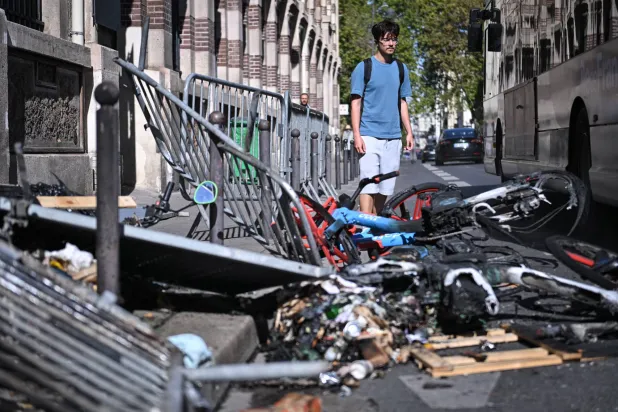
Hundreds of French high schools will begin a second week of closures on Monday as protests over dilapidated schools and classrooms, overcrowding and teacher shortages precede a nationwide day of demonstrations on Tuesday. The nationwide demonstrations and blockades underline a fraught social atmosphere as France's government embarks on trying to pass a deficit-narrowing 2027 budget. France's 10-year bond yield briefly topped 5% last week, its highest since 2002, as the protests compounded investor concerns over the country's fiscal outlook, said Reuters. About 400 to 500 high schools are expected to remain completely or partially closed on Monday in France, out of a total of 3,700, Education Minister Edouard Geffray said on Sunday evening, Reuters said. The protests began in late September at a high school in a Paris suburb over teacher shortages before spreading nationwide. "Our priority is to restore order," government spokeswoman Maud Bregeon told CNews television on Monday. Geffray said that 24 schools had been burned or ransacked and that 78 teaching staff had been injured since the beginning of the demonstrations. POLICE AND STUDENTS CLASH, TEAR GAS USED On Monday, BFMTV showed images of police and students clashing in Lille in northern France, tear gas being used in Toulouse in the southwest and of a fire being lit as people tried to break into a school in central Paris. Carole Zerbib, head of the vandalized Lycee Vauquelin in the 13th district of Paris, said her school had been attacked by a "very determined" group wearing hoods and masks who tried to break through the school's entrance door and then lit a fire. Police and firefighters quickly put out the fire and the school was evacuated and classes suspended. "It was very violent and happened very quickly," she said, adding that the attack lasted 15-20 minutes. "It was terrible for students who witnessed this outburst of violence," she said, adding those behind the attack on her school were not students of the school. Since last Monday, around 5,000 people, mostly teenagers, have been arrested nationwide and dozens injured. Teachers and members of the public have been attacked, while damage to property is estimated in the tens of millions of euros. Bregeon said the French government would fast-track a bill in parliament on October 27 to make those found to have damaged property during protests financially liable. Paris police chief Patrice Faure, in an open letter published on X on Saturday, said those who had launched the protests no longer controlled them and called on students to abandon blockades in favor of peaceful protest. Student unions have nevertheless called for a national day of demonstrations on Tuesday. Security officials fear that an organised protest in central Paris in particular could see further violence amid concerns that far-left and anarchist groups could try to take over the protests. CGT union head Sophie Binet told TF1 television on Monday that CGT union members will attend Tuesday's demonstrations "to protect high school students." "We've been appalled by what we have seen over the past 10 days and by the unprecedented crackdown that the government has organized against the protests by high school students," she said.