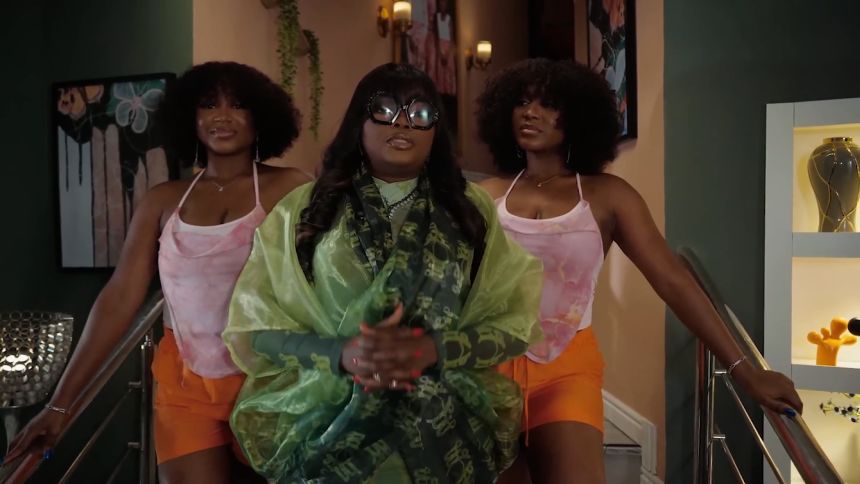
Africa’s highest grossing filmmaker is about to release another potential blockbuster. On December 11, media mogul Funke Akindele will release “The Four: No One Fights Alone.” The movie, which is her eighth major theatrical feature film, tells the story of four strong women who fiercely fight for the future of a young man they love.
Its cultural themes are consistent with her approach to storytelling.
“I tell the Nigerian or the African stories that people can sit back, relate to, but I make sure it’s a global standard, so that when it cuts across, they can understand it and we get more audience,” she told CNN’s Larry Madowo in Lagos earlier this year.
Box-office success
Akindele, who wears several hats in her career as an actress, producer, writer and director, earned the distinction of being Africa’s most commercially successful filmmaker after the 2025 release of “Behind the Scenes” made more than 2 billion naira, roughly $1.6 million. The movie, about a real estate mogul facing a crisis who reexamines her generosity, was the first Nollywood film to cross that financial threshold. It was streamed on Netflix, which helped it gain a global audience.
“I’m so happy, it’s a big pat at the back,” she told Madowo about the success of the movie.
Nigeria’s movie industry is the world’s second largest by volume, according to UNESCO, behind India’s. It produces more than 2,500 films a year, surpassing Hollywood’s output. Film production is the country’s second-largest source of jobs, employing more than 1 million people.
A shot from the 2025 film “Behind the Scenes,” starring Funke Akindele
FAAN
Akindele is the first African filmmaker whose films topped the Nigerian box office for three consecutive years.
Her 2023 film “A Tribe Called Judah” was the first Nollywood movie to make 1 billion naira at the box office — more than $745,000. The comedy-drama tells the story of five brothers with different fathers who rob a store to save their sick mother, played by Akindele. She says she wrote the screenplay because she wanted to “tell it as it is, no sugarcoating,” adding that she was inspired by real life. She recounts a story of a woman she knew who had seven children by seven men and how society judged her and labeled her a “prostitute.” That experience echoes in Akindele’s character in the movie.
“My own style of writing is being authentic because anything you have to do in life, you have to make sure that you are intentional about it … Ambition is good, but it’s not what will sell the film. It’s the fact that you’re doing something [with] quality, something real, authentic,” she said.
The first big hit
Before the success of “Behind the Scenes” and “A Tribe Called Judah” there was “Jenifa,” her first big financially successful film. The 2008 release tells the story of a village girl who moves to the city to attend university and desperately tries to fit in. The movie launched Akindele to stardom.
“I just wanted to speak to young people out there,” she said, explaining why she wrote the script. “I see storytelling as a tool to show people what is happening in society, correct ills, reach out to young people out there, help them believe in themselves, because I’m very, very passionate about the young people.”
The sequel, “The Return of Jenifa,” in 2011 was Akindele’s first movie to play in Nigerian theaters. And in 2024, Akindele made a second sequel, “Everybody Loves Jenifa,” which she said was her most expensive film to date.
“We filmed in Ghana, and we flew down to Ghana with all the cast and crew members. We filmed in Safari Valley Resorts. That’s a very expensive place to film. And we came back to Nigeria again, and I build all my sets. I don’t go to people’s houses to film. I create the set myself. I could go rent out a place, buy a place, and start constructing sets there. So, ‘Everybody Loves Jennifer’ was very expensive,” she said.
But she said she made her money back, adding that the film “was successful in cinemas and on streaming platforms.”
Funke Akindele talking about her “Jenifa” character with CNN’s Larry Madowo
CNN
The hurdles
Despite the success of her films, Akindele — who landed her first role in 1998 as Bisi in the United Nations Population Fund (UNFPA)-sponsored sitcom “I Need to Know” and has acted in more than 100 films — said filmmakers in Africa still face hurdles.
“Our major barrier is distribution,” she said. “The more we partner, the more we collaborate globally, we will break that barrier because when you collaborate with the filmmakers across the world, you get to share experience, you get to share ideas, perspectives, and you get to learn production standards over there, technology, distribution. So I feel collaboration, partnership is really going to help us a lot.”
She encourages filmmakers to partner with other creatives and tell stories that resonate globally.
“If you’re a filmmaker, a story writer, write stories that are authentic, but that can cross the borders. Make sure that the emotion’s there. Everybody can relate to it … you have to be patient, because Rome wasn’t built in a day.”
Nigerian filmmaker Funke Akindele
Sabigal
When it comes to a legacy, Akindele hopes that her work leaves a lasting impact on people’s lives.
“I want to be remembered for that woman that gives access to other women, all the people out there, that broke the barrier for them. I want to keep … creating platforms for their voices to be heard, to help them develop their crafts, their skills. That is why I’m here,” she said.
The post How Nigeria’s Funke Akindele is helping take Nollywood global appeared first on Egypt Independent.